To mark the opening of the eleventh edition of the UK’s leading biennial and international contemporary art prize, ArtReview partners with Artes Mundi and catches up with the six international artists presenting their work across Wales from 24 October 2025 to 1 March 2026.
Anchored by a group exhibition at National Museum Cardiff that foregrounds ambitious new commissions and major loans, Artes Mundi 11 invites thematic resonances between practices shaped by displacement, memory and the environmental and emotional costs of political conflict, expanded through solo presentations at venues including Aberystwyth Arts Centre, Chapter in Cardiff, Glynn Vivian Art Gallery in Swansea and Mostyn in Llandudno. Platforming global perspectives on the human condition, Artes Mundi 11 continues the organisation’s commitment to socially engaged art.
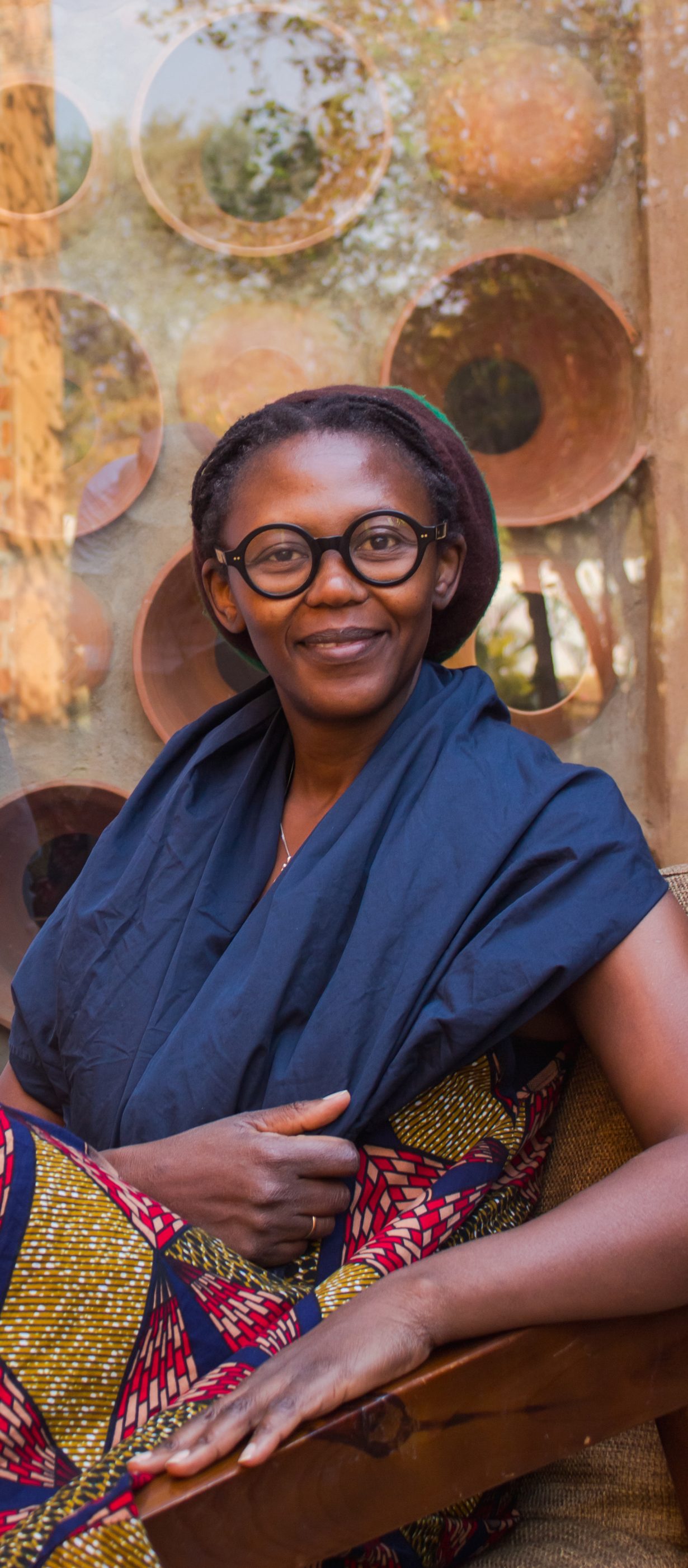
Among this year’s artists is Anawana Haloba, whose practice unfolds across video, installation, sound and performance to examine how societies are shaped within shifting political, social and post-independence frameworks. Beginning with sketches that function as poetry ‘drafts’, Haloba develops works that move between language and action, history and lived experience. Her work frequently reflects on colonial legacies and their ongoing cultural and political impact, foregrounding the role of narrative and translation in shaping collective memory. Haloba has presented work internationally in solo and group exhibitions at venues including Centre Pompidou, the National Museum of African Art (Smithsonian), the Venice Biennale and multiple editions of the Sharjah Biennial.
AR How do you help audiences connect with stories that come from your own background or community?
AH By anticipating that I function within a sector with unspoken expectations steeped in a dominant academic system’s way of presenting knowledge, and where non-Western knowledge is rarely acknowledged. As an artist and thinker whose premise and cultural socialisation are based outside the Western canon of knowledge, I have decided to respond on my own terms. Therefore, I employ decolonial methodologies, voice and performative knowledge systems informed by my own background to investigate the positions of different societies within varied political, social, economic and cultural contexts, as well as ideological and post-independence frameworks. So, I am deciding to tell a story or respond to what is going on around the world, through a story whose timelines will enter books for referential readings, vividly walking you through a childhood formed against the backgrounds and geographies forged by the histories of the liberation struggle movement against Western coloniality. And coming to terms with the condition of exile. Because that is the gaze through which I see.
AR When you work with shared or inherited stories, how do you decide what to include and what to leave open?
AH I think about the episteme of the invisible that have been responsible for whole civilisations elsewhere outside the West. To do so, one must engage in the confrontative labour of retrieving the story of an object’s missing voice – and obsessively do so in order to create mental and physical space for these voices to manifest. Therefore, in working with history, it is not the exercise of claiming subjectivity I am interested in, but a negation of it – because that is the only way I think aids the story of the object to be heard. I think that to achieve this, a different type of dialogue must occur; it must be one that reveals the naked truth. Here, dialogue also means recognition. ‘To see, to listen’ is the first action towards empathy.
Therefore, as a creative and critical thinker, my exercise is that of carving out the nuanced narrative that is based on oralities and customary community practices embedded in African spaces. This is a responsibility I take through my recent practices, but also my response to Senegalese philosopher Mamoussé Diagne, when he challenges the African researcher in his Afterall article ‘Logic of the Written Word and Oral Logic: Conflict at the Heart of the Archive’.
He writes:
‘So, what task or set of tasks present themselves to the African researcher? To cut a long story short: to imagine the absent plea of the god of writing. To make a global claim, what is needed in order to cease being on the periphery of the process of knowledge accumulation is to settle the accounts of a “double memory”, to undo a conflict at the heart of the archive. This is a theoretical decision which involves a responsibility and demanding methodological protocols, with an attitude of critical reappropriation, from which any substantialist vision and their judgements of value would be absent.’
AR What would you like visitors to experience after spending time with your work?
AH I have always thought of my work as a conversation or a space to create a platform for dialogue and recognition. Recognition in the sense that the visitors can recognise themselves or confront themselves, that the ‘objects’, which I think of as vessels, are part of a collective subconscious: they scream, whisper, talk, sing and sometimes shout. Therefore: talk back, whisper, scream back or are the whispering voices your thoughts too?
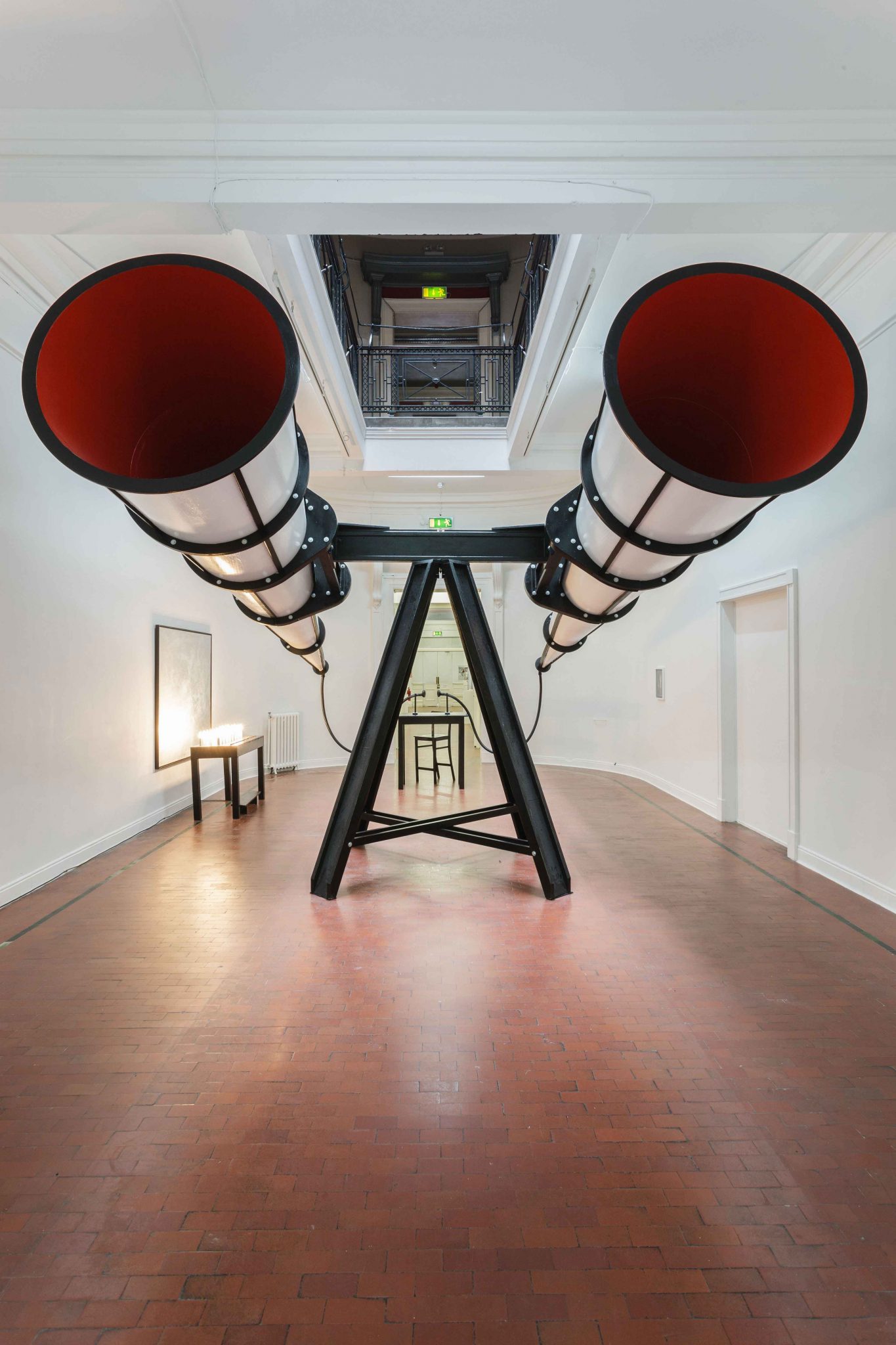
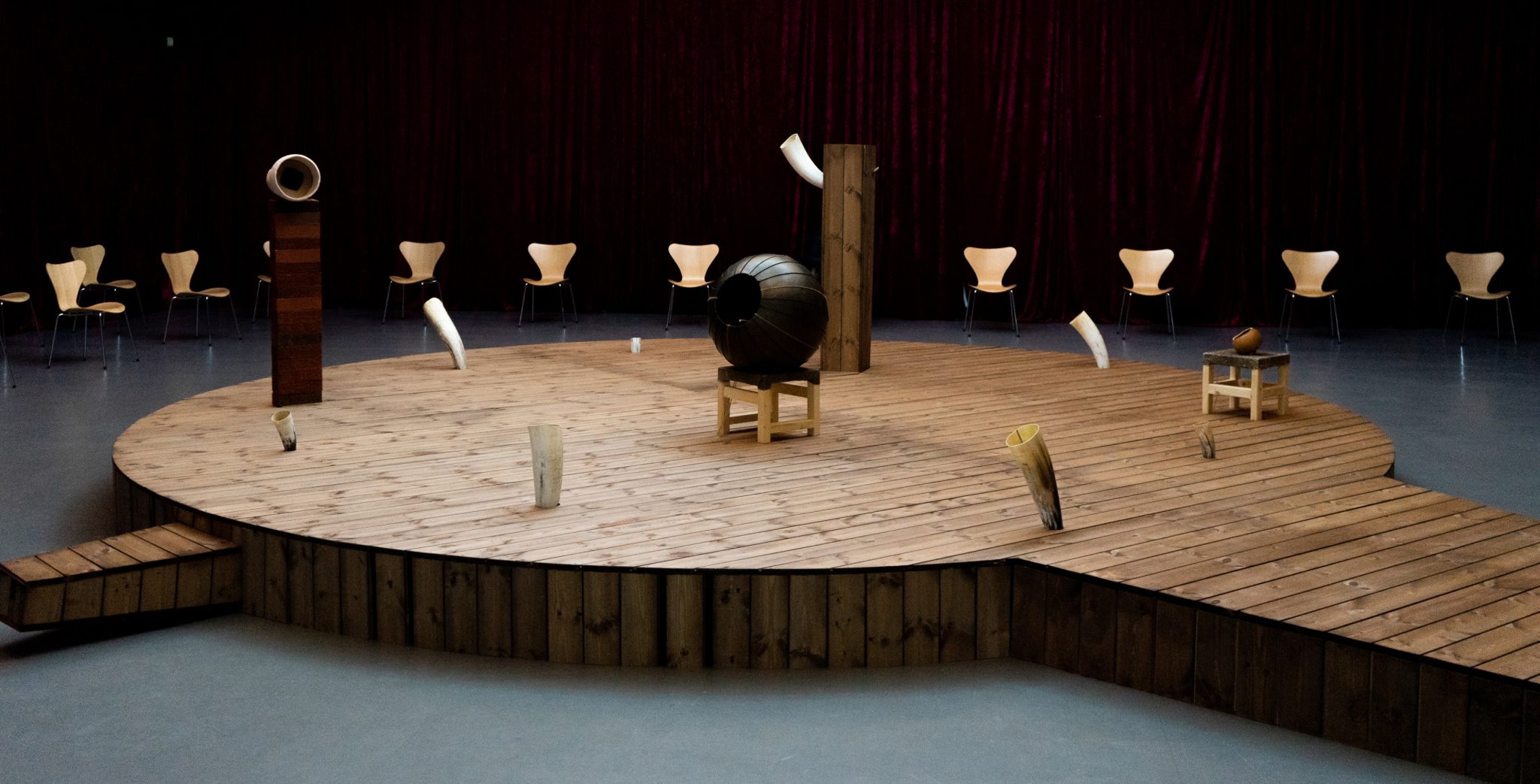
AR Your installation at Aberystwyth Arts Centre unfolds as an experimental opera that hopes to encourage empathy and understanding around the plight of migrants, amid growing nationalistic sentiment. How do you see the act of listening (both to the work’s spoken and sung dialogue and to the whispered and sonic fragments in your Cardiff sculpture) functioning as a form of healing or solidarity?
AH My obsessive belief is that for dialogues to happen, there must be a sense of recognition; hence, to me, dialogue also means recognition. And in this is the first action towards empathy is ‘to see, to listen’. Here, dialogue can be confrontational or even painful, or open streams of unresolved trauma, but listening must take place.
Anawana Haloba is showing work at Aberystwyth Arts Centre and National Museum, Cardiff, through 1 March 2026