The artist doesn’t think of orthoses and prostheses as medical aids, but as integral parts of the human body, without hierarchy
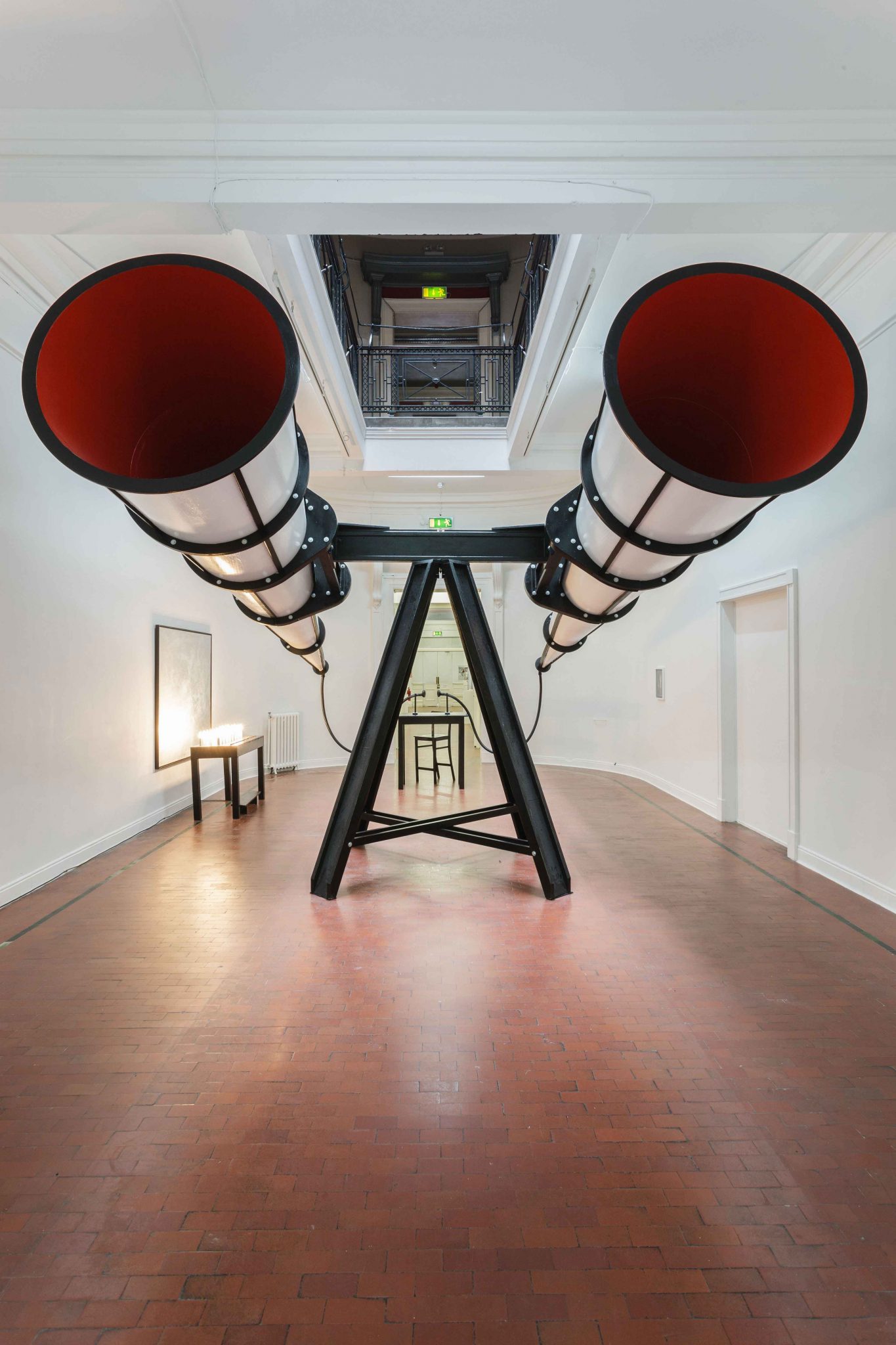
The iron lung, childsize, stands upright in the gallery. Cylindrical, it has a series of small windows through which to monitor the body that, we might imagine, once lay inside. There is a basic control panel: four switches and a dial. A glass dome crowns this device, through which the patient might stare, immobile, at the world beyond their prosthetic breath.
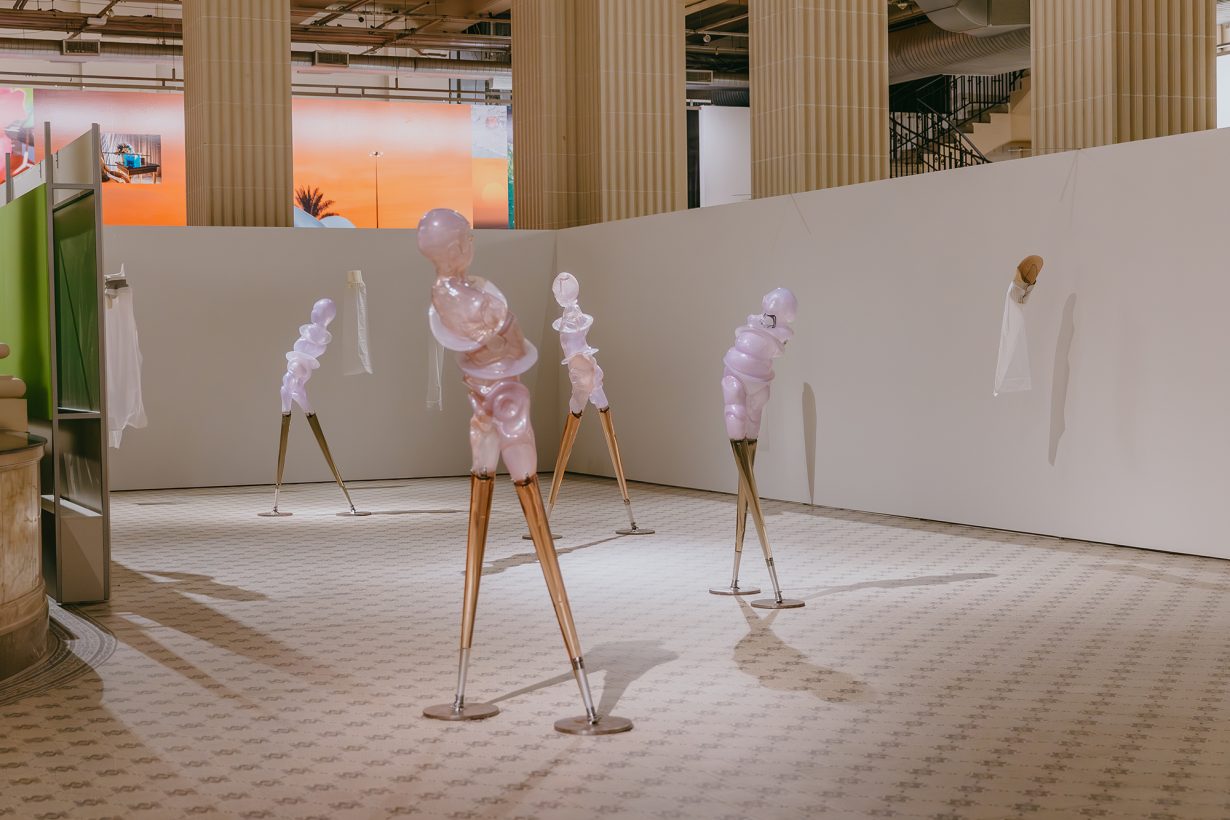
Pnoê (2025), inspired by the vintage breathing aids, was made by Berenice Olmedo for last year’s Bienal de São Paulo. It is the latest work by the Mexican sculptor to take disability and biopolitics as its subject, utilising medical equipment as both a recurring motif and a symbol for technology in general. “Technology is a prosthetic that allows us to construct ourselves anew,” Olmedo tells me, having returned home to Mexico City a few weeks after the Bienal’s opening. Her studio is packed with stacks of braces, walking aids, surgical corsets, prosthetic legs, arms and feet, moulds and boxes of electronic parts and small motors. “When we are born, we are totally empty, no? We have no way of knowing how to survive; how to eat, how to stand up, to walk. To survive we need to learn how to use the technology of our body, this machine of the human body.” That development is ongoing, as our body develops and decays through the various stages of life. Olmedo manipulates the orthoses and prostheses (the former a device that accommodates a body difference, the latter a replacement for a body part present in most people) into figurative and organic sculptures. These can be unsettling, but display an empathy towards the often-secondhand equipment she utilises and the histories that are part-and parcel of them, such that each sculpture inherits a particular personality. Last year she showed a series at the Bienal do Mercosul in the south of Brazil comprising a series of ominously tall works – what might be described as cyborg Giacometti sculptures – seemingly striding across the exhibition space in Porto Alegre on elegant steel and aluminium tubes utilised as lower legs and found prosthetics for calves, their torsos constructed of hollow silicone. A set of kinetic works, currently on show at the Boros Collection in Berlin, are cuter, incorporating found infant walking aids animated at the joints by motors and cheerfully patterned with cartoon animals.
Iron lungs were invented during the early twentieth century to assist polio patients whose paralysis had affected their chest muscles and who required assistance in order to breathe; Pnoê is based on a 1960s model. “Our bodies are fragile, we saw that during the [COVID 19] pandemic, but that fragility is not extraordinary: our bodies are disabled in all kinds of environments. They work, but only if the correct ambient conditions are in place,” she says. I tell her that the sculpture reminds me of the clunky, copper-hat diver’s suits, a reminder that it is environmental factors as much as body difference that render the body disabled. “The human being is a prosthetic being,” she says. “We can intervene, we can modify our nature, in order to open horizons, possibilities of who we are and what we are able to do.” Attached to the bottom of the lung is a series of LED-lit tubes that snake across the gallery floor and then up to three semitransparent silicone sculptures, suggestive of human organs or air bubbles that hang suspended from the gallery ceiling. Like the Mercosul figures, there’s an alien aesthetic to these elements, an indication that the artist is as interested in speculative transhuman futures as she is in questions of disability past and present.
Olmedo’s grandfather died while she was studying at Universidad de las Américas in Puebla, and by way of tribute the artist staged a performance using his wheelchair, referring to the object as his “last gift” to her. Later work introduced biopolitics to her artmaking, when she used the bodies of stray dogs that had become victims of Mexico City’s frenetic traffic, harvesting the fat from the squashed corpses to make soap. Inherent in this gruesome project are ethical questions about which lives matter, with the end cleansing product symbolic of eugenicist ideas around social hygiene and the sanitisation of ‘unproductive’ life.
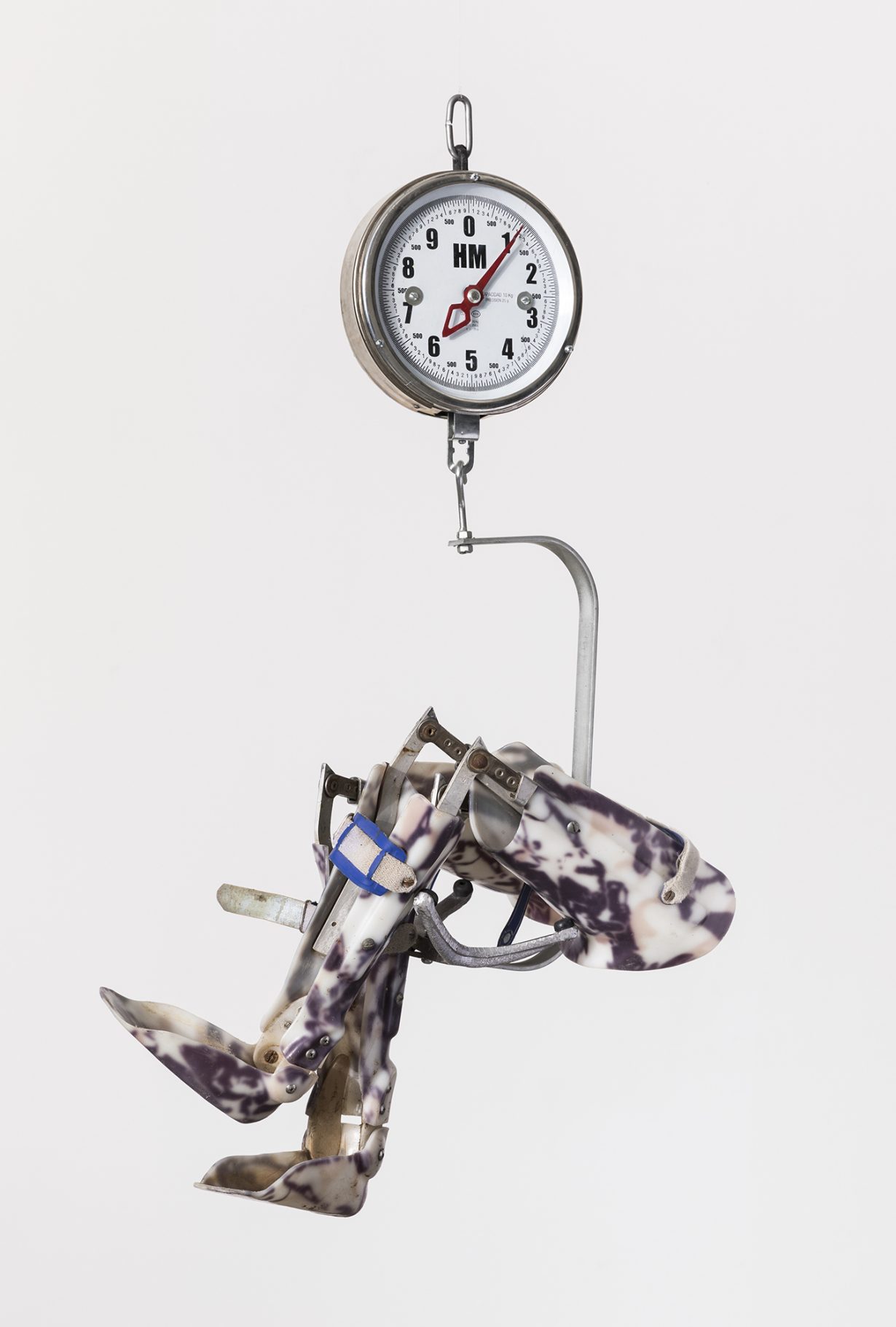
Prosthetics then became Olmedo’s mainstay material by coincidence. In her birth city of Oaxaca she had embarked on a project relating to the heavily despoiled river Salado, following its waters and the rubbish downstream. On the banks she came across a junk store, and among the old washing machines and broken furniture was a leg-shaped object she didn’t recognise: the shop owner told her it was a child’s orthosis for limbs damaged by polio, once endemic in the area, not least due to the very river pollution Olmedo had been investigating. Abandoning the river research, she bought the object and would later discover that there was a substantial trade in secondhand disability aids (though polio has since been eradicated in Mexico), ill health invariably affecting the poorest members of Mexican society. The orthosis became the major element of the kinetic sculpture Olga (2018), in which the found medical device is connected to a series of motors and sensors. The latter power the legs as they attempt to stand up, though eventually the humanoid sculpture collapses to the ground. Though Olga is missing an upper body, Olmedo refers to the work anthropomorphically. “I just want to help her to walk. I showed her in one exhibition and she didn’t move, and then I started to work with different engineers until six years later Olga could finally walk.” Many of the artist’s assemblage sculptures are given female names, imbuing them with a sense of personality, which in turn heightens the viewer’s investment in this robotic aid’s struggle to stand. More works in this vein followed: Anastasia (2018), a scrappy leg prosthetic, the joints rusty and the leather straps dirty; Amalia (2021), made from an orthosis for adult legs, again with signs of wear, again engaged in a Sisyphean attempt to rise up.
The sculptures might just as happily lie on the floor, Olmedo says, but part of the promise of the humanoid form is the expectation that it will be able to stand. The tyranny of verticality – the ‘humanity’ of Pnoê is defined by the work standing upright – is something that Olmedo wishes to draw attention to. “Verticality is the key physical difference between us and animals. This anatomical behaviour, walking upright, is seen as a critical marker of the human. The construction of cities, of knowledge, of society comes from a position of assumed verticality. So my sculptures are often attempting to achieve verticality, but more often not fully achieving it, with the message that we don’t need this anatomical universality; variation of bodies offers a different route.”
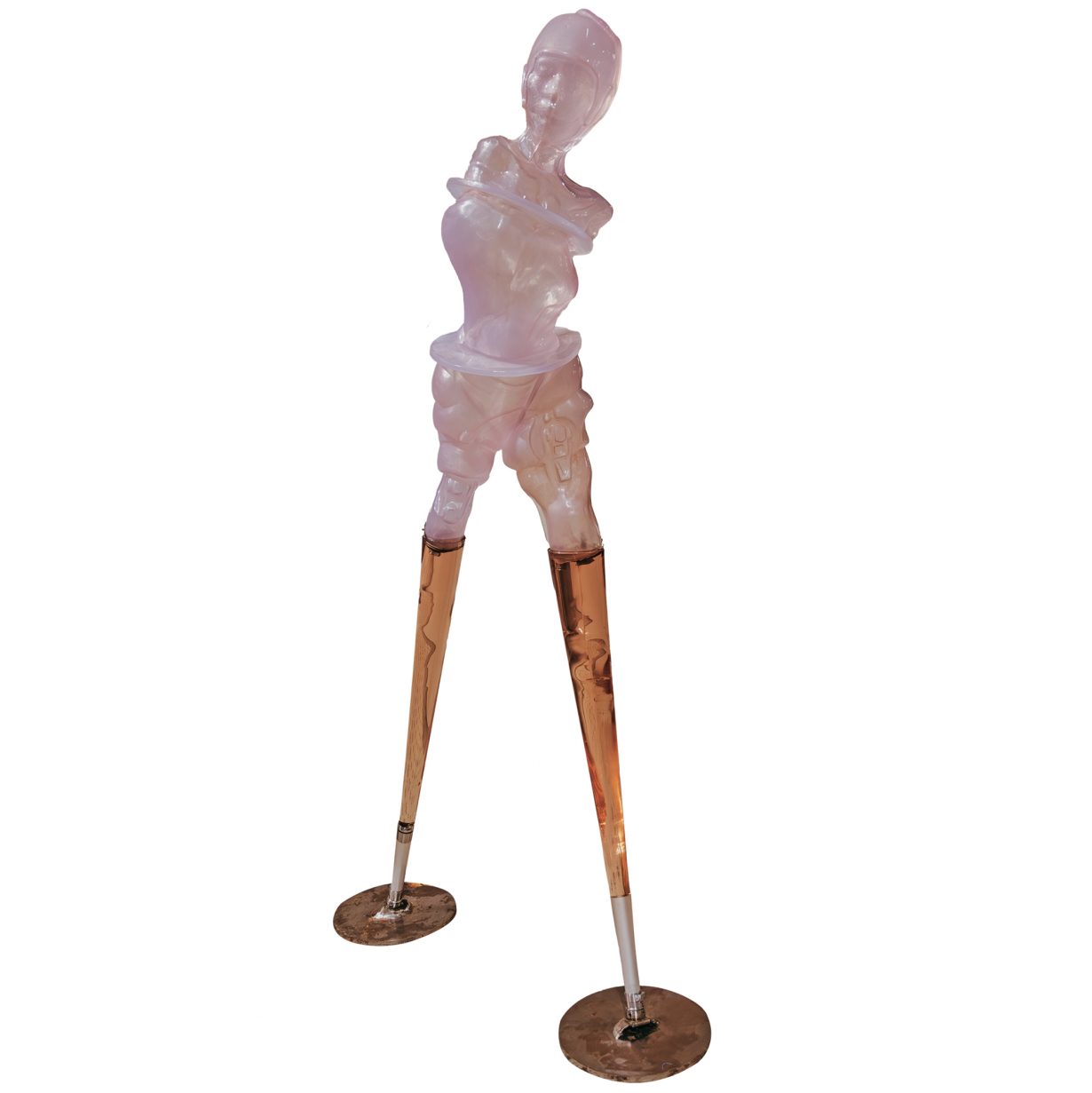
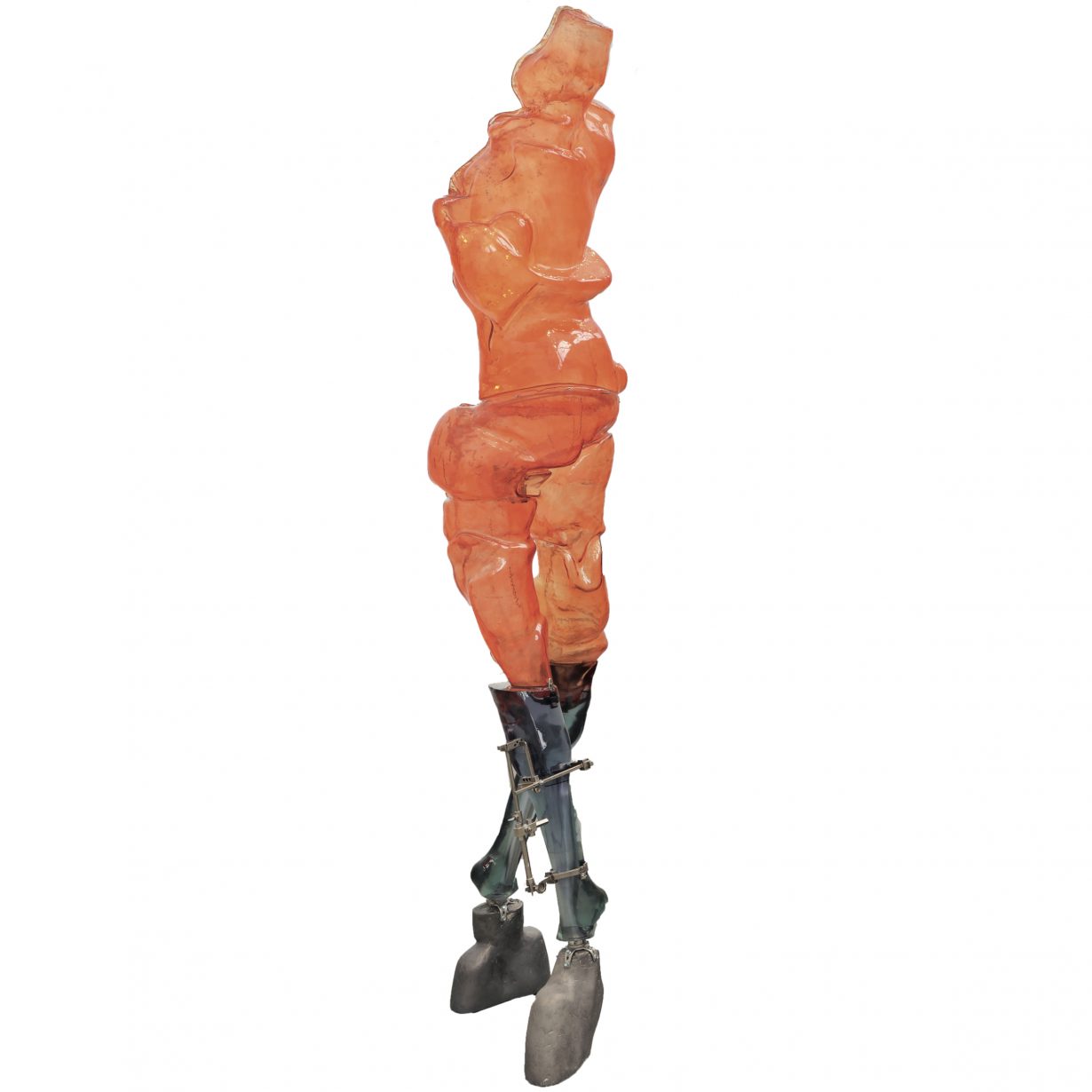
(above) Rutilio, 2024, ThermoLyn orthoprosthetic, intramedullary femur nails, cortical screws, surgical steel traumatology instruments, aluminium tube and socket adapters for prosthesis, resin and lead, 247 × 59 × 46 cm. Photo: Chris Gunder. Courtesy the artist
She says that she thinks of her material not as disability aids or medical equipment, ‘substitutes’ for something ‘missing’, but integral parts of the human body without hierarchy. Each individual’s body is an orthosis to another, she points out: our bodies are socialised and used as tools by others to reach a greater potential than we could achieve individually, that’s how a society is evolved or populations are engineered. “There are different temporalities that can cross disability; some abilities can be heightened, and others can be made invisible, but disability allows one to reflect on bodily exploitation and what it might be to produce a self beyond the paradigm of capital.”
The humanoid works are invariably shown in groups. At her recent solo show at Berkeley Art Museum and Pacific Film Archive, a new series of four figures – gaily coloured cast medical-plastic mashed together with a hodge-podge assortment of armatures, implants, prosthetic arm and leg sockets, scoliosis corsages and collars – seem to be in communion. They might be dancing, they might be fighting, but they are definitely interacting. “Nobody wants to accept the fragility and vulnerability that we possess from the beginning,” Olmedo says. “We want to believe we are these independent autonomous beings, that we are enough by ourselves, nobody wants to admit the interdependence we have with each other, with nature, with other species. We are interconnected with people, interconnected with machines, with the natural world.”
As a model for this, she introduces the example of the clinic in which she volunteers, facilitating art classes for children with disabilities. The community there is a study in mutual aid, she says, in which organic and artificial bodies cohabit, as well as operate a language that has developed beyond the linguistic. Each patient swaps functionality within their own body, as well as lending it to others. “You can exchange functions, a foot can take the place of a hand,” she says, by way of example. “The body can be reorganised. I think the same way about technology: OK, the function at the moment is the accumulation of capital for a few, but we can reorganise that. It’s not so idealistic and romantic, because it exists, no? I’ve seen that happen at the clinic. The language that we’re using, whether it’s Spanish or English, is useless there. Communication operates on a different level among my students: it might be through noises, or with the movement of the body, gestures, but speech as we know it is useless, the language is more corporeal. That offers us lessons too.”
I wonder if this vision, and the idea of a transhuman future – the development of the human body through new and emerging technologies – is overly utopian, given that such a philosophy seems mostly the preserve of tech oligarchs these days, those seeking eternal life or interplanetary colonisation. In a society that is designed for a particular vision of how a body should operate, how it should stand, how it should communicate, however, Olmedo utilises ‘disability’ and the technology that has grown up around it to offer an alternative vision. “The problem with the technology is who has the access, who has the knowledge, the code or whatever. That’s the hard task, penetrating that knowledge base.” Her sculptures have a futuristic bent, but many are also slightly hokey and DIY in their construction, a suggestion that perhaps the future might be reconfigured from the ground up, one body at a time.
From the January & February 2026 issue of ArtReview – get your copy.
Read next The Prosthetic and the Posthuman