Meriem Bennani and Orian Barki present coming out as an ongoing process of reevaluation
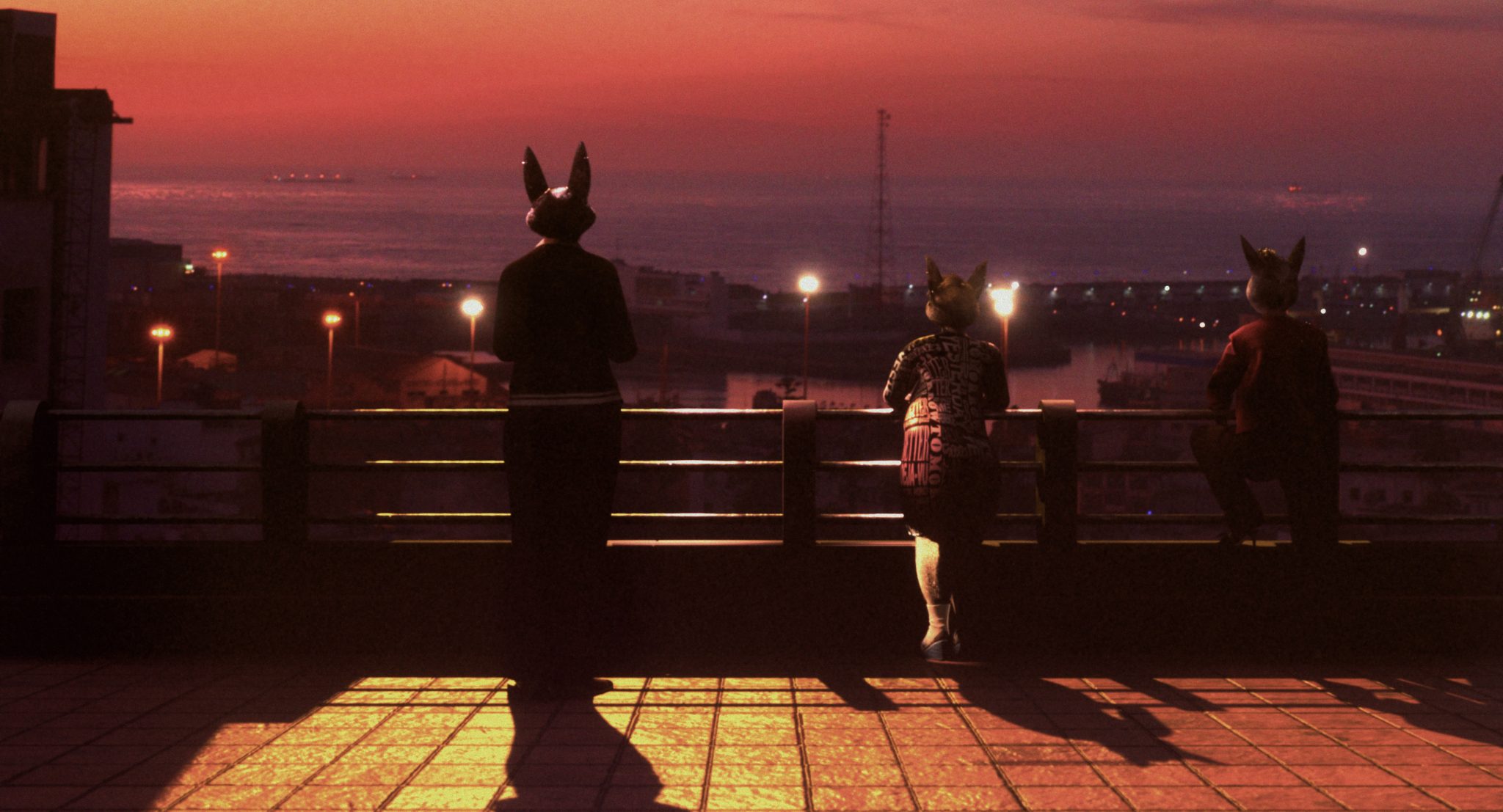
What does it mean to make a self-portrait? Bouchra, an intimate debut feature by two New York-based artists, Moroccan Meriem Bennani and Israeli Orian Barki, approaches this question through an ongoing dialogue between a mother and a daughter, who, in this case, are anthropomorphic coyotes, in the style of the duo’s lockdown project 2 Lizards (2020). The CGI-animated Bouchra is based on a series of conversations between Bennani and her own mother, the film opening with a phone call between the eponymous protagonist (voiced by Bennani) and her mother, Aicha (voiced by Yto Barrada), in which they speak about the nine-year silence following Bouchra’s coming out. We then follow Bouchra as she makes a film to reconstruct and reexamine their relationship during that period. Her creative process methodically unfolds before us: hand-drawn storyboards expand into flashbacks of visits to her family home in Casablanca and phone calls to Aicha, and the film constantly slips between these fragments and Bouchra’s present-day life and romantic dalliances in New York. It is often unclear whether the story-boards reveal Bouchra’s memories, or if they expand into episodes of a film Bouchra has already made.
Blending live-action, photogrammetry and 3D scanning, the film nevertheless sports the romantic, wistful edge of a noir, and shifts between capturing expressive affects and oblique details. In one scene, Aicha and Bouchra’s large coyote eyes glisten with tears, as they lick menacingly sharp teeth, expressing a yearning that’s suspended between tenderness and aggression. Bennani and Barki’s coyotes embody those outwardly tough personas who desperately desire to be acknowledged while also shying away from such exposure. Whereas when Bouchra’s bubbly gaggle of coyote aunties press her about a potential new job, she is reluctant to answer (considering her ex Nikki is the one offering it); the image lingers not on Bouchra’s face but on her younger cousin’s furry feet, which are slipped into too-large adult denim wedges.
Here the cinematography echoes how memory can concretise such incidental fragments while allowing the rest of the scene to fade. Bouchra’s storyboard scenes are often coloured by her own desires and projections, blurring the boundaries between reality, fantasy and memory to question how best to represent a murky past. In Bouchra, coming out is neither linear nor final but an ongoing process of reevaluation, its narrative frequently revisiting Bouchra’s confessional moment and the phone calls subsequently made between the mother and daughter, examining anew their diverging versions of events. Bouchra feels rejected by her mother’s silence, but it is not until later that she learns Aisha’s own sense of isolation, when, during a call, the mother reflects on how she is unable to confide in her extended family about Bouchra, for fear that Bouchra’s queerness would disrupt the entire heteronormative family unit. In some senses, Bouchra extends the autofictional tradition of queer diasporic female filmmakers like Chantal Akerman and Kaori Oda who often bind multiple perspectives without reaching a singular truth. Bennani and Barki show that autobiography is never just self-construction, but is paradoxically grounded in dialogue; one’s ‘self’ can only be voiced in relation to, or in tension with, that of another’s.
Bouchra by Meriem Bennani and Orian Barki premiered at the New York Film Festival, 27 September.
From the November 2025 issue of ArtReview – get your copy.