The Taiwanese artist looks to Buddhist scripts, painted shells and a circle of dung to grapple with new configurations of the spiritual and the aesthetic
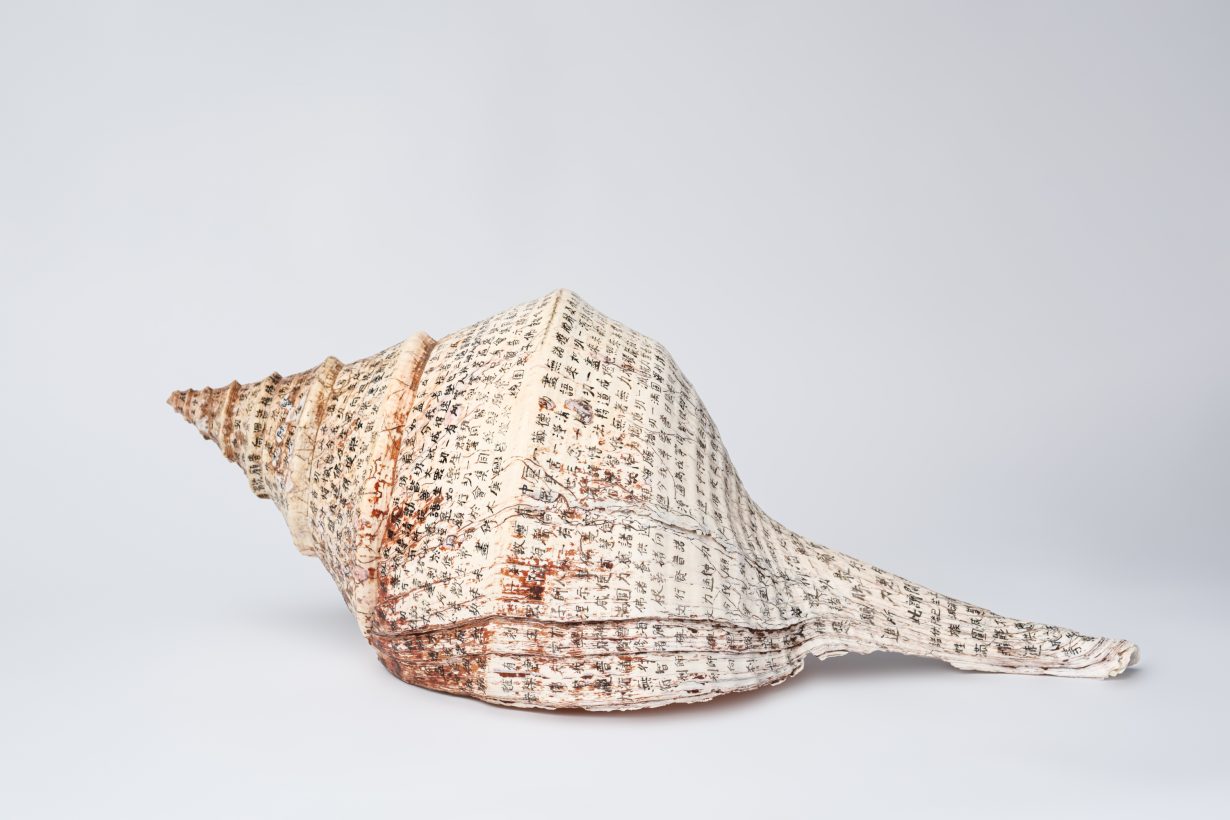
Tsai’s exhibition is split between two rooms. Five paintings on canvas (all works 2025) have been installed throughout the first – a couple on the walls, the rest of them suspended from the ceiling. They feature circles of varied pastel hues – green, purple, three shades of blue. Leaning into the natural world, Tsai utilises pigments derived from materials such as charoite, malachite, sodalite and lapis lazuli, which give them a dense, textured finish. Up close, these ritualistic renderings have been inscribed with swirling Buddhist scripts translated into Chinese characters. The text Tsai selected for these paintings, the ‘King of Aspiration Prayers’, is meant to lift the chanter beyond mundane worldly problems, and elevate them to the same plateau as those bodhisattvas whose thoughts and actions are focused on the wellbeing of all sentient forms of life. The sacred is necessarily abstract, these paintings seem to aver; even for the nonfaithful – or those unable to read the language, but able to appreciate the aesthetic qualities of Chinese calligraphy – they might serve as beacons of hope and lightness. The space is further punctuated by three large seashells, one titled An Ocean of Prayers and two others An Ocean of Languages in a Single Syllable; presented on mirrored plinths, each is covered in the same script, uniting them with the paintings and their rendering in natural pigments. This is perhaps the sole point of a show in which Tsai veers dangerously close to hokiness and cliché, given the conch shell’s overuse as a signifier of sound and communication: who, exactly, is listening to these prayers?
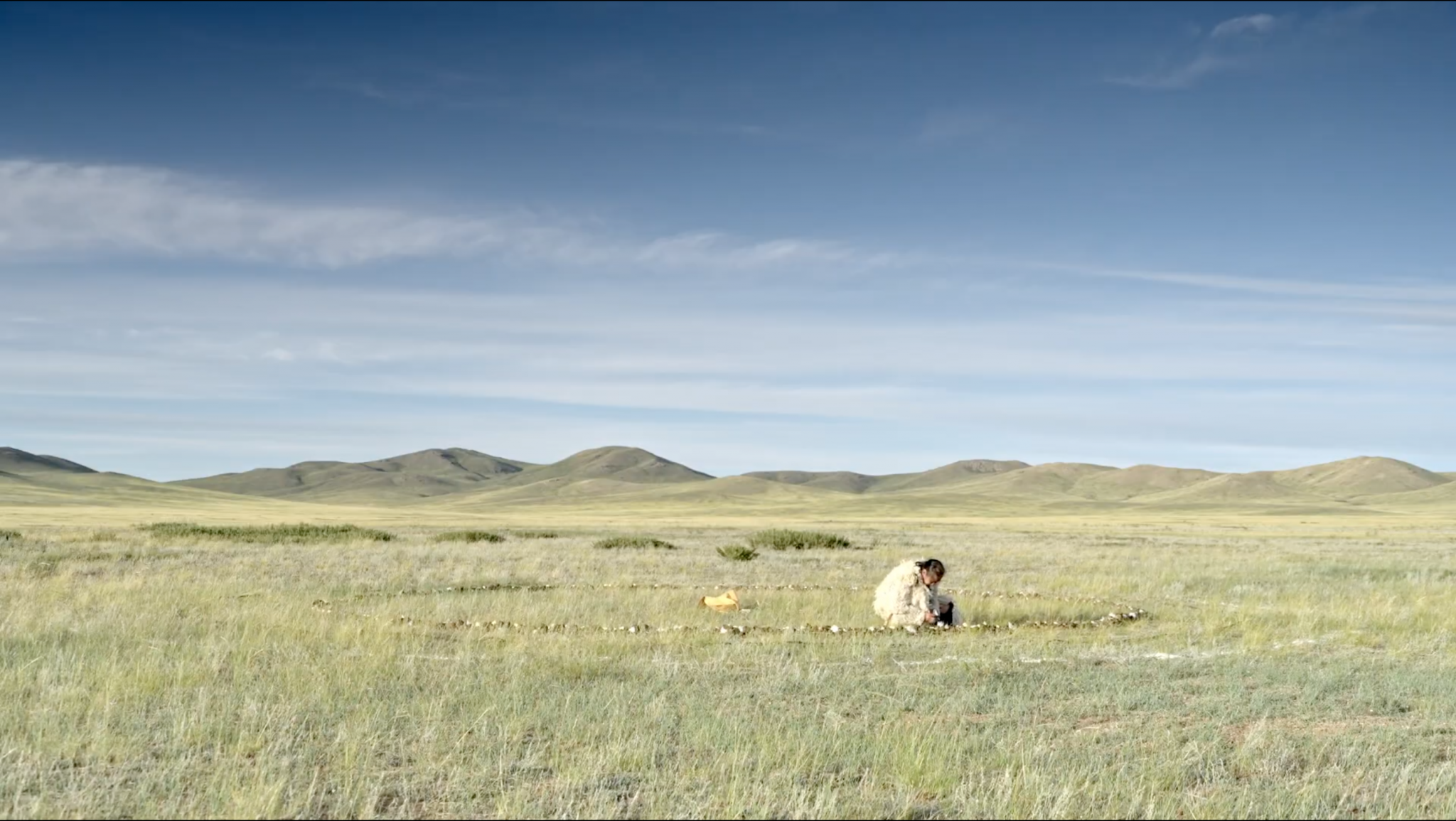
In the second room, viewers step into a circular, roped-off space to sit on low wooden stools to watch a nine-minute video, produced by Tsai, that documents a shamanistic ritual by Mongolian performance artist Ganzug Sedbazar. Kiss the Earth takes place in the Mongolian grasslands, where Sedbazar, wearing a sheepskin coat, enters a vast circle – roughly the same scale of the circle in which we’re seated – of cow dung. He goes around the circle, lighting sections of it on fire with a torch, until the entire circle emits smoke and flame. By the time he completes the process, day has commenced its fade. Sedbazar removes a piece of smoking cow dung from the circle, wraps it in animal skin and ties it to a length of rope, which he proceeds to swing around him, chanting all the while. His chants turn to grunts as his exertion increases; he now swings the rope above his head. Until it comes to an end. He kneels, putting his face to the grass-covered earth, to give thanks to the gods that possess it. He gets up and leaves the dung circle as it continues to smoulder, turning to ash. The film reaches its apotheosis with a poem, penned by Sedbazar, that flashes across the screen: an ode to fire, war, air and the Eternal Sky.
The rest of the room is filled with a gorgeous array of ceramics – three large bulbous vessels, glazed in turquoise and presented on mirrored plinths, and two further shelves filled with palm-size vessels, some of which have been filled with such fragrant medicinal ingredients as goji berry, cinnamon and peony root.

Ancient Desires – Persian Flower Vesse. 65.5 x 26 x 26 cm. Ink, ceramic offering vessels with turquoise glaze. Courtesy the artist
While it’s easy to assess these two rooms as filled with beautiful objects and the quietly moving filmed collaboration with Sedbazar, it is difficult to parse exactly what Tsai wishes to convey about the role of the sacred in contemporary art – and, by extension, in contemporary life. It is far from an unintriguing premise in this era of polycrises, and one rather welcomes the prospect of grappling with new configurations of the spiritual and the aesthetic – at least as a break from the party-line virtue-signalling that makes so much work ‘engaged’ with the contemporary world seem a mere extension of the social-media echo-chamber, which is itself a paradigmatic spiritual hollow. Yet Tsai’s gestures here come off as perhaps a bit too hermetic, in their limited appeal to followers of the sect, and conventional, in the selection of materials and source texts. We all could use some healing; we just need to be persuaded first.
Charwei Tsai: Touching the Earth at tkg+, Taipei, through 31 January
Read next Hito Steyerl’s ‘Conservative’ Turn