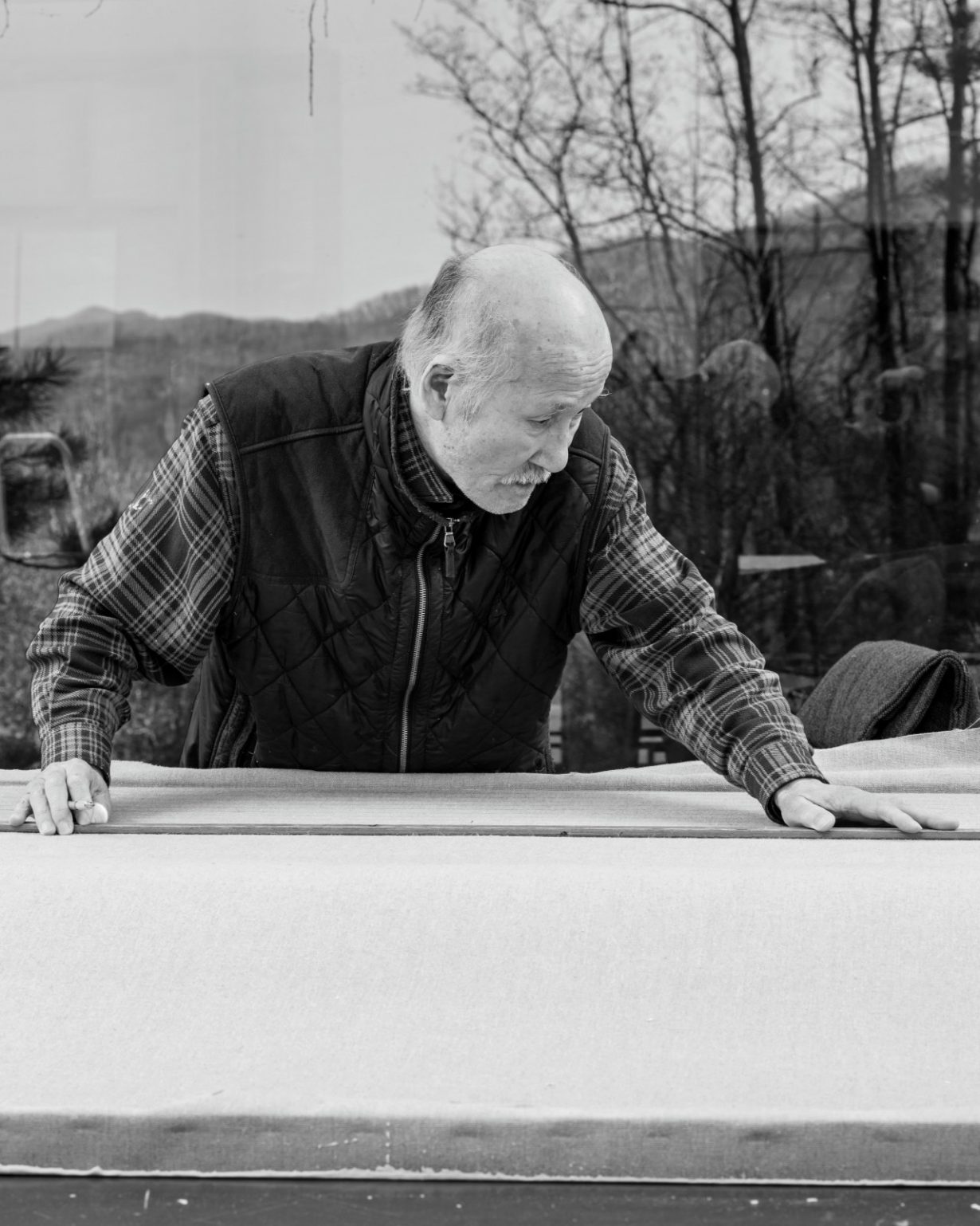
Chung Sang-Hwa, a member of the Korean Dansaekhwa movement known for his textured minimalist paintings, has died at age 93.
Born in Yeongdeok in then Japanese-occupied Korea, Chung Sang-Hwa studied painting at the Seoul National University College of Fine Arts. Following his graduation in 1957, his work focused on expressing the pain and hardships of the Korean War in the dynamic and abstract style of Art Informel. During this period, he developed his ‘peeling off’ and ‘filling in’ methodology, removing and adding paint and kaolin to his canvas, which became distinctive of his practice. From 1969 to 1977, he moved to Kobe where he expanded his exploration of flatness by restricting his colour palette and developing his monochrome grid paintings. Following the death of his wife in 1977, Chung Sang-Hwa moved to France and continued to perfect his technique while reintroducing colour into his work, before returning to Korea in 1992 and establishing his studio in Yeoju.
Chung Sang-Hwa’s work was widely exhibited during the artist’s lifetime. In 1962, he held his first solo exhibition at the National Central Information Center in Seoul. In 1963, his work was first shown internationally alongside that of Park Seo-bo, Kim Chong Hak and Kwon Okyon in Jeunes Peintres Coréens at Galerie Lambert in Paris. He participated in the 4th Biennale de Paris (1965), the 9th São Paulo Biennial (1967) and further solo and group exhibitions including at Galerie Jean Camion, Paris; Jean Gallery, Seoul; Gallery Hyundai, Seoul and Motomachi Gallery, Kobe. Later in his career, he was the subject of major retrospectives at the Musée d’Art moderne et contemporain de Saint-Etienne Métropole (2011) and the National Museum of Modern and Contemporary Art, Seoul (2021).