Craig Jun Li’s work returns us to the problems of film photography in an age of seamless digital image circulation
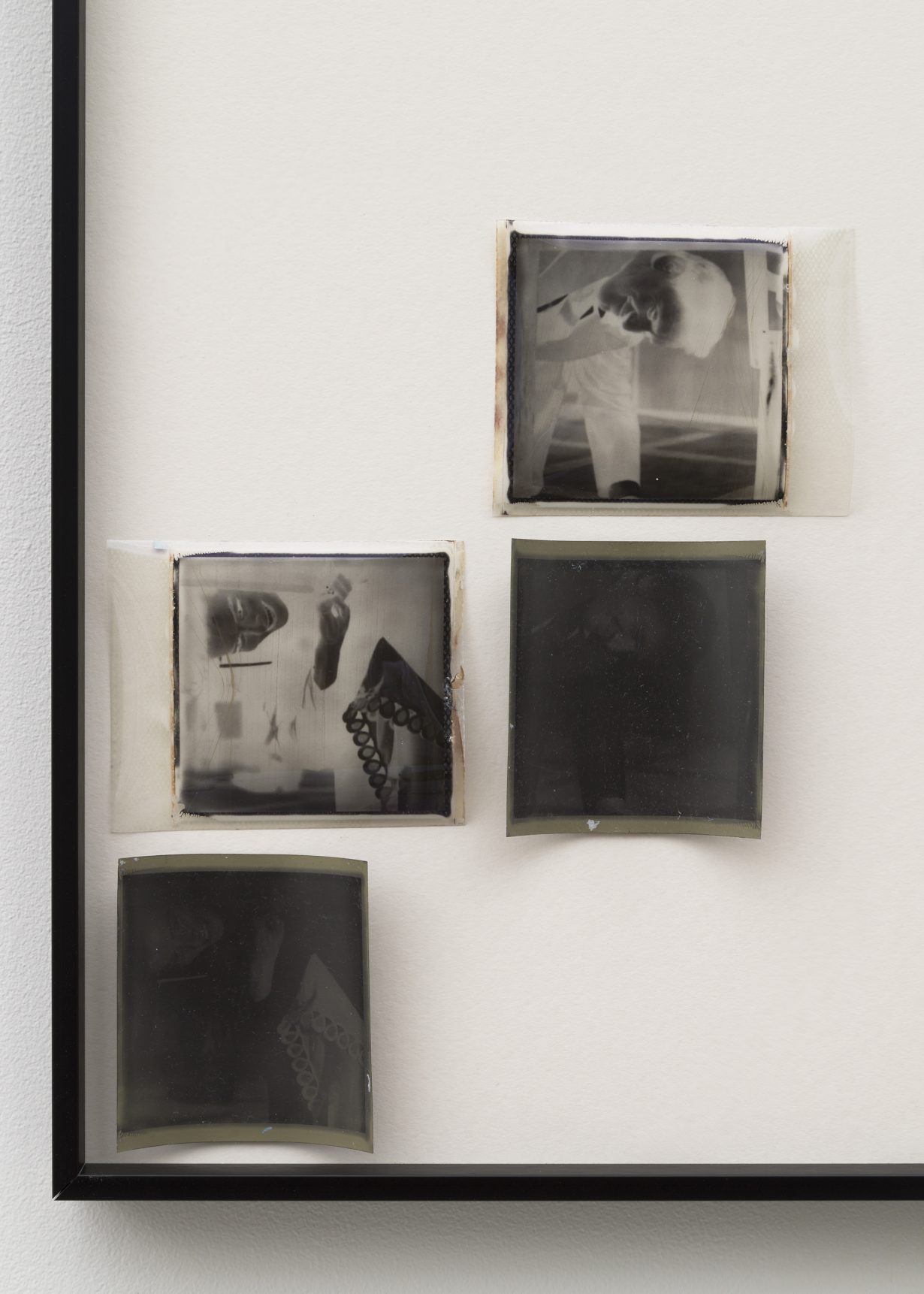
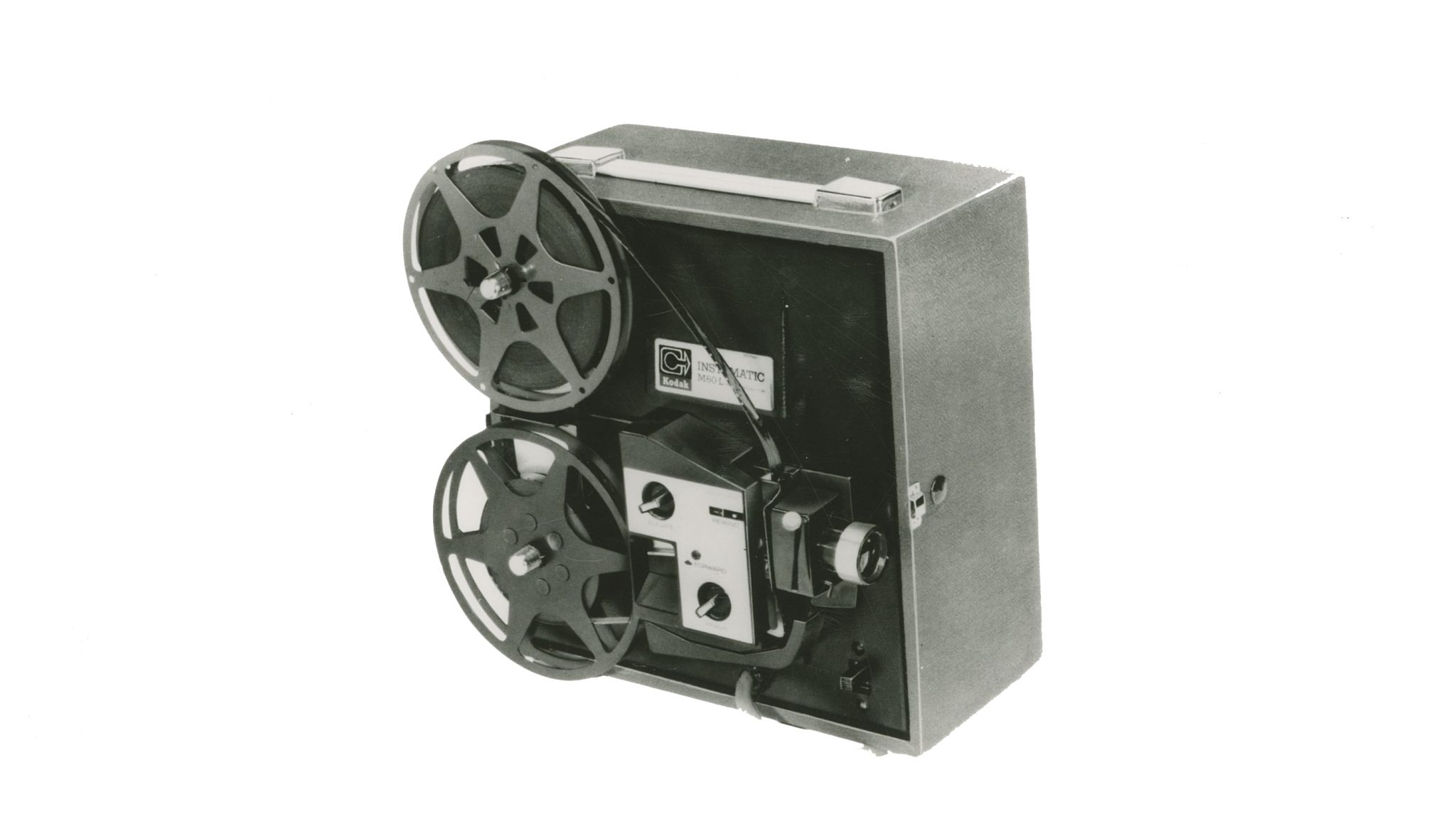
‘No photographer, not even the totality of all photographers, can entirely get to the bottom of what a correctly programmed camera is up to,’ Vilém Flusser wrote in Towards a Philosophy of Photography (1984). ‘It is a black box.’ The strongest pieces in Craig Jun Li’s solo exhibition dramatise the inherent incomprehensibility of technical image-making by trying very hard to get under the hood. In a series of collagist wall-works from 2025, all vertical sheets of silicone framed by metal, Li presents us with a sparse economy of photographs applied to the polymer surface: distorted dye-transfer prints depicting the insides of 16mm projectors, paired with Polaroids of projected images, some flayed so that multiple emulsion layers are visible at once. Each work is also adorned with a film-cartridge spring stripped from a Polaroid SX-70 camera, tucked into the frame’s side. The projector and the projected, the Polaroid and the hardware that produced it: together, this closed system diverts our attention from the traditional concerns of pictorial photography, specifically indexical representation, and redirects us towards its mechanical apparatus.
Literally deconstructing the photograph or scrapping the camera for parts, or otherwise inventing elaborate printing processes, Li returns us here to the problems of film photography in an age of seamless digital image circulation. The installation As She Puts It, “One Big Ruin” (2026), titled after a phrase the artist Lutz Bacher once used to describe her own work, for instance, accumulates print ephemera, both appropriated and original, to form a delicate collection of material studies. Arranged across the windowsills of the gallery’s back room, it is an inventory of process-based experiments (abstract images printed on paper or aluminium) and artefacts drawn from a vanishing material history (expired Kodak paper, ethnographic imagery, film stills, photo scans of used books). These materials, which lie flat on the sills, are weighted down by a number of ‘decommissioned’ thermographs and cooling units placed on top of them.
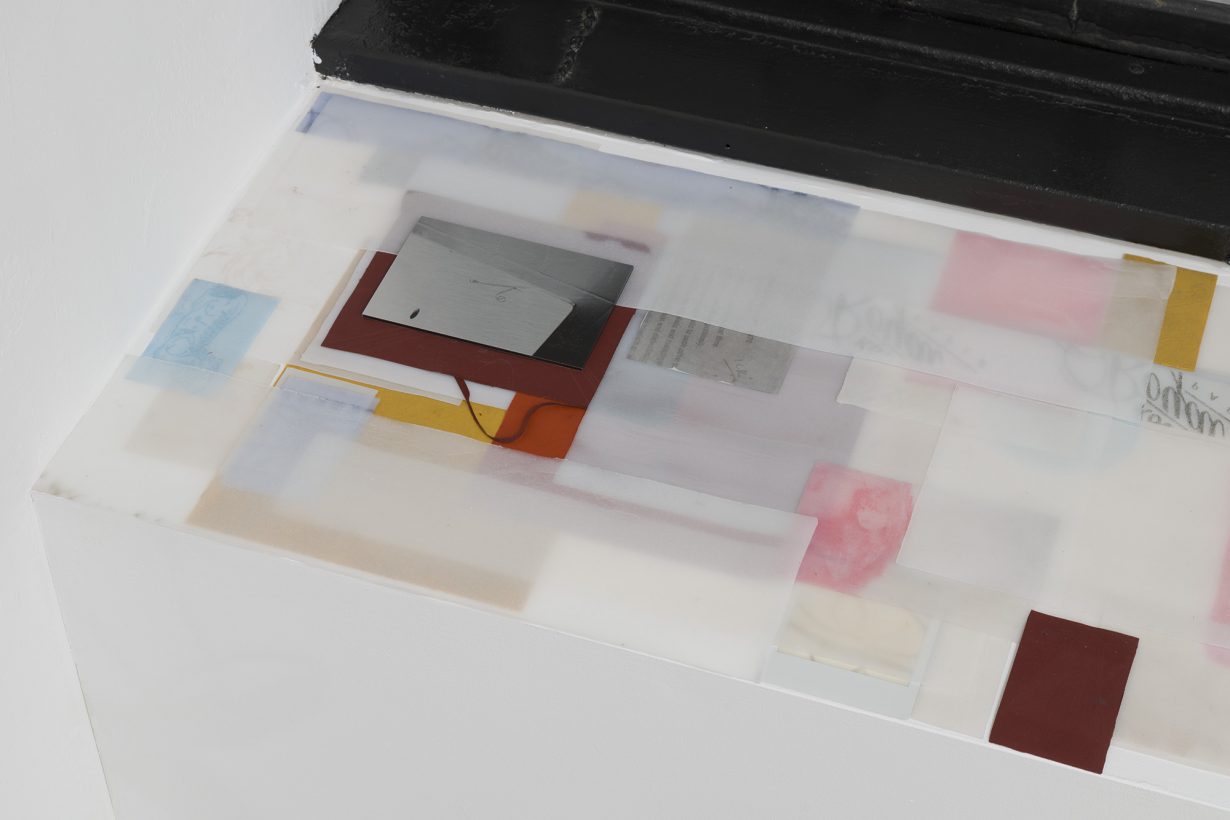
As suggested from these devices once employed in the preservation of degrading materials at the museum, there is an allegory threaded through Li’s show, anthropomorphising the instability of such materials, a suggestion that all this compiling and conserving also poses a poetic kind of ‘holding on’. An additional wall sculpture, Mechanical Model for Two Clocks (2026), echoes Felix Gonzalez-Torres’s “Untitled” (Perfect Lovers) (1987–90), paring back the poignant image of two synchronised clocks to envision a system of interconnected gears and cogs that could perform a similar, although more durable, function. Faceless and encased in transparent plexiglass, the sculpture extends Li’s fascination with operations beneath the surface. Yet one wonders if this model, too, brings us back to photography. Like a stalled clock, the still image also arrests time.
Why analogue photography now? One response might be that conspicuously rematerialising the image – printing on unconventional materials or capturing the projector’s immaterial light – restores some of photography’s indexical function, its ‘trace of the real’, that has been lost since the advent of digital media. Another could be that film photography provides an approachable model, as it does in Flusser’s writings, to begin considering the far more confounding ‘black boxes’ structuring contemporary life. Flusser’s metaphor of the camera is just that, a metaphor, and so is Li’s – it scales.
Craig Jun Li was at Chapter NY, New York, 9 January through 21 February
From the March 2026 issue of ArtReview – get your copy.
Read next Beatriz González’s ‘Bad Painting’