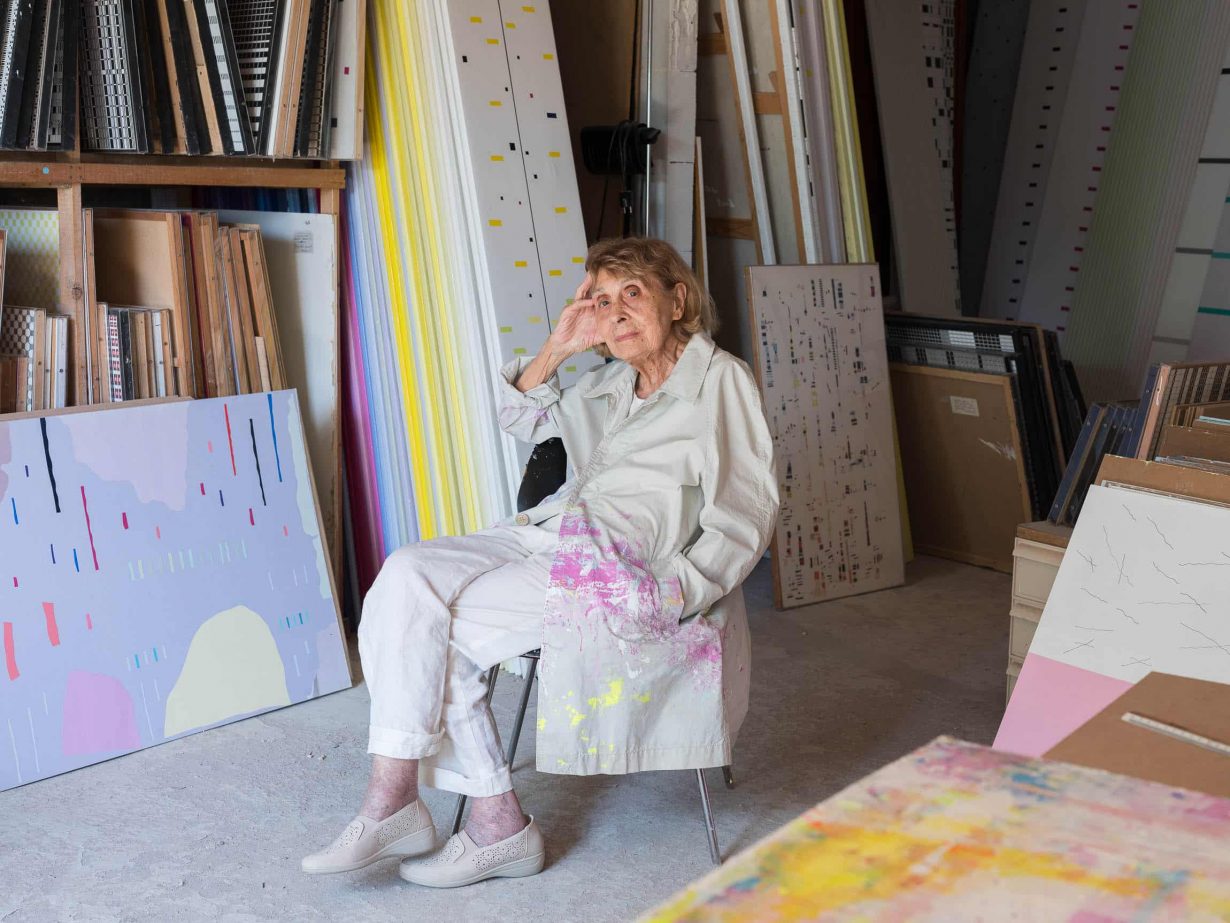
The Italian artist Lucia Di Luciano, a central figure in the Arte Programmata movement, has died.
Di Luciano was not included in the the original exhibition of kinetic and computer programmed art at the Olivetti Showroom in Milan in 1962, but joined the movement two years later as a member of Operativo R, also involving Carlo Carchietti, Franco Di Vito, Mario Rulli and her husband Giovanni Pizzo. She would go on to be one of the most active proponents of applying rational ideas to art.
The artist’s early paintings, characterised by the overlapping of black and white grids rendered in industrial Masonite and Morgan’s Paint, attempted to redefine visual language according to systematic, and anti-expressive principles, made in reference to theoretical principles such as Gestalt analyses of vision and Bertrand Russell’s writings on mathematical logic.
In the 1990s di Luciano and Pizzo moved to Formello, a small village outside of Rome, to obsessively dedicate their lives to painting in isolation. It resulted in the loosening of the grids, which eventually disappeared altogether, and the introduction of colour – once nonexistent in her paintings.
She was featured in several early Rome Quadriennals and New Tendency exhibitions in Zagreb and more recently was included by Cecilia Alemani in the 59th Venice Biennale in 2022, and in Electric Dreams, the survey of optical, kinetic, programmed, and digital art held at Tate Modern, London, in 2024.