The Libyan artist conjures in space and material a simultaneous understanding of presence and absence
At the entrance to Nour Jaouda’s exhibition is a bronze rail on which the artist has hung offcuts of fabric. Thus the artist’s materials, these strips of textiles, are present in the exhibition not only as a final product but also as a nod to process. Jaouda’s work combines textile and metal into sculptures and installations, and she often reuses materials found or sourced for other works. Titled Remnants of Tomorrow (all works 2025), this introduction to the exhibition subtly presents its themes: the passage of time, process and materiality.
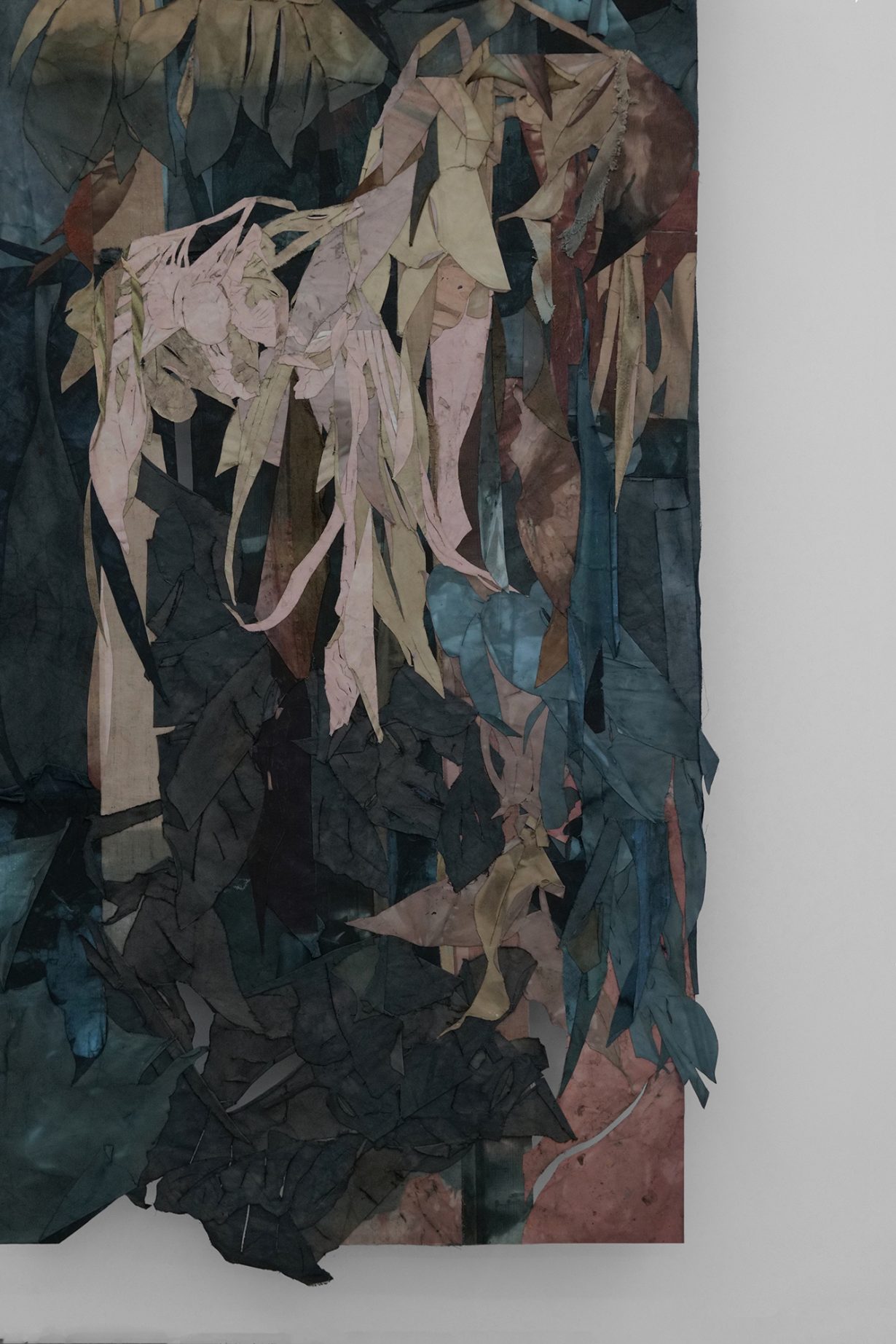
Jaouda’s process is slow and additive. She sources fabrics which she then dyes, cuts and assembles. The six wall-based pieces on view are composed of fabrics dyed in natural earthy tones of browns, greens and some blue that Jaouda then cuts and uses heat pressing to combine. The pressure makes the textiles flat and heavy, which brings them away from the realm of painting and into the sculptural. They hang from a metal rod protruding a few centimetres from the wall, so that they feel more like curtains, only weighted down so they remain quite rigid at a distance from the wall. Dark and heavy, the materials introduce a gloom that frames the space.
The space of the exhibition, Jaouda’s first institutional show in the UK, where the Libyan artist is partly based (she splits her time between London and Cairo, the city she grew up in), is mostly taken up by a large installation, The iris grows on both sides of the fence. It is a large rectangular bronze structure supporting a khayamiya canopy, the fabric named after Shari’a al-Khayamiya, the street in Cairo where artisans make the kind of tents used to shelter people from the elements during events such as festivities and funerals. Jaouda collaborated with six of these Cairo craftsmen (all credited in the exhibition’s handout), procured textiles and natural pigments from the nearby area, and provided drawings for patterns that these craftspeople then assembled into the tent that is present in the gallery, making the work an exercise in the artist letting go of control, and stressing again the importance of community, the mark it leaves.
Next to the tent are three sculptures, all titled An echo has no shadows, which comprise stacks of chairs or parts of chairs, made of bronze but completely recognisable from the aftermath of an event when chairs are stacked and taken away. They complement the tent, which offers protection from the weather and demarcates a temporary community. In a gallery space, the installation no longer has the same social function as it does in its culturally specific location; still it carries the memory of its use as a social space, of the people who were there, who aren’t there.
At Spike Island, the installation is situated in the middle of the gallery, under large skylights. The dark canvas of the tent, reminiscent of tarp, is sombre, but the structure retains some of this social element, drawing viewers to stand within it. Once they do so, they see the iris from the title: a large pattern imprinted on the inside of the tent. It is a Faqqua Iris, the Palestinian national flower – a purple bloom indigenous to the hillsides of the Occupied West Bank, which has become a symbol of resilience. But with the textiles painted the same dark earthy hues as the wall pieces, even a viewer who does not know or recognise the flower would feel the mournful nature of the work, the people it was meant for, who may not be standing there. Still, if you look up, you’ll see the light coming through some parts.
Matters of Time at Spike Island, Bristol, through 11 January
From the November 2025 issue of ArtReview – get your copy.
Read next Gaza Biennial 2025 review: defiance amid devastation