Phillip Lai’s weirdly wrought works, on view at Bristol’s Spike Island, straddle the line between art and the everyday
It’s true, as per Spike Island’s gallery notes, that Phillip Lai’s sculpture leaves you wondering ‘what, exactly, you are looking at’. You might grasp for some bit of phenomenology, or science of cognition, to puzzle through the experience of Lai’s densely wrought, weirdly fugitive objects. When do objects become sculpture? In the skylit vault of Spike Island’s main gallery there’s a line of three works on the floor. (Almost everything in Lai’s show is on the floor, or very near it, and everything is untitled (all but two 2026), keeping words and their power of suggestion at bay.) Weighing down two of three folded-flat white plasticated rubble bags are gleaming slabs of a metal that appears to have been first poured molten, then compressed and flattened. Into these once-fluid solids are embedded, as if pressed in, circular spunaluminium dishes (these two works from 2021). On the third sack is a yellowish, transparent acrylic vessel, its bucket-size cylindrical body set on four feet. It contains an inner chamber with a scattering of mysterious greyish dust in the interstitial space.
One could chase down such descriptive rabbit-holes everywhere here, such is Lai’s care at slipping the gears of easy recognition. But then common qualities and associations gently build between the works, making connections between solids, liquids and gases. The dark, knobbly organic outlines of an untitled pair of sombre grey concrete troughs are filled with black wax, out of which loudspeakerlike conical cavities have been cored. Nearby, three metal trays are filled with a deep red liquid, like wine or cranberry juice, which partly submerges flat chunks of black cast-resin, like masonry fragments, again indented with circular depressions, receding into the gloomy, light-defeating red. Around the corner, on a wall-mounted panel of brushed steel, is a barebones LCD panel showing a video of a black polythene bladder or lung, quietly inflating and deflating. To the perimeter of a nearby brushed-steel plinth are fixed other little screens, depicting, in differently coloured monochromes, smoke drifting about anonymous shadowy indoor spaces.
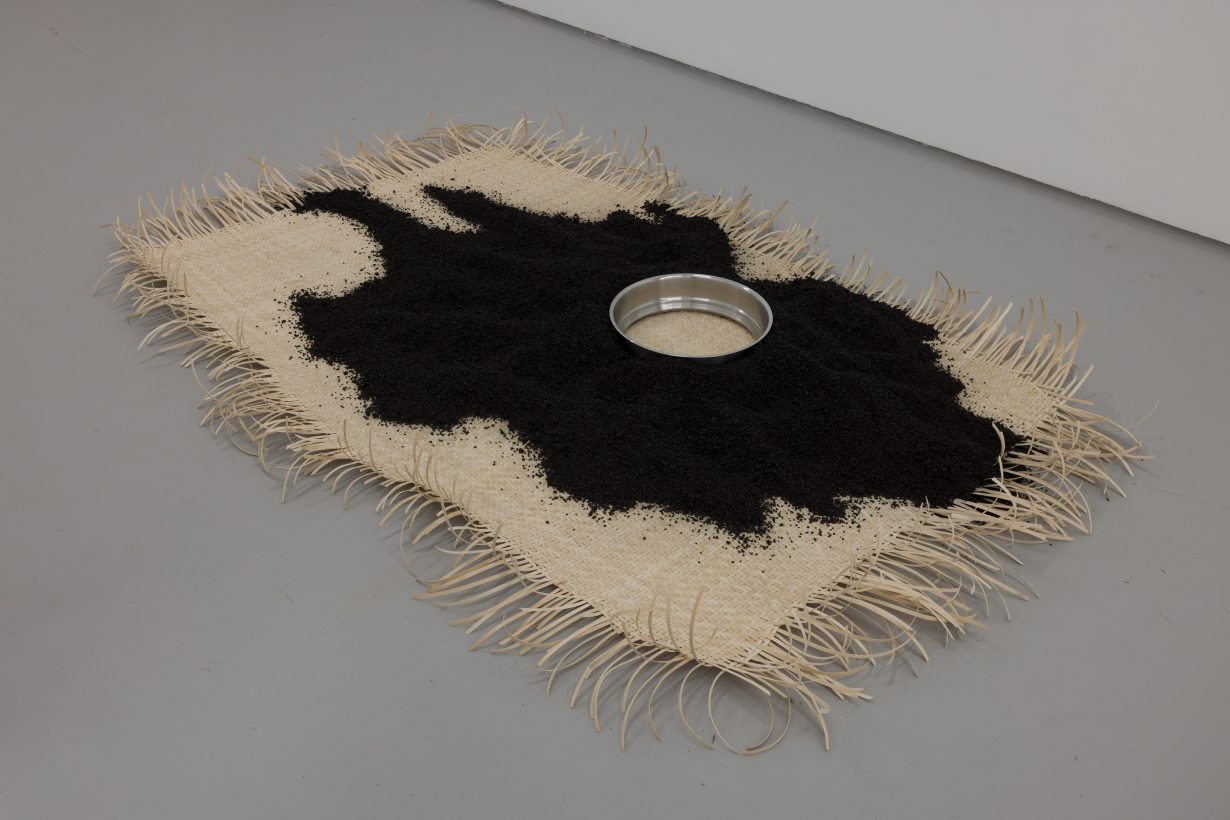
Receptacles and platforms, containment and carrying, these nouns and verbs flicker across Lai’s objects, whose forms follow their function, if only you knew what their function was. Just off the centre of a large rectangular mat of woven cane slivers sits a hollow ring of turned aluminium, like the rim of a tyre, around which (leaving the inside empty) has been poured (the checklist tells us) burnt wheat grains; a tide of saturated black that only just reaches the edges of the mat.
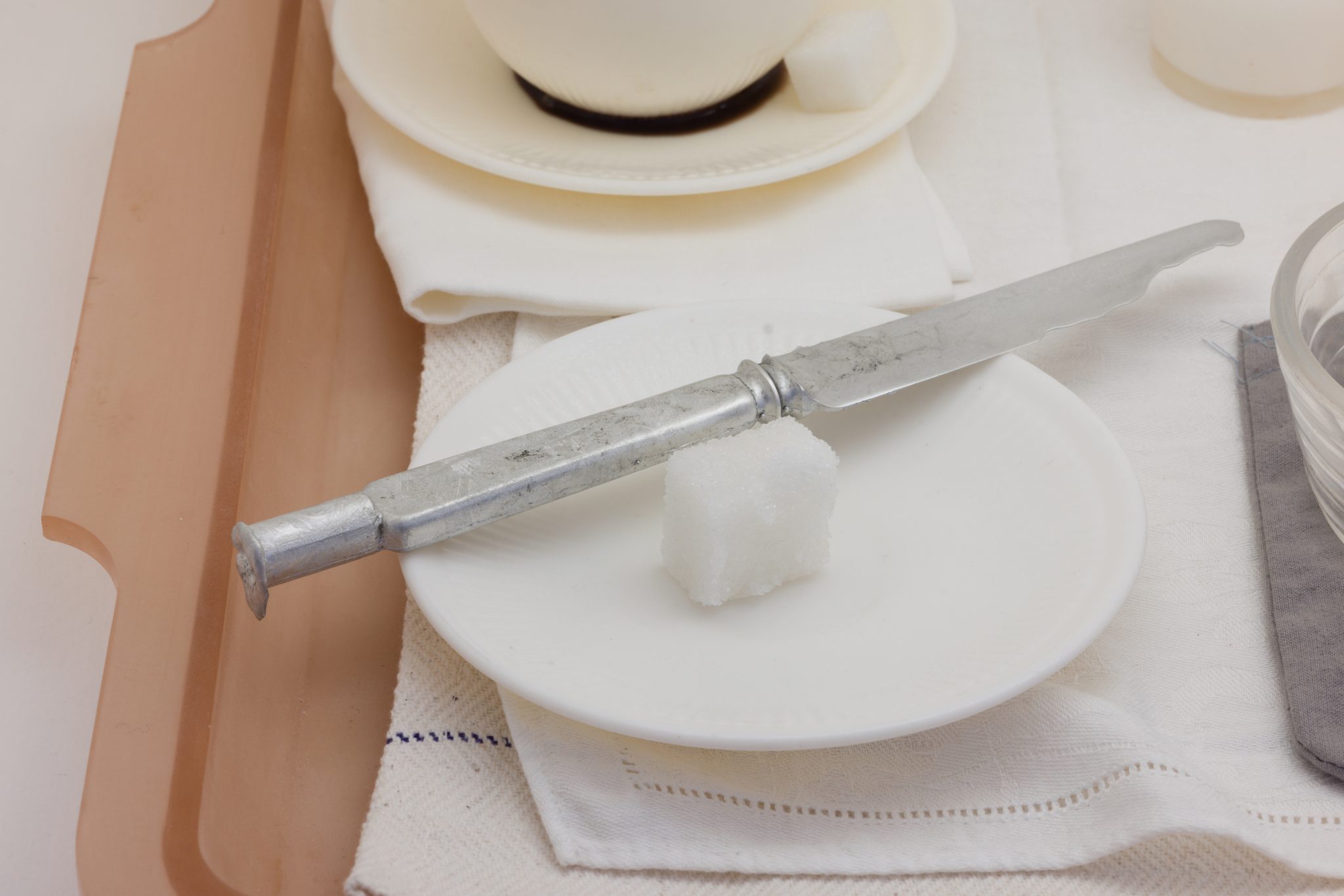
We could be doing something else than staring at these things; there’s a world of calamity and injustice out there, after all. Here, though, are thought experiments in matter, about porosity, desiccation and fluidity, that lead use back to the peculiar nature of the gallery, its physical and imaginative boundary, which makes possible the shift from the everyday to art. That this might be the case is bolstered by the two other, anomalous works here; above head-height on the wall in the main gallery is mounted a large rectangular metal cage, a utilitarian enclosure inside which hangs an audio speaker emitting a loud, harsh electronic din that floods the space, smashing any sense of quiet contemplation; an enervating white noise, almost like that of torrential rain. In the far corner, a low niche has been let into the wall. Behind an acrylic window, in this illuminated recess, sits a dinner tray, plate, cups, glasses, a knife, a jug – all of these, on close inspection, not ‘real’, but meticulously fashioned from casting resin and cast metal. It’s a coda of gentle humour to the show’s scrutiny of how artworks can distinguish themselves without recourse to glamour and spectacle – the lowly remnants of room service, things parked at the threshold of hotel rooms, but here neither in nor out, the remainder made pristine.
RAIN / RUIN is on view at Spike Island, Bristol, through 10 May
From the March 2026 issue of ArtReview – get your copy.
Read next Paul Dash’s Permanent Carnival