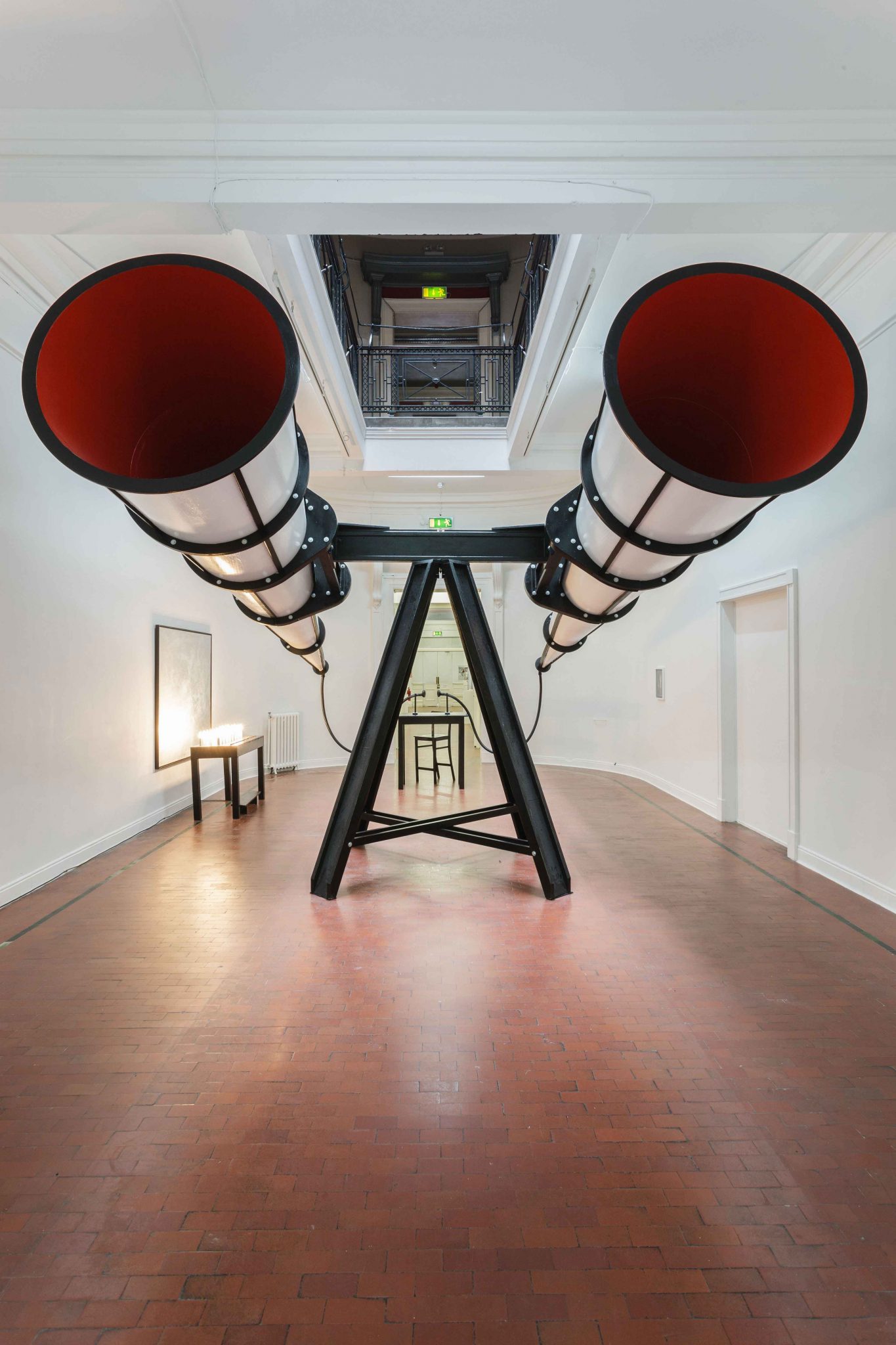
At a moment when AI is increasingly used to virtually undress women, the French artist’s dehumanised female avatars feel particularly icky
The cavernous Halle am Berghain, part of the decommissioned power station that houses Berlin’s legendarily unbridled Berghain club, is in practical terms a logical place for a video installation. It can be blacked out, and you can project at massive scale onto its soaring concrete walls, as Pierre Huyghe does with Liminals (2026). Beyond its location, the French artist’s work here might not outwardly appear connected to uber-hedonistic clubbing. Rather, it’s a seeming attempt, using generative AI, to find a legible visual analogy for the scientific postulate that quantum particles can exist simultaneously in multiple states, times and places (note: author is not a physicist). That said, Huyghe is quoted in the show’s PR materials as saying that the work aims to place us ‘in a realm outside time and space, where there is no beginning or end, no inside or outside, only an incessant dance of matter, in which every moment is a maybe’ – which does sound a bit like Berghain.
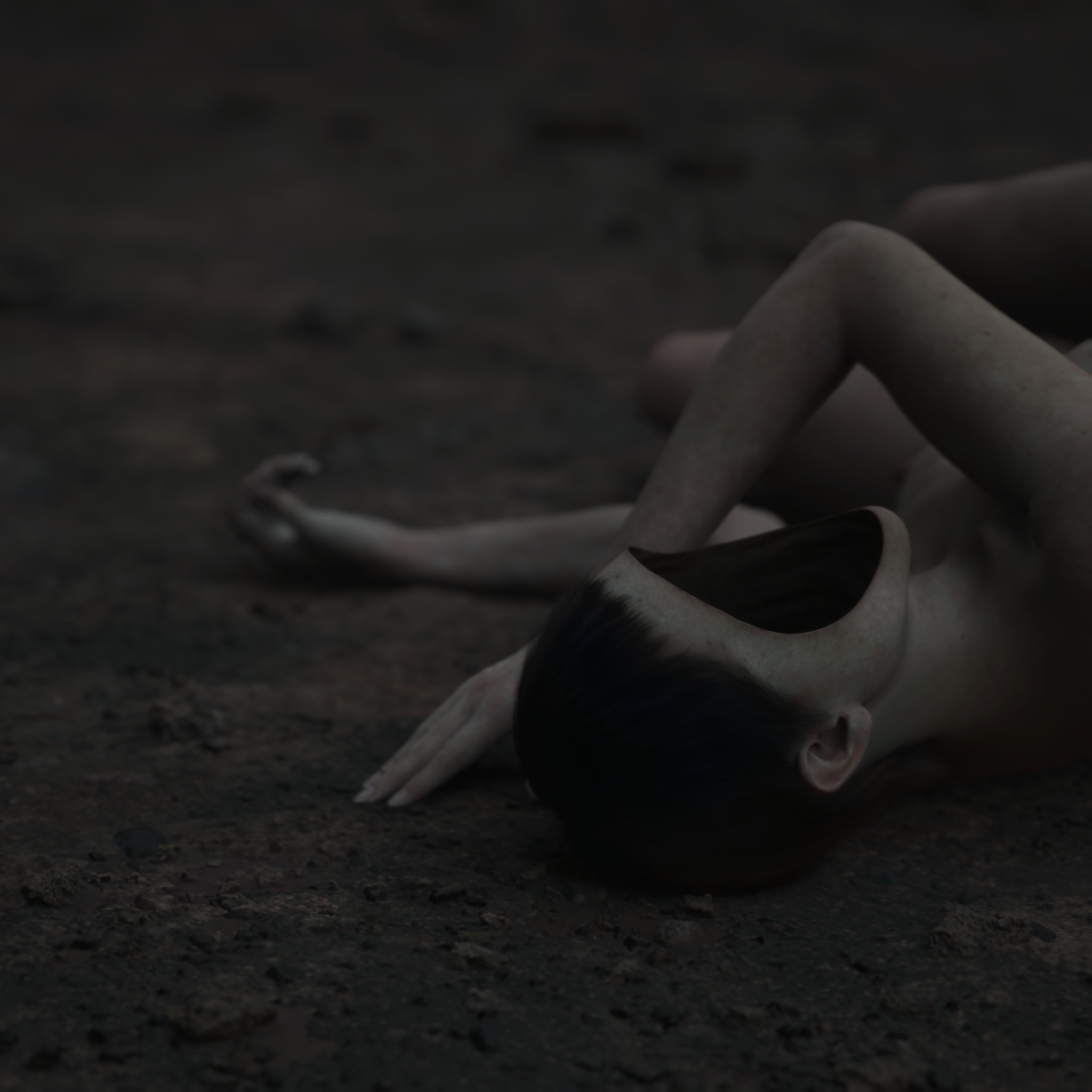
Entering, you stumble around in pitch-darkness until you reach what is effectively the only source of light, the black-and-white (or near enough) CGI film that’s being shown on a wall facing away from the entrance. You likely reach the film at midpoint; that’s not a problem, though, since it soon becomes clear that approximately the same evocation of colossal, fearful uncertainty is going to happen over and over. A naked woman with no face, her features digitally scooped away to leave an abyssal black concavity, awakes and stumbles around in a rocky alien landscape that looks like it might have formed from lava. She has about as much idea of what she’s doing there as we do and gamely performs improvisatory tests – rubbing her head and body against the ground, discovering counterintuitively that she can poke rows of holes in said harsh terra – before passing out exhaustedly. Sometimes it’s night, sometimes a near-lightless grey daytime. On occasion we get an aerial view of what looks like a vast, curving coastline and a black sea, which seems the same shape as the woman’s missing face. At intervals there’s a massive rumbling on the soundtrack, the landscape dissolves and transforms at high speed and the woman reappears in what is seemingly meant to be a different reality, though it looks dismayingly like the previous one, and she continues blindly probing. On one indelible occasion she moves close to a sideways-jutting rock and allows it to entirely enter her voidlike face.
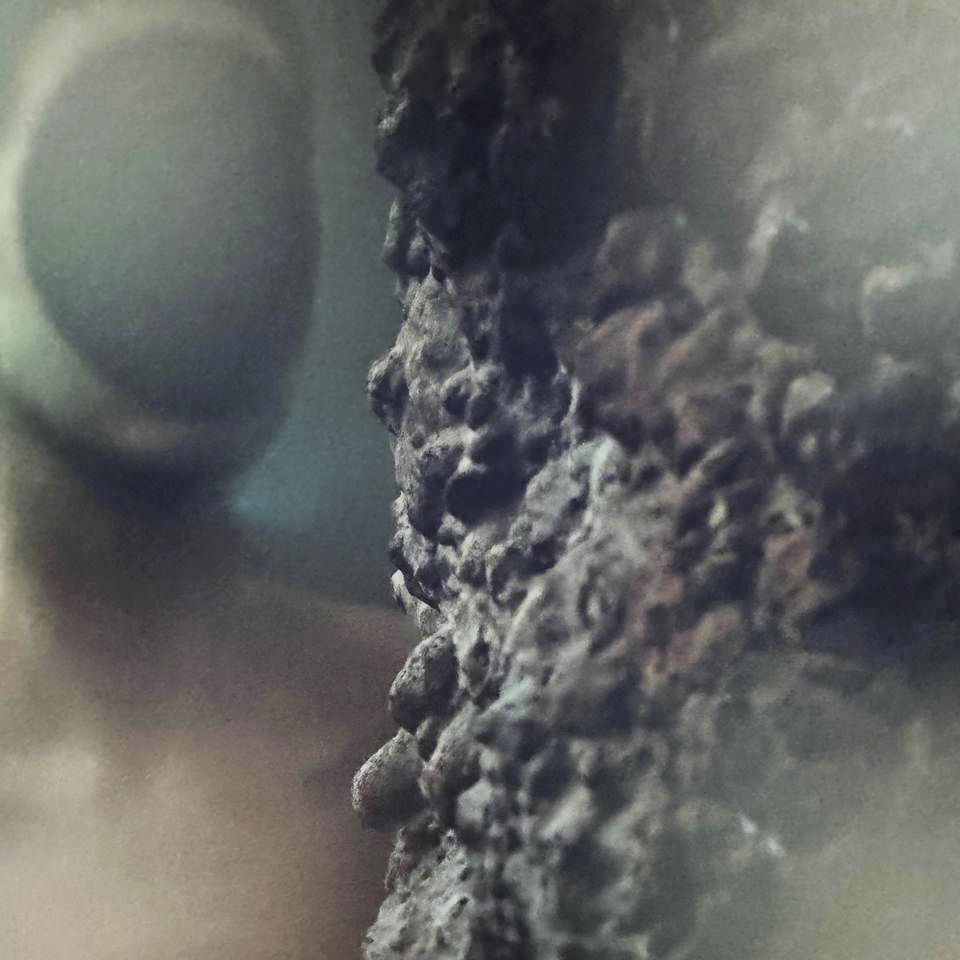
Now, charitably, this might be seen as a literalisation of trying to ‘wrap one’s head’ around something you can’t understand, like the fact that you’ve woken up in someone’s horror vacui model of the cold, indifferent infinities suggested by quantum theory. But even before this point you might have wondered why Huyghe (in the grand tradition of French directors) has chosen a shapely young female avatar and undressed her – the motion-capture-driven footage lingering repeatedly on her breasts and pubic hair – while also dehumanising her into facelessness, and throwing in some blunt penetration imagery for good measure. Admittedly, none of this is remotely arousing: the film’s bleak, mysterious vibe, the woman’s mottled and bruised skin, and the industrial soundtrack make it about as erotic as a sex scene in a film by David Lynch, whose terrorising neo-surrealism is a clear reference point here. It’s also not the first time Huyghe has decided that posthumanism is best evoked through the dehumanised female form, for reasons upon which one might only speculate: for example 2012’s Untilled (Liegender Frauenakt) (Reclining Female Nude), a statue with a live beehive for a head, or the monkey dressed as a waitress in the 2014 film Human Mask. But here it feels particularly icky, not least at a moment when AI is increasingly being used to virtually undress women.
Beyond that, the problem with Liminals is that in conceptual terms it expends itself so quickly. You might guess soon enough that the footage is somehow AI-powered and aleatory: previously presented versions of the work, since 2024, have flagged the figure’s actions as determined by inputs including ambient temperature and the movements of viewers. Here that’s not mentioned. But whatever its inner levers, Liminals evidently uses bleeding-edge technology to visualise something resistant to picturing – per the info, a situation in which ‘infinite possibilities collapse into a single version of reality’, and where the borderlines between people, environments, inanimate matter, agency and turbocharged computing are erased. The result has some of the near-visionary estranging qualities of Huyghe’s best work, which allows it to grip for a while, but it also soon comes to feel like a demonstration piece. After a while, you might wish you were somewhere else – which, per the science, you probably are.
Liminals at LAS Art Foundation at Halle am Berghain, Berlin, through 8 March
From the March 2026 issue of ArtReview – get your copy.