R. Crumb’s solo exhibition at David Zwirner, London places all the predictable crudeness beside his more touching humanisms
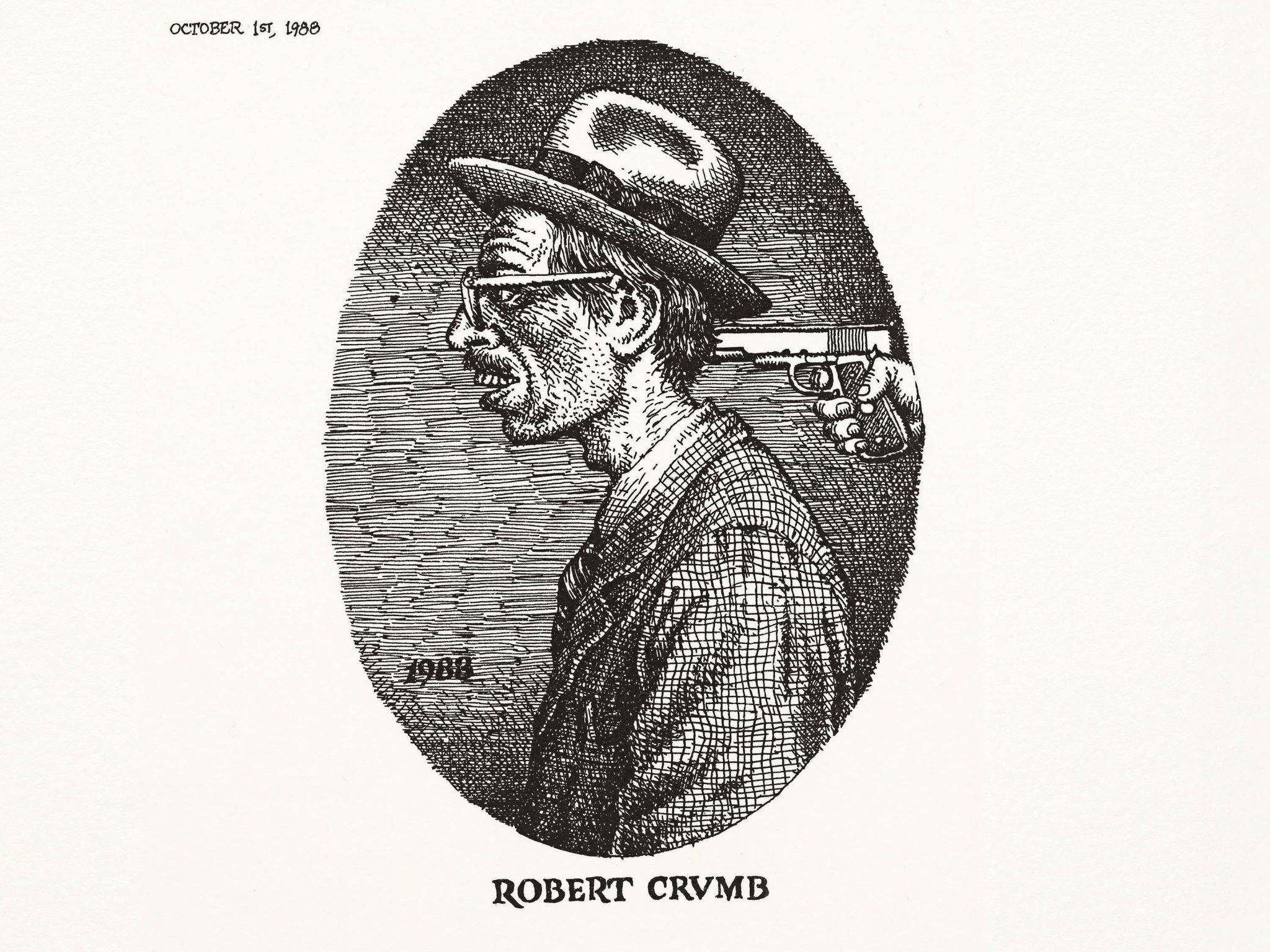
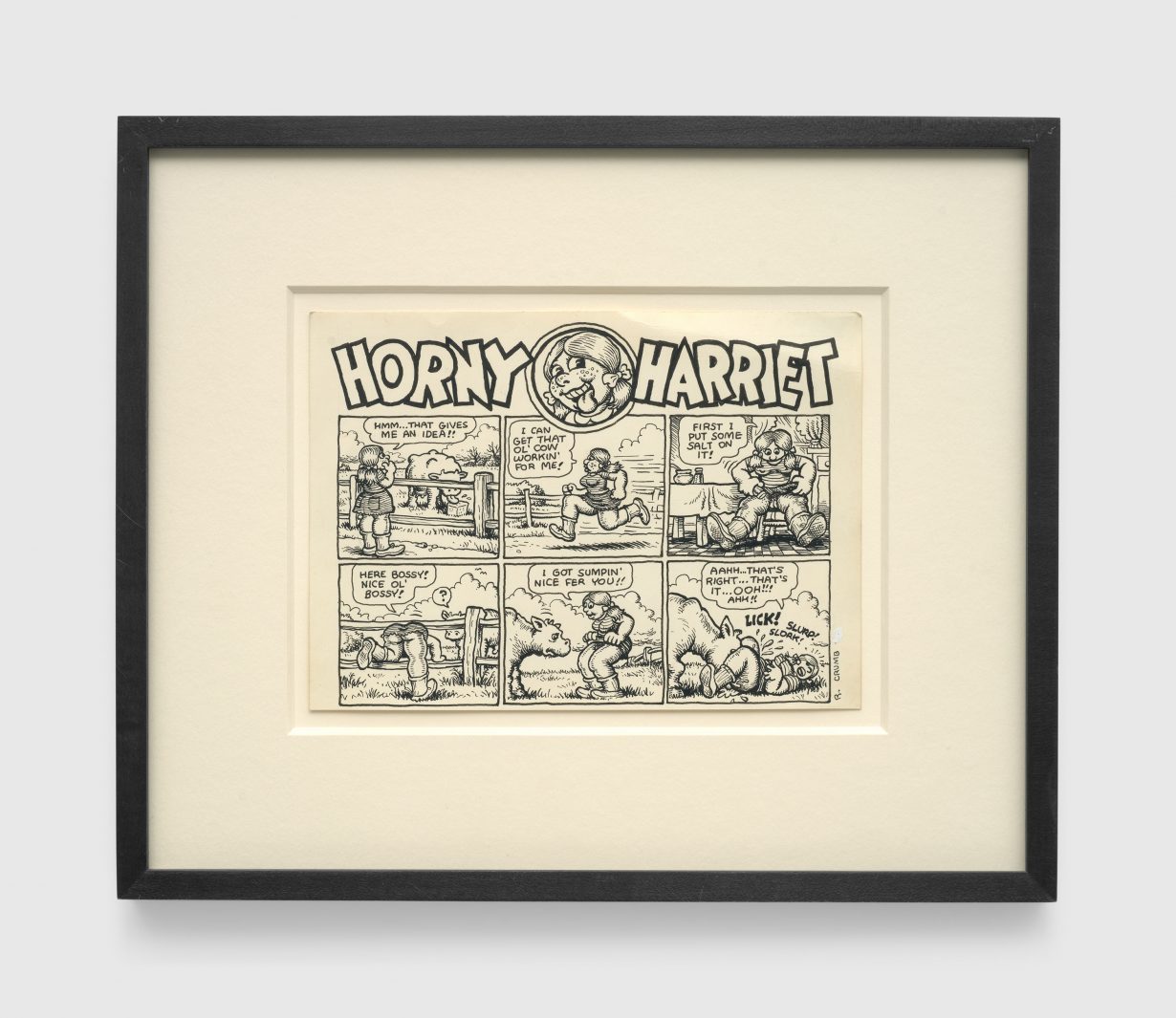
In Untitled (Horny Harriet) (undated), ‘Horny Harriet’ appears as a teen – an optimistic estimate, considering her pigtails – drawn in a thick, bulging outline, which delineates the story of her sexual proposition to, and eventual engagement in cunnilingus with, a bovine. On an adjoining wall to this romp is an ink on paper self-portrait by the octogenarian artist, The R. Crumb Dartboard (1992). It sees the artist as a lecherous, dribbling fiend within target rings. Robert Crumb surrounds his self-portrait with an acerbic but clearly sadomasochistic text suggesting that any female viewer taking offence to him – and his work – should accept this image of him at face value and employ it for easy skewering.
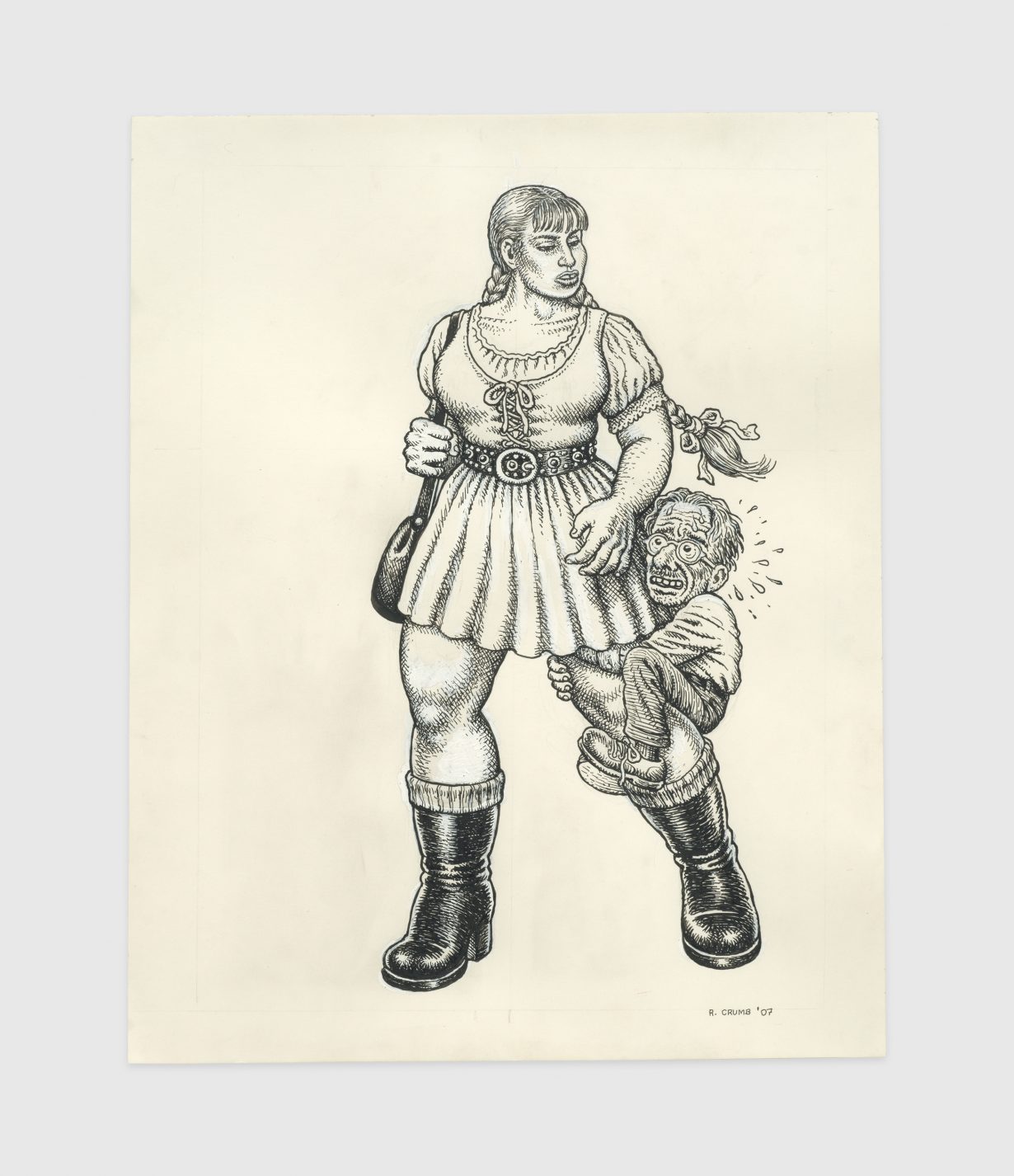
Across two floors, There’s No End to the Nonsense presents work from the outset of Crumb’s career, in the 1960s, to today. It neither apologises for nor exaggerates the more questionable aspects of his still controversial oeuvre, instead placing the crudeness beside Crumb’s more touching humanisms. It is Crumb at face value, foregrounding his caustic irony, antibourgeois sentiment and love of ‘Amazonian’ women without caveats. Stabs at the public’s fondness for a more palatable type of licentious genius are made in Picasso (2025), which sees a Georges Bataille quotation alongside an image of the dwarfish master tugging at (Picasso’s lover) Marie-Thérèse’s towering figure, as she coos: ‘First he rapes the woman, then he does the painting… teehee giggle…’; in Crumb Family Covid Exposé (2021), a narrative interjection by Crumb, mid-sexual romp with his wife, winds up post-MeToo concerns: ‘To you “wokies” – is this too “rapey”?’
A selection of Crumb’s early work made at the height of Haight-Ashbury’s 1960s comic scene is shown alongside sketches ranging from 1970 to 2025, and the only work not on paper, Untitled (1974), a painted plywood cutout in the shape of Crumb’s infamous Mr. Snoid – a strutting, short-statured sex pest. Other career-defining characters, such as the bearded Mr. Natural, also appear, albeit nostril-deep in orifices.
Unlike illustrators whose mutual interest in grotesque exaggeration – the now-fashionable homoerotics of Tom of Finland, or the unselfconscious BDSM of Eric Stanton – Crumb is often grouped with, his view is broader, continuously reaching into political commentary. In Conspiracy Theories! (2025) and Deep State Woman (2024, not shown here), his style is that of an anti-Norman Rockwell, an American vernacular grounded in personal paranoia, continuing to utilise the underground ‘comix’ medium to distribute countercultural nostrums. However, the show’s opener, I Don’t Know What I’m Doing (2025), makes it clear that comparisons with great social satirists like Daumier or Hogarth must end at a certain point: the work sees a typical stereotype of the Capitalist, monocle and top hat, being towed by a lowly ‘Crumb’ iteration. An endnote states: ‘This is not a political cartoon… It is a representation of my personal inner conflict.’
© the artist. Courtesy the artist, Paul Morris, and David Zwirner
Evidently, Crumb’s politics stem from his deep-seated rejection of authority, whether it be at state-level or cultural – a remnant of a then-hopeful but now largely forgotten 60s counterculture. Crumb’s persistent, if reflexive, narcissism poses questions for younger generations: his images of women are oft uncomfortable, out of touch and irreverent – but misogyny isn’t the best label. It’s obvious he has a kink for built women – based on a childhood obsession with Sheena, Queen of the Jungle. But from a woman’s perspective, Crumb’s most endearing quality is the self-acknowledgement of his base perversion – a preferred outlook to a contemporary culture offering surgical services to standardise the female form. To put it lightly, he’s a proud simp for a highly specific musculature. Crumb’s unbridled id is the irreverent motor behind his work, sitting firmly between each densely hatched line. And that criticism is, evidently, another fire under his bony rump.
There’s No End to the Nonsense is on view at David Zwirner, London, through 14 March
Read next The Distended Forms of Grotesque Satire