“I love dreams. They are escape rooms for the psyche”
ArtReview sent a questionnaire to artists and curators exhibiting in and curating the various national pavilions of the 2026 Venice Biennale, the responses to which will be published daily in the leadup to and during the Venice Biennale, which runs from 9 May through 22 November.
Andreas Angelidakis is representing Greece; the pavilion is in the Giardini.
Celebrating Visions. Versace partners with ArtReview to share stories from the 2026 Venice Biennale.
ArtReview Tell ArtReview what you plan to exhibit in Venice. What has influenced or inspired you?
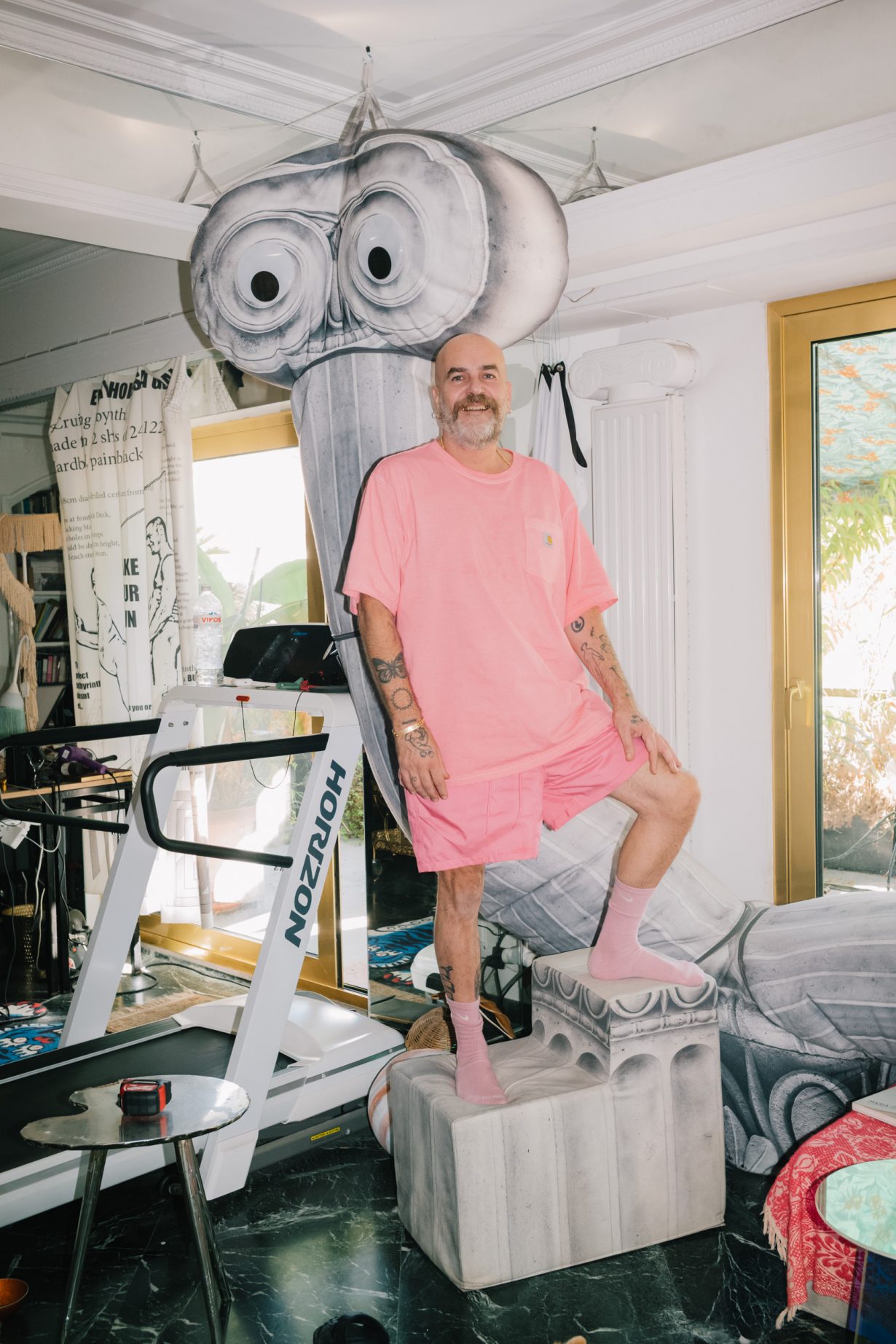
Andreas Angelidakis I’m splitting the pavilion in two, in reference to the National Schism (Εθνικος Διχασμος), what you might call Greece’s childhood drama. The split was literal: Greece was two countries for two years, some might argue the split never healed.
Grecia the Pavilion knows that history works in weird loops, knows what it was like to be inaugurated during the Fascist Friendly 1930s, familiar with the world turning MAGA.
The inspiration behind the pavilion has been the building herself, and her two identities; National and Pavilion, political history meets exhibition history, and I split those too, but exhibition might not be the right word: we are preparing a full on experience. Think the closing scene from All That Jazz (1979) but with a political subscript, MAGA meets Situationist Sissy while Grecia plays Jessica Lang.
AR In what ways (if at all) does your work relate to the theme of the Biennale exhibition, In Minor Keys?
AA I love the James Baldwin quote about how ‘some people wish to colonize the moon, and others dance before it as an ancient friend’ [No Name in the Street, 1972], but the dancing I imagine is a Tea Dance at The Pavilion on Fire Island during the AIDS crisis. Guernica on the dancefloor.
Minor keys can play a bombastic beat, like Frankie Goes to Hollywood’s 1983 ‘Relax’, a Hedonistic Survival Rhythm while gay men’s bodies were still being handled by hazmat suits. At the same time ‘Relax’ became king of the Greek summer disco, generating endless tourist T-shirts, while missing the point entirely. Their album Welcome to the Pleasuredome’s 1984 album cover artwork riffed on Guernica (1937) with the band sexy and shirtless and dancing with the ancient moon. ‘Relax’ is this pavilion’s soundtrack with a few surprises thrown in.
Grecia’s two citizens are my ‘Minor Keys’, the National and the Pavilion played by the two columns on Grecia’s Neo-Byzantine front porch. I took both citizens on a deep dive in the chasm between history and story, and the findings form the content of the show, titled Escape Room. Everything inside the pavilion is a question.
It started in 1934 when Mussolini invited Hitler to the nineteenth Venice Biennale, their first ever IRL meeting and the year when their Fascist Easter Egg first hatched. There, Grecia was a debutante dressed up and ready to join the just formed AXIS, but she got second place to Austria.
AR Why is the Venice Biennale still important, if at all?
AA I’ve been going since 1997 and I was definitely over it after COVID, but I fell in love again because of Cecilia Alemani’s Milk of Dreams (2022). I love dreams. They are escape rooms for the psyche. The Venice Biennale, even though it began life as pure foreign policy in the end of the 1800s, is now the best public announcement speaker system for artists, and now is definitely a time when we need to reconsider the concept of ‘the national’.
AR What role does a national pavilion play at a time of increasing confrontational nationalisms? Is it about expressing difference or commonality?
AA A national pavilion is a mirror, made by the artist, that reflects but also distorts. The Greek Pavilion was built to evoke Byzantium; the two front columns are simplified reproductions of pillars inside the Hagia Sophia in Istanbul, which the Greek right-wing has always promised to ‘make Greek again’. The 1922 Lausanne Convention had erased that dream/nightmare, yet in 1934 the government promised Greeks the ‘glory of Byzantium’ in exchange for votes, and left their Giardini pavilion as a souvenir.
It survived intact all through the civil war in Grecia that followed WWII. That was the moment Greece was split into two countries, and in many say she still split, State vs Citizen.
AR Who, for you, is the most important artist (in any discipline) that your country has produced?
AA My country has not produced any artist, but the land is so fertile we sprout everywhere, like weeds. If I had to pick one, it would be Paola Revenioti for her work in activism, publishing, documentary and photography. She is one of the two reasons I ever tried curating: I wanted to show Paola to the world. The other was to play with the Dakis Joannou collection.
AR What is something you want people to know about your nation that they might not know already?
AA In Greek, ‘story’ and ‘history’ are the same word: ιστορία.
AR Given that you are exhibiting in a national pavilion, is there something (a quality or an issue or attitude) that distinguishes the art of that nation from that of others? That makes it particular? Are there specific contexts that it responds to? Or do you think that art is a universal language that goes beyond social, political or geographic boundaries?
AA The idea of the national is exactly what the Pavilion investigates, everything that is part of Escape Room has at least two ‘nationalities’, because modern Greece has always been about being split in two. Escape Room is split in two, but each contains infinite readings – one part physical, the other cognitive. At once a national stage and a ‘periptero’ (‘pavilion’ in Greek), one mechanism skips the present over and over, the other builds a story of fragments.
AR What, other than art, are you looking forward to seeing – or doing – while you are in Venice?
AA I have tons of amazing friends in Italy, it’s my other work-home. In recent years I have done projects like BrixiaDue (2024) in Brescia, VR Man (2024) in Torino, POST-RUIN Bentivoglio (2022) in Bologna, and it’s a body of work that lead to this pavilion, so it’s like coming home.
AR Could you give us a brief overview of your average working day while creating your presentation in Venice?
AA The day starts with a call or text to George Bekirakis, curator of Escape Room but also the person who is making everything happen. George has amassed a fantastic army of private supporters, and for the third Venice Biennale in a row The Onassis Foundation is the strongest shield, as if the National Pavilion was a family.
After making a plan for the day with George, I alternate between TikTok and my Kindle: Hasan Piker and TsMadison on contemporary American politics; Susan Buck-Morss on the synonymity between Stasis and Polemos, and Byung-Chul Han on the importance of children’s literature in the midst of our fake news Blitzkrieg.
AR Can art really change the world?
AA Art is the signal of change already in motion.
The 61st Venice Biennale runs 9 May through 22 November 2026