Julio Le Parc, whose work was defied by his embrace of kineticism and Op Art, has died.
The Argentine artist turned to abstraction while living in Paris in 1958, creating his Surfaces series, paintings that sought to replicable grids of symbols while eliminating any trace of the human hand. These ranged morse code to polygons, dots and blocks of seemingly coded colour. ‘The systems I used most frequently were based on progressions that developed from left to right, from top to bottom, and from bottom to top. Thus, each form was closely linked to all the others. Their relationships depended on a pre-established system’, Le Parc wrote.
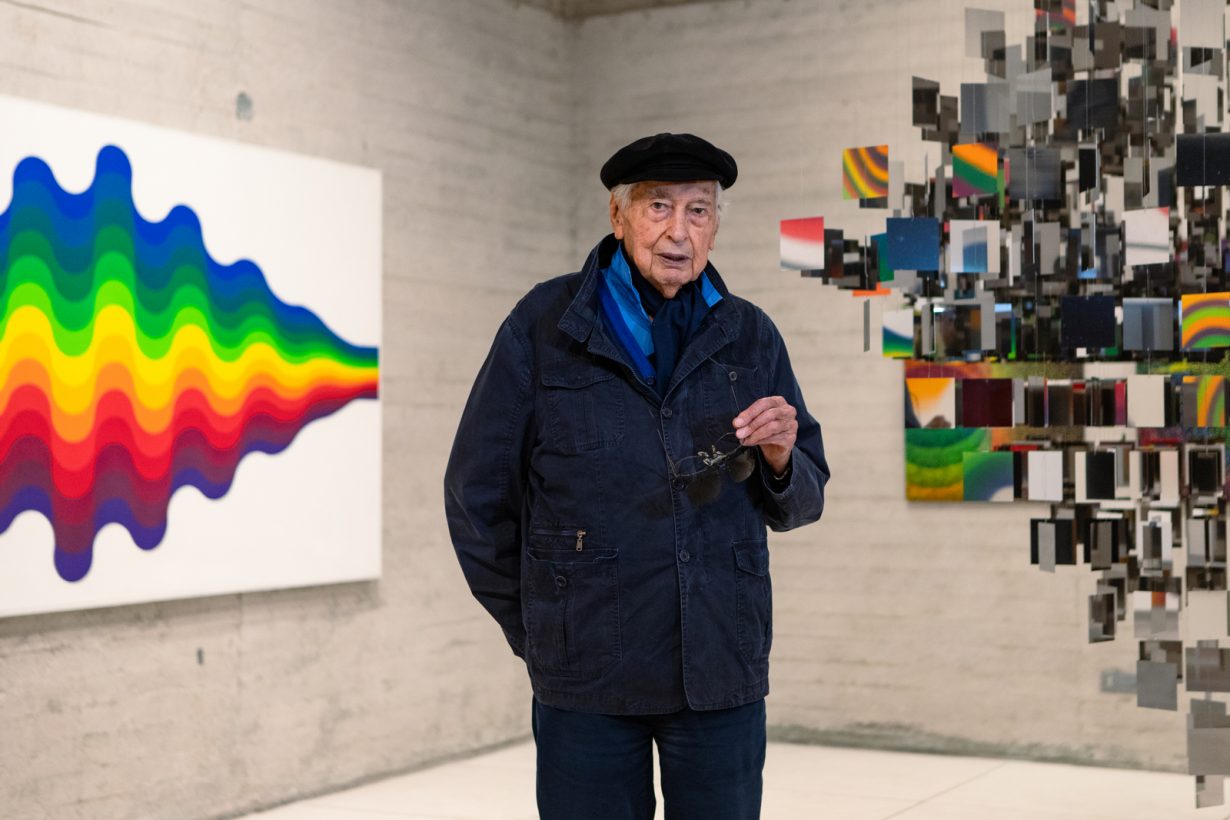
By the following decade he had transferred this machinic way of working into sculpture, adopting Plexiglas, a material he would turn to throughout his career. Mobil Transparent Theme featured a curtain of small pieces of connected Plexiglas which flowed from the gallery ceiling. In 1968, Le Parc introduced light to his work: Celule Avec Luminere un Vibration featured a projector filling a room with vibrating patterns across the walls. From thereon, Le Parc began producing works based on distorted mirrors, the spectator disorientated by means of labyrinths and play rooms.
‘Through my experiments, I have sought to provoke a change of behaviour in the spectator… in order to find, together with the public, ways to combat passivity, dependence, or ideological conditioning, by developing the capacities for reflection, comparison, analysis, creation, and action’, he explained of his work political impetus.
Le Parc left full time schooling aged 13 and, after four years taking evening art classes in Buenos Aires, he travelled around Argentina for eight years, cut off from his family, hanging out with Marxists and anarchists. Eventually, having gained a grant, he made his way to Paris, where he was a founding member of the activist Groupe de Recherche d’Art Visuel (GRAV), the acronym a play on the French word for ‘serious’. Organising happenings and political meetings, Le Parc was briefly expelled from France following the social unrest of 1968. By then however he had already shown at the Bienal de Sáo Paulo in 1957 and in 1966 he has received the International Grand Prize for Painting at the Venice Biennale.
‘If my works bring joy to people, then I’ve succeeded: these little things can help change a state of mind,’ he told Le Monde. ‘I will always remember the energy that Charlie Chaplin’s films gave us poor kids. It is this energy that mobilises all hope, because it allows us to discover things within ourselves.’
Recent solo exhibitions include the Serpentine Galleries in 2025, the Daros Foundation, Buenos Aires in 2014 and the Palais de Tokyo in Paris in 2013, the latter breaking visitor number records. A retrospective at Tate Modern opens this month.