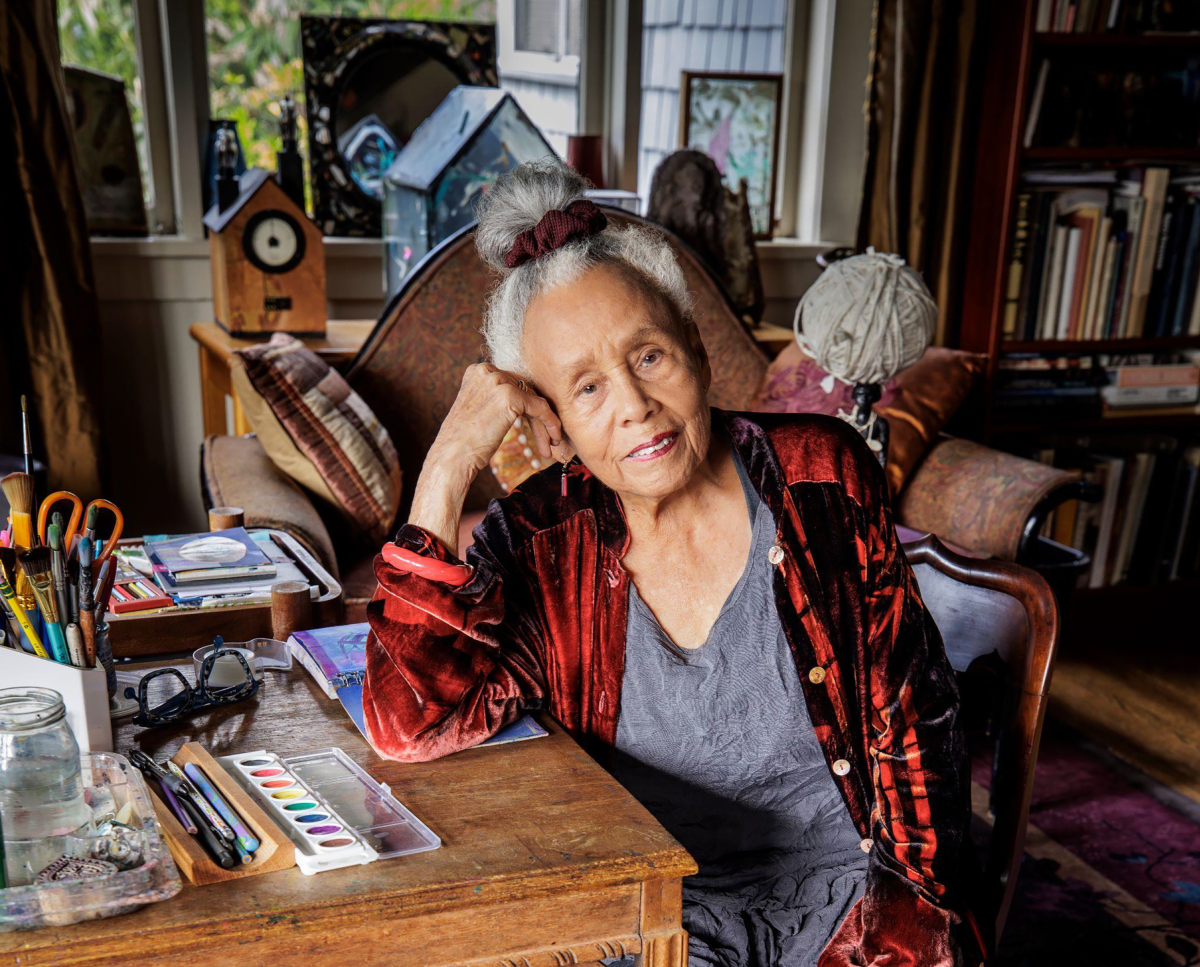
Betye Saar, whose assemblages confronted racist depictions of Black women, has died aged 99.
Born in Los Angeles in 1926, Saar first studied design at UCLA. After obtaining her BA, she worked as a social worker before returning to graduate studies where she discovered printmaking, the medium that dominates her early works. However, it’s for her assemblages that the artist became best known. Inspired by a 1967 exhibition of assemblage artist Joseph Cornell at the Pasadena Art Museum, Saar began collecting materials to create her own work: ‘I’m a recycler, or a hoarder, or a magpie’ she later said. ‘Certain things just catch my eye for whatever reason and I think, “I can make that into art.”’
Following Martin Luther King Jr’s assassination in 1968, her work took a more political turn. As a young mother of three, she couldn’t attend marches and used art as a form of protest instead. Her work was shown, along with that of other then-emerging and politically engaged Black artists like David Hammons and Senga Nengudi, at the short-lived Gallery 32 in Los Angeles. In 1972, she created The Liberation of Aunt Jemima. The assemblage reclaims a figurine of Aunt Jemima – the logo of an American food company rooted in racist stereotypes – by giving her a rifle and transforming her into a symbol of resistance. In 2007, the political activist Angela Davis said that the work had sparked the Black women’s movement.
From the seventies, Saar started gaining more widespread recognition for her work. First with a solo show at the Whitney in New York in 1975, from which followed exhibitions internationally. In the seventies and eighties, Saar also taught in universities in California, influencing a new generation of artists, including the painter Kerry James Marshall. Throughout her seven-decade career, she continued to create assemblages and installations, intuitively incorporating objects and references acquired locally, through her travels, and from family memorabilia.