Natasha Lennard’s ‘On Un/Certainty’ wonders what to make of the very notion of certainty, and whether the best course of action is refusal
Today we are frequently told, as the British-born, New York-based academic Natasha Lennard reminds us in On Un/Certainty, that ‘we live in uncertain times’ – and of course, across multiple related metrics, from developments in AI to climate change to geopolitics, we do. But this invocation of uncertainty, along with talk of crisis and polycrisis, serves the needs of power in that it suggests a reality founded on doubt, a reality that is, per the documentarian Adam Curtis, too complex to process. Meanwhile, myriad bad actors and flat-out neofascists are acting in absolute ideological certainty. US cops shoot Black civilians in the certainty that they can walk free after claiming self-defence. ICE officers and politicians enact the certainty that open borders and migration are bad things, empowered in turn by both racism and the certainty that immigrants are, Lennard writes, ‘a reliable scapegoat for working-class economic pain’. Politicians declared, against the uncertainties of COVID, that the pandemic was over, endorsing the certainty that capitalism-as-usual is more important than human life. Anti-trans activists are certain that trans women are not women. Trump’s cuts to science funding are ‘acts of certainty against knowledge’ – which, in turn, will produce uncertainty themselves, for instance, when the next pandemic hits.
Lennard explores all these dualities lucidly, readably and in detail, but to get there she begins with the weaponisation of the very notion of crisis. Crisis, when invoked, is generally authorless and so blameless, so (for example) the genocide in Gaza is framed by news outlets as a ‘humanitarian crisis’, rather than the result of extremely deliberate actions by Israel. AI, meanwhile, has authors (the techbroligarch class) but is framed by them as something like manifest destiny, inevitable, eschatological; the ‘myth of our inevitable replacement’ more important than the waste of natural resources, since what’s at stake is ‘the very survival of humanity’, if not human beings (capitalism would, if it could, do away with human labour, Lennard notes: robots, besides being cheaper, won’t unionise or protest).
All of this is framed within philosophical arguments from Ludwig Wittgenstein’s posthumous 1969 book On Certainty, which explores the extent to which we can be certain: how we can say we know what we know, which turns out to be fairly relativistic, a middle way between knowing and not-knowing. (You can’t ask if there’s wine left in the bottle, Lennard writes by example, if you doubt there’s a bottle.) Beyond philosophicopolitical investigations, though, where do we go? At the outset, Lennard says that what matters, in terms of resistance, is our ‘acts’, a simple enough notion she returns to at the book’s conclusion, allying it to the existential question of how ‘antifascist, liberatory practices’ can be sustained without their proponents falling into exhaustion or apathy. Lennard’s answers are straightforward, fillable, non-revelatory frameworks: general strikes that consist of ‘community care, militant disruption, working-class refusal’; remembering previous times when ‘[w]e have cared for each other, refused complicity, refused to work, worked, taken risks, taught, shared, marched, blockaded, found each other and acted in great numbers’.
This being an art magazine, it’s worth considering how the thematic applies to art. Since modernity, arguably since Cézanne and unquestionably since Duchamp, art has founded itself on bedrock uncertainty, to the point where it has sometimes become a schtick of dense codifications, obscure references, deliberate incoherence. The past decade, though, saw artists pursuing social justice lose patience with uncertainty and want to make statements instead. Of late, in apparent reaction to that, it seems like ambiguity and obscurity are staging a comeback. Yet if uncertainty, as seen through Lennard’s lens, has been coopted by power, what kind of doubt is appropriate to art today? For all its other virtues, this slim volume is as good a place as any to begin asking that question.
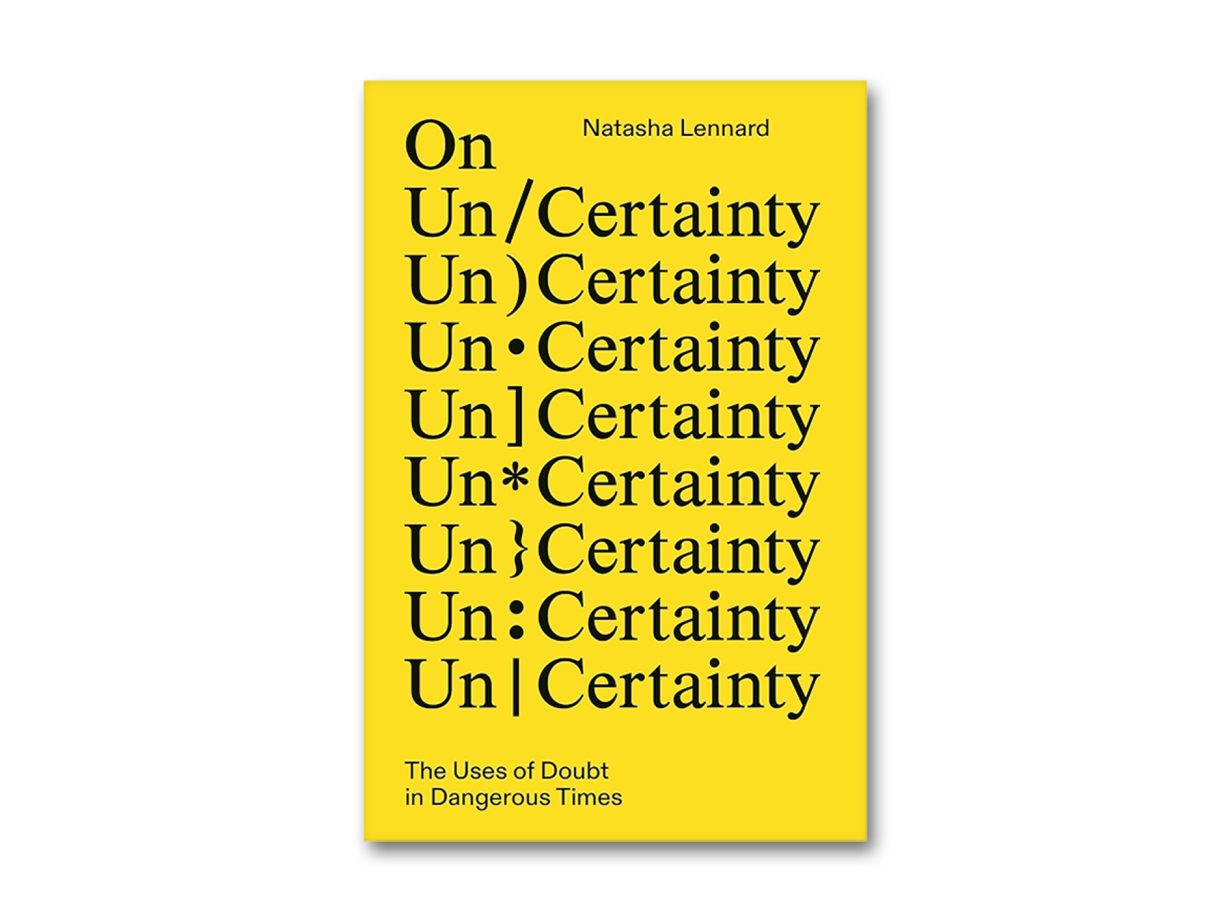
On Un/Certainty: The Uses of Doubt in Dangerous Times by Natasha Lennard. Verso, £16.99 (hardcover)
From the October 2026 issue of ArtReview – get your copy.


