This exhibition asserts that the village can be both cosy and domestic as well as a politically contested ground
Rooted in a respect for humble, organic materials, Malaysian artist Cheng Yen Pheng’s latest exhibition meditates on the relationship between people and the land. Her home of Batu Arang, Selangor, which was once the centre of Malaysia’s coal-mining industry, is the source of most of the materials used in her installations – clay, ash and plant fibres. With them, she creates moving tableaux exploring personal themes of family life, intertwined with critiques of the present-day land disputes dogging the territory.
For Cheng, the kampung, or village, is both a cosy domestic setting and a politically contested ground. Upon entering the exhibition, one encounters works exploring peaceful home life. Salt of the Land (2020-25) features a hanging quilt of mulberry and banana-stem papers that flows neatly onto a white platform, ending in an arrangement of gold-leaf spoons and stitched on Chinese characters spelling out 柴 ‘firewood’, 米 ‘rice’, 油 ‘oil’, 酱 ‘soy’, 盐 ‘salt’, 醋 ‘vinegar’, 茶 ‘tea’ – the seven household ‘necessities’ as set out in Chinese culture dating back to the Song dynasty. To the left lies The corners were wet (2023–25), a fibrous shirt floating midair on a hanger, with a pair of matching trousers draped over a wooden chair. On the floor are two additional wooden platforms holding coiled, multitoned shallow discs woven from mulberry bark (both Untitled, 2023–25). Overall, the scene is one of a home in a state of suspended animation: the hanging laundry, the woven plates, the household essentials left splayed out. But another work in the corner of the room moves from the domestic to the explicitly political. Feathers on the floor, but we stand firm and tall (2023–25) comprises handmade bricks on the ground, arranged into low tiers and shallow platforms that accumulate towards two black walls. On the walls are dozens of paper figures depicting families and children, many of them holding blank placards above their heads. The figures crowd up in the centre on an upside-down cardboard placard, propped precariously on a pile of bricks, the top brick of which is stamped with the words ‘BATU ARANG’. The work references a controversial proposal to build a waste-to-energy incinerator in Batu Arang, and local protests against it (for which Cheng has become a spokesperson), based in part on the possibility that the incinerator could ignite gas pockets over the old coal mines, setting off a subterranean fire that could burn for decades. The use of ‘natural’ materials in Cheng’s art is part of this everyday labour of maintenance; her works are grounded in local specificity: the protesters are her neighbours, the soil is from her garden, the paper is from a tree in the village. The resulting aesthetic – the exhibition’s pervasive tan palette – is a reflection of the infrastructures of sustenance from which it draws.
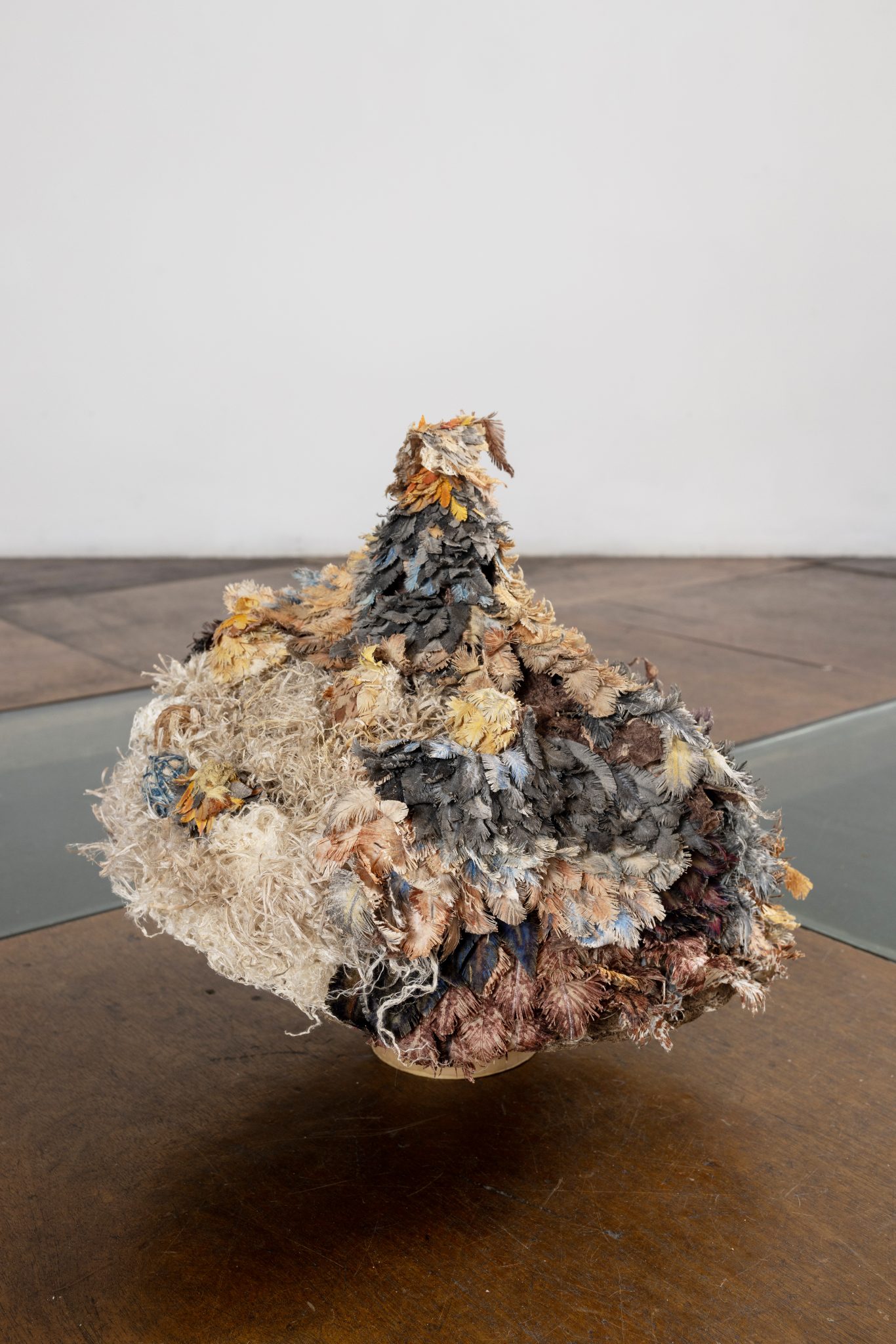
One such infrastructure is the chicken, which the artist has conjured in rough figures made from straw and other natural fibres. Feather mother, feather home (2023–25), a figure of a mother hen, reminds me of the childhood game of hen and wolf, in which the mother hen protects her young from pursuit. In One Ringgit Chicken (2023), her interpretation of the Malaysian one-ringgit banknote using self-made paper, a chicken form bursts from the place usually reserved for a portrait of Malaysia’s king. One Ringgit Chicken is a stand-in for something affordable, much like a Costco hotdog, and in this piece, it is precisely the chicken’s affordability – its essentialness to life – that makes it sovereign in Cheng’s political economy of sustenance. Yet, while these works gesture towards national symbolism, the exhibition’s potency lies in its material specificity. In its insistence, in others of the works on show, that the local is already political.
Cheng Yen Pheng: Salt of the Land was at Wei-Ling Gallery, Kuala Lumpur.
From the January & February 2026 issue of ArtReview – get your copy.