The artist’s gaudy figures – a doe-eyed Betty Boop here; a labial Buddha there – at A. Squire, London, are both knowing and dumb
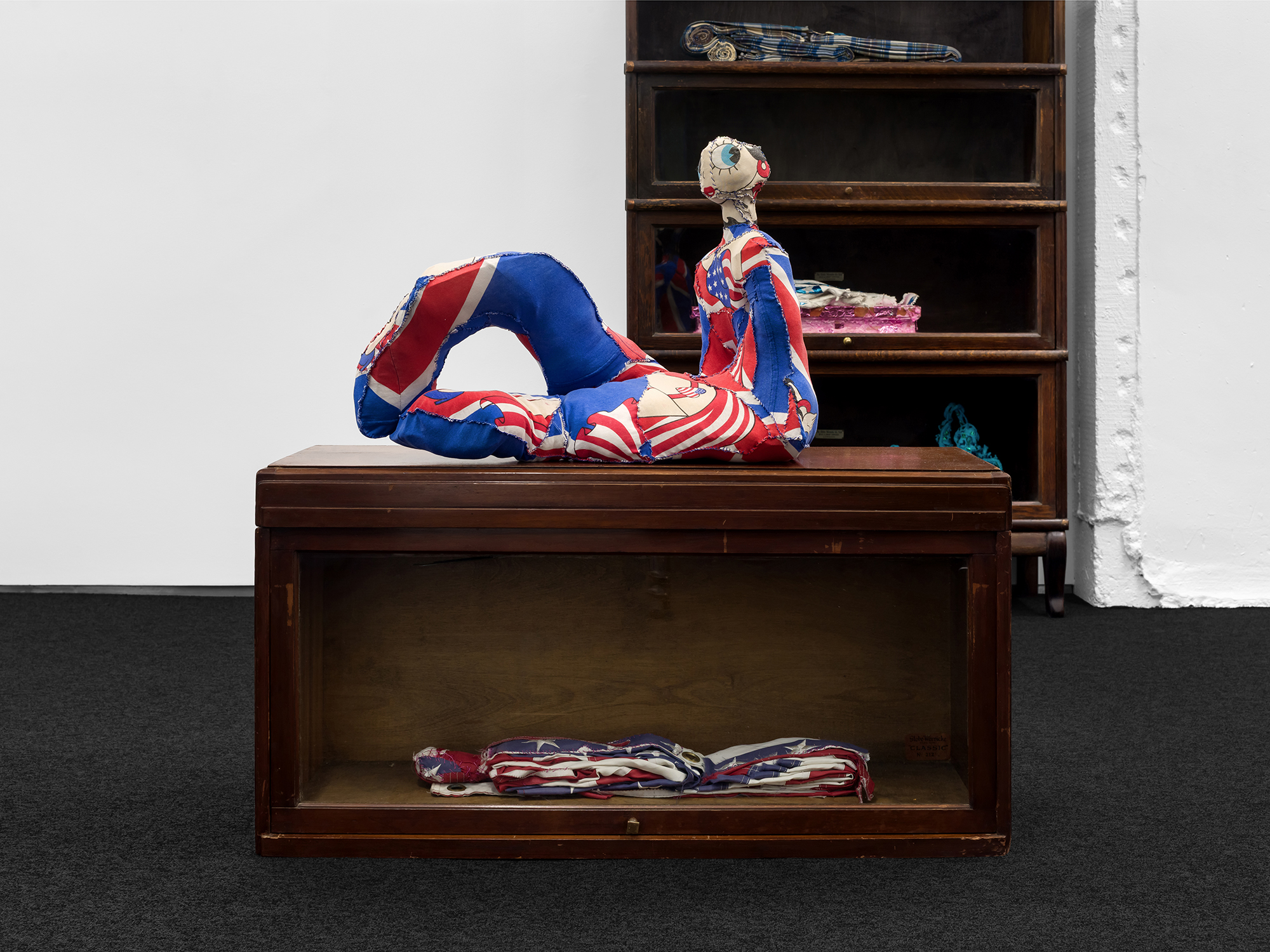
Under the cold luminescence of A. Squire’s fluorescent lighting, the straight, dark, wood lines of Globe-Wernicke ‘barrister’ cabinets, typical of the late Victorian period, contrast with sensual, haphazard figures, positioned atop and within these glass-fronted bookshelves: soft cuts through hard. Reclining within the shelves are sculptures representing parinirvana – iconographic depictions of the death of Buddha. Seemingly made from whatever materials were to hand, these are abbreviated renditions, as though the details were remembered from a dream. American artist Elizabeth Englander incorporates objects and materials in various configurations across the 13 figures, including her mother’s kilt, an old T-shirt, plaster-soaked jute, paint and scraps of Mylar balloon in a tacky imitation of the gold leaf traditionally applied to Buddhist statues. Each work carries its own mood, yet repetition is apparent, as though the artist were attempting to arrive at a perfect final form.
These are gaudy objects, depicting death, sleep and the erotic impulse, reminiscent of confectionary wrapping: electric blue, purple, violent fuchsia, gold fabric shot through with glitter. Freedom exists in the materials and, with the languorous repose, a lightness, which the clerical bookcases aim to discipline. At the centre of the space is Parinirvana (UNESCO Betty) (all works 2025). It is biomorphic and uncannily familiar. It’s Betty Boop; it’s a Henry Moore rendition; it belongs to a lineage of soft sculpture by women artists; it’s a Union Jack; it’s the Stars and Stripes. Like all the work here, it defies simple identification, or even identity. Betty’s doe eyes bulge, their enormity accentuated as the fabric stretches to its limit over the wire armature beneath. This Betty, like many of Englander’s figures, exists somewhere between grotesquery and amiability, grace and lumpishness. They are both knowing and dumb.
The designers of Alessi once described their cartoon-cute utensils as ‘anonymous presences’, a phrase that clings to Englander’s sculptures. So close are they to ‘something else’ that they approach anonymity. In Buddhist tradition, parinirvana signals the end of the reincarnation cycle, liberation from rebirth, and therefore from identity itself. Unlike the Buddha, though, these are no benign teachers. Facial features are absent; they keep their secrets. Only Betty has a face, but her expression is strained to the point of strangulation.
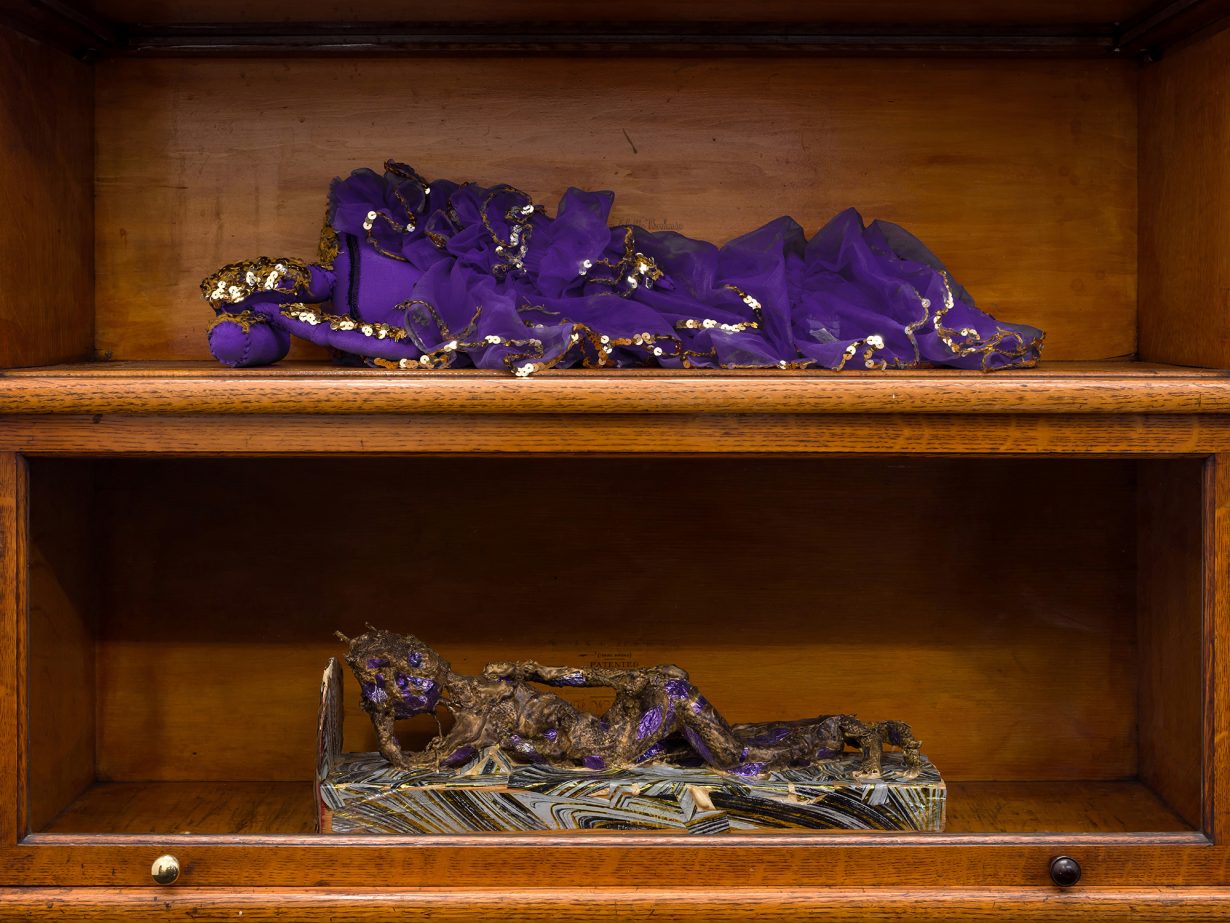
Englander’s work embraces humour and contradiction. The parenthesised naming of each sculpture after Parinirvana attests to this: (pussyhat); (Barbieland). When the sculptures are gendered by their titles, they are female, and where fabric is used (as in Parinirvana [Sugar Plum Fairy 2]), it suggests labial folds toppling the masculine structure of the Buddha; transcendence collapses into bodily pleasure. The gesture recalls a nineteenth-century Japanese shunga portrayal of parinirvana, held within the British Museum’s collection, in which the Buddha is depicted as a gold-coloured phallus with arms and legs. Here, too, sanctity and sex are inseparable.
What is the purpose of aestheticising Buddhist iconography in this way? The cabinets suggest a counterfeit reality in which anything can be taken and repurposed. The short walk from A. Squire to the mahogany-panelled authority of the British Museum seems wryly hinted towards. Englander’s shelves echo those institutional displays in which spiritual objects are stripped of function and recoded as style or spectacle, which brings into relief the self-erasure at the centre of Buddhist teachings and the parinirvana sculptures. Englander’s reference in her exhibition text to Virginia Woolf’s Orlando (1928) suggests a trial of elastic selfhood: both the search for a self and the desire to dissolve it. The Elizabethan Lumber Room becomes an archive of selves to be shed, until enlightenment arrives, or until nothing is left to discard.
The Elizabethan Lumber Room at A. Squire, London, through 7 March
From the March 2026 issue of ArtReview – get your copy.