Golnar Adili’s work at Smack Mellon, New York, embodies the desire to account for loss through art
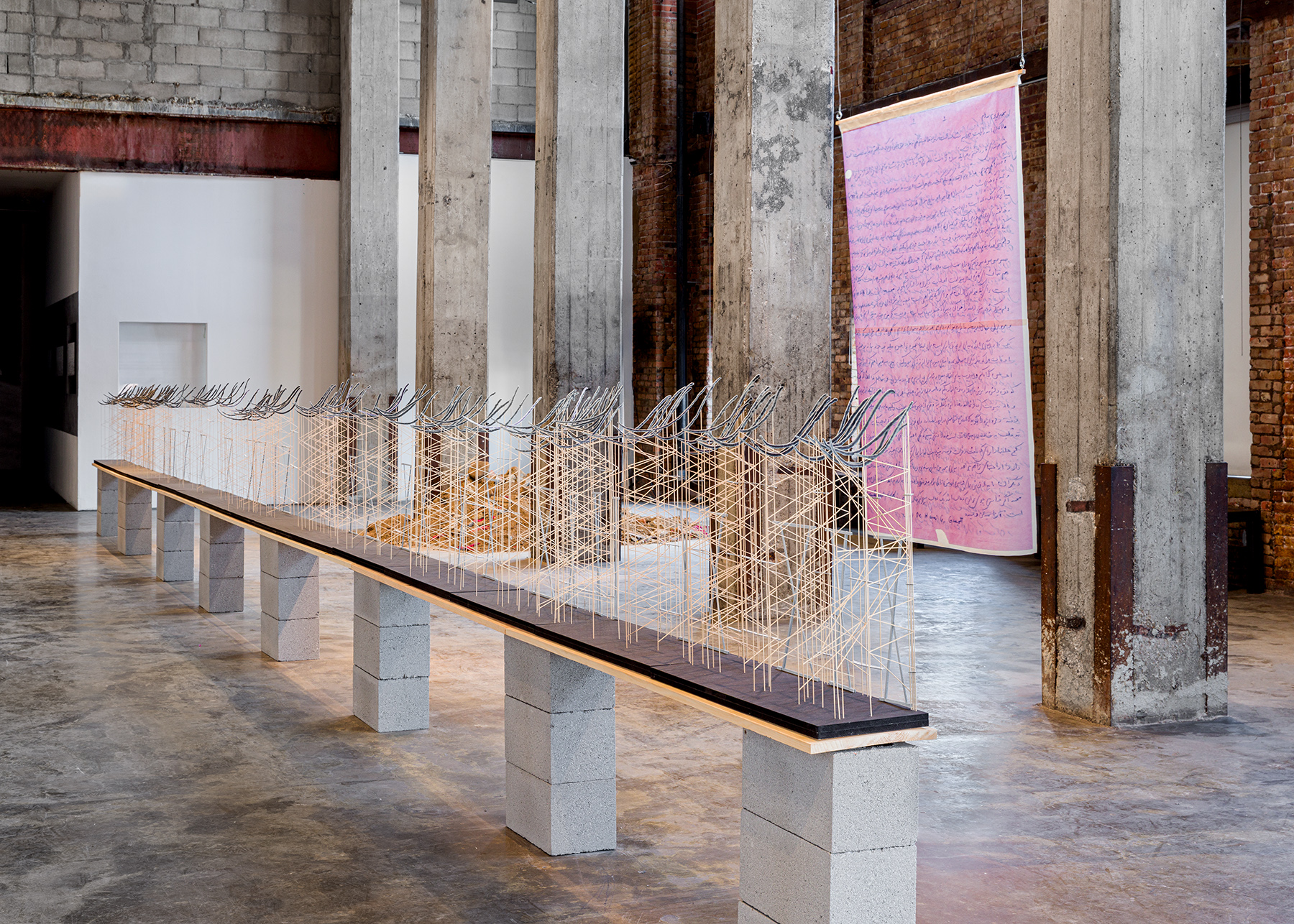
‘If only one could measure the emotions of others,’ reads a letter sent from Golnar Adili’s mother in Iran to Adili’s father in the US. He was living there in exile as a result of the couple’s leftist activism in the years after the 1979 Iranian Revolution. An enlarged reproduction of the letter, printed on pink Japanese paper, hangs towards Smack Mellon’s entrance like a state document in a history museum. In the main gallery, a 15-metre sculpture, Ye Harvest From the Eleven-Page Letter–Installation (2016), attempts something like the accounting Adili’s mother pined for. Attached to a dowel scaffold that resembles a model roller-coaster support, the artist has reproduced in archival cardboard every Persian ye character, which has the shape of a swooping check mark, from a long letter her father sent – not to her mother but to his US lover. As if by repeating the Persian alphabet’s terminal letter she might close this unsettling chapter of her family history.
This delicate row of repeating characters forms the exhibition’s figurative spine, an embodiment of the futile desire to account for loss through art. Ye Harvest… gives architectural form to text culled from the artist’s extensive, ongoing archive of family letters dating back to 1981, creating a kind of concrete poetry that renders script as sculptural gesture. Other text works in the show incorporate similar poetic techniques: the rumpled transfer print on Japanese paper, When All the Tears Filter Through the Forest of Alef and Collect in My Ocean of Ye (2016), for example, reproduces all the vertical alef characters (the first letter of the Persian alphabet) from the same love letter, the accumulation of which resembles a prisoner’s tally marks. Eleven-Page Letter Redaction (2016) emphasises disappearance, superimposing a sheet of paper, with apertures cut out, over a copy of the letter, to reveal glimpses of Persian words that use the ye character, with English translations of those words handwritten on the cover sheet.
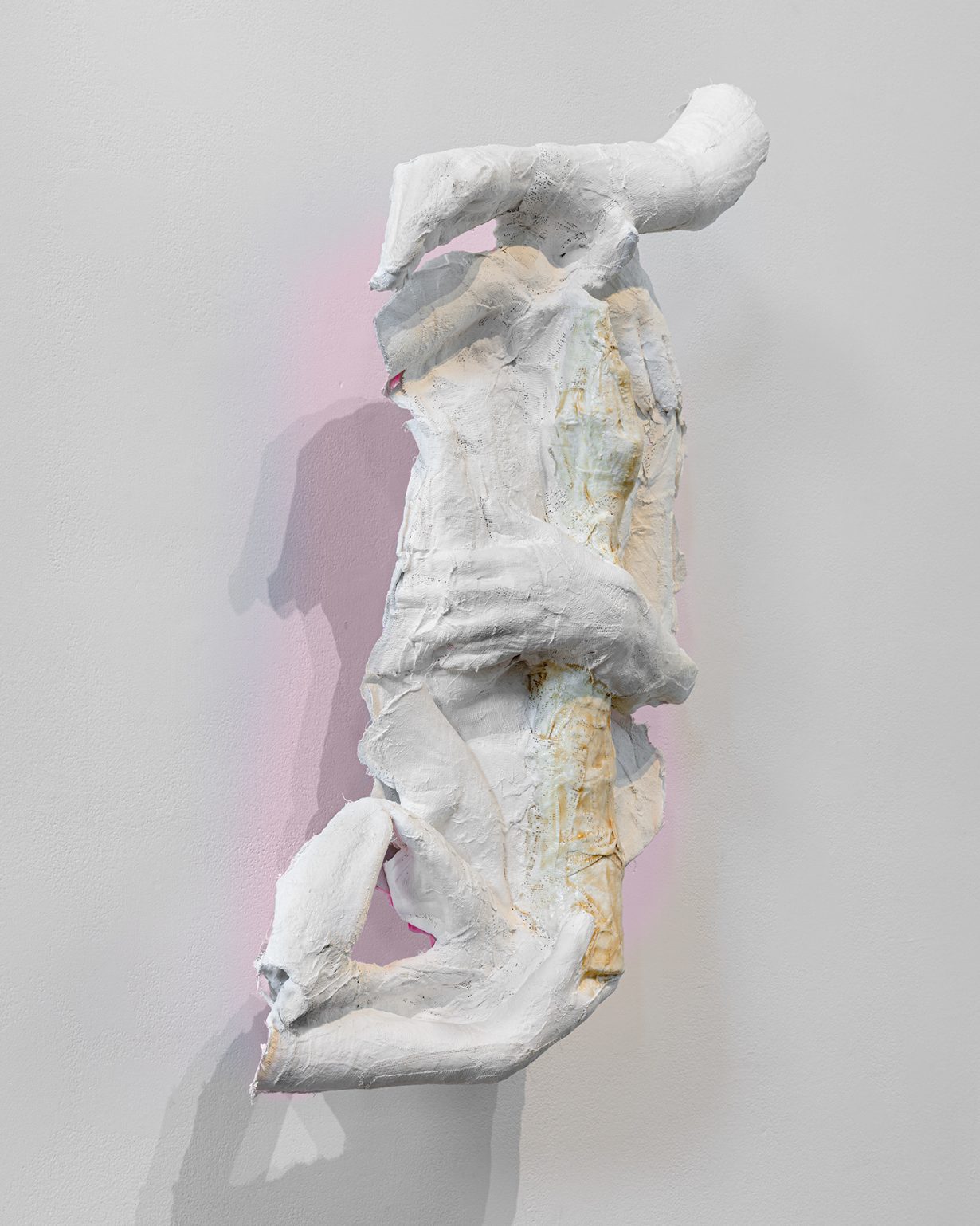
Adili’s beguiling procedures suggest that aesthetic gestures convey emotions in ways that words alone cannot. The exhibition also includes a new group of plaster sculptures, arrangements of casts of her arms and hands. Hold them tight (2026), made as Adili embraced her elderly mother, retains a connection to both women’s bodies, while in works such as Posht (Back) (2025) or Falak (2026), the overall impression – of a ribcage and a spiral, respectively – predominates, suggesting wholes greater than the sum of their repeating parts. The works’ part–whole dynamics preserve personal memories while acknowledging their subsumption into the impersonal historical record.
Their formal repetitions contrast with the looseness of Ministry of Utmost Happiness (2026), a sprawling pile of dirt and debris, with crimson blankets jutting out from the rubble, that responds to years of similar imagery from Gaza, as well as the Iranian regime’s mass murder of its own citizens during their ongoing recent protests. The ironically titled installation, which alludes to an eponymous novel by Arundhati Roy, feels more despairing than Adili’s work with her family’s letters. The former grieves while the latter maintains faith in the capacity to rebuild after personal and political catastrophe. The artist’s piecemeal reconstructions of her family archive may not be able to measure what has been lost, or even provide definitive closure, but they give poignant form to imperiled memories.
Golnar Adili: To Measure the Emotions of Others is on view at Smack Mellon, New York, through 29 March