In the artist’s new exhibition, Steyerl continues to lead the pushback against AI slop and digital individualism
The work of Berlin-based Hito Steyerl has always stayed with a particular trouble – the life and fate of images as they circulate the systems and economies of the contemporary world, and the lives and fate of people, caught up in these same circuits. In both of these, politics is never distant from how subjects and their images appear or are erased. For an artist who has become synonymous with a response to the dangers and perversities of techno-culture – and obsessively attentive to its latest developments – the calamitous arrival of AI might be a worst nightmare realised. So, following on from this year’s fiercely AI-critical book Medium Hot, Steyerl continues her pushback in her new exhibition The Island.
Since her breakout 2007 film Lovely Andrea, Steyerl has honed a style of collagelike video essay, both acerbic and playful, that features allusive mixes of critical exposition, documentary fragments and an absurdist CGI- and effects-driven satire, alongside delirious reflections on society, capitalism and technology. Here she uses the technology of generative ‘AI slop’ videomaking to attack it, while seeking out some kind of viable alternative, politically and culturally, when faced with the ubiquitous presence of deepfaked, algorithmically – and ideologically – driven online content.
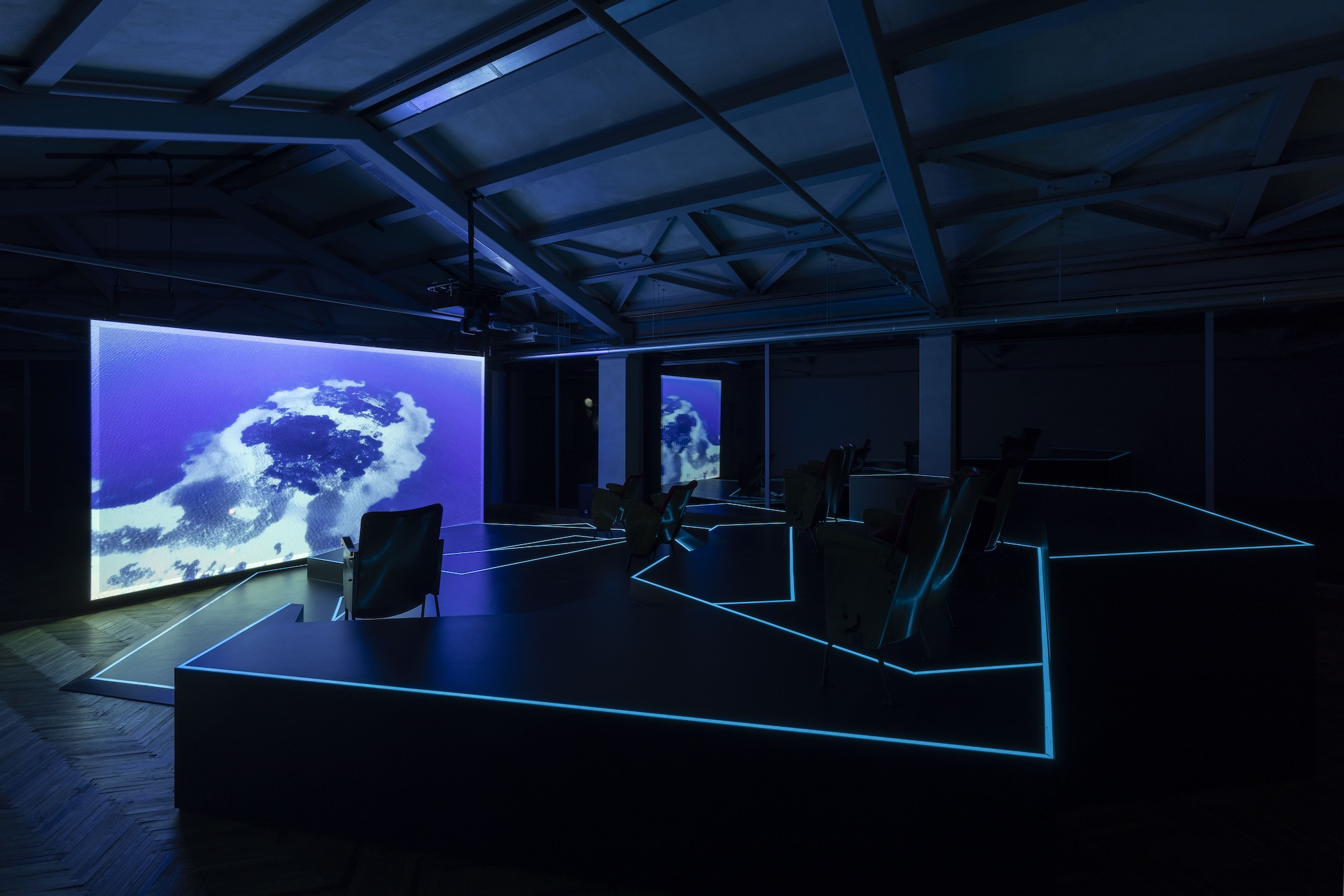
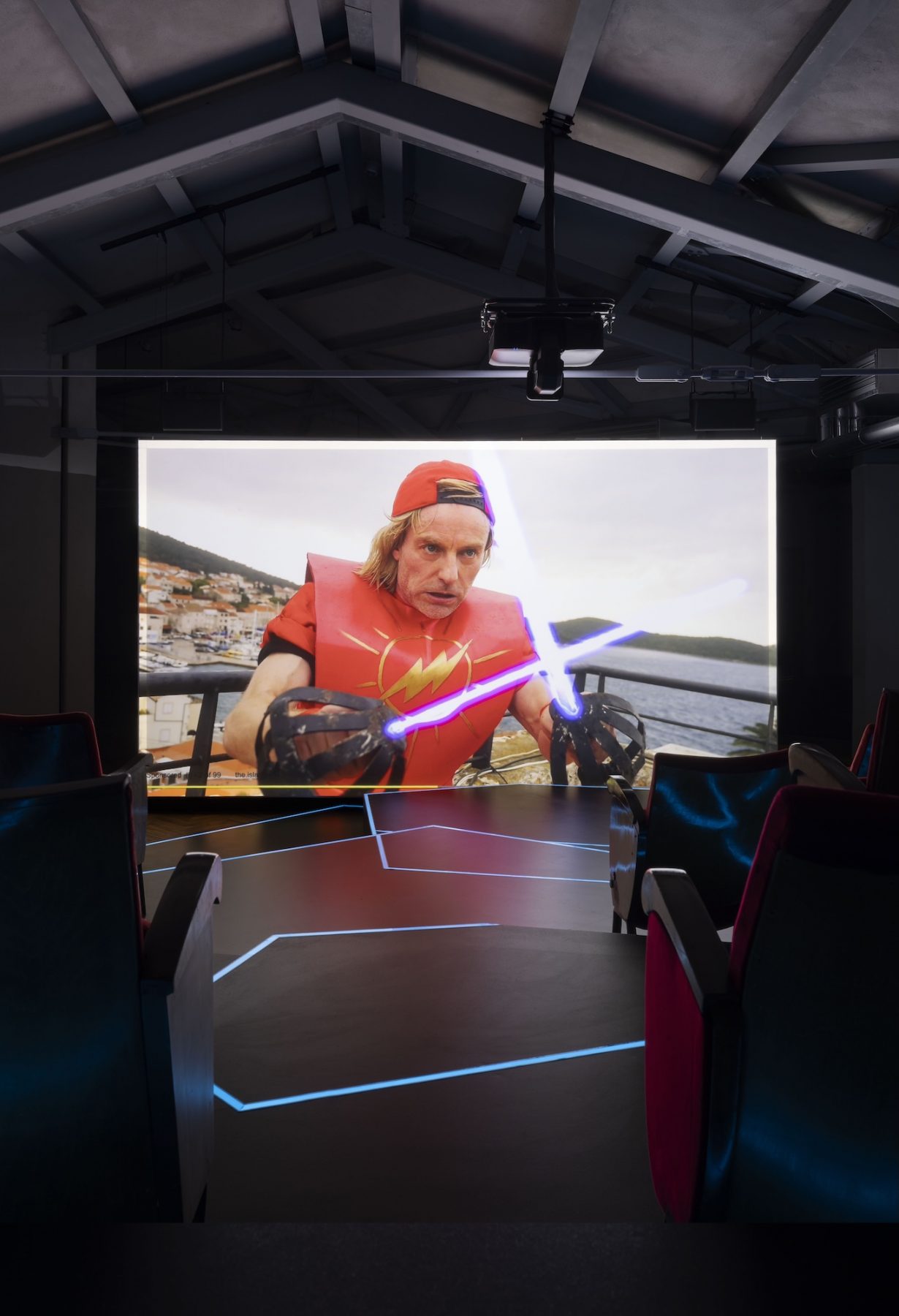
Housed in the blacked-out interior of Fondazione Prada’s penthouse gallery, with visitors guided by TRON-like blue luminescent floor-strips, are videos and video sculptures. The Island centres around an eponymous, madcap videowork, in which its comic protagonist, the avatar of Flash Gordon returned from the 1980s film (here hammed up winningly by German actor Mark Waschke) has appeared on the streets of the picturesque Croatian island town of Korčula, to ‘save the world’. The choice of Korčula links not only to the Croatian-born science-fiction historian Darko Suvin, whose recollections of his childhood during the Second World War intercut AI sequences and Flash’s adventures, but also to the story of a submerged but evidently manmade artificial island, dating to neolithic times, that was discovered offshore.
As Flash chases around Korčula, Steyerl connects the apparently unrelated themes of archaeology, quantum physics and science fiction through the voices and stories of Suvin, the quantum physicist Tommaso Calarco, punctuated by the transcendent voices of Croatian a cappella group Klapa Ivo Lozica through precarious associative leaps. These weave past and future, alternative realities and historical recurrences: an elderly Suvin muses on the ‘brown tide’ of fascism that swept Europe, which is visually reprised by the giant AI tidal wave of shit seen engulfing an AI’d Korčula; Flash battles his evil AI-spawned double; and then there’s the historical doubling of Korčula and its vanished prehistoric twin.
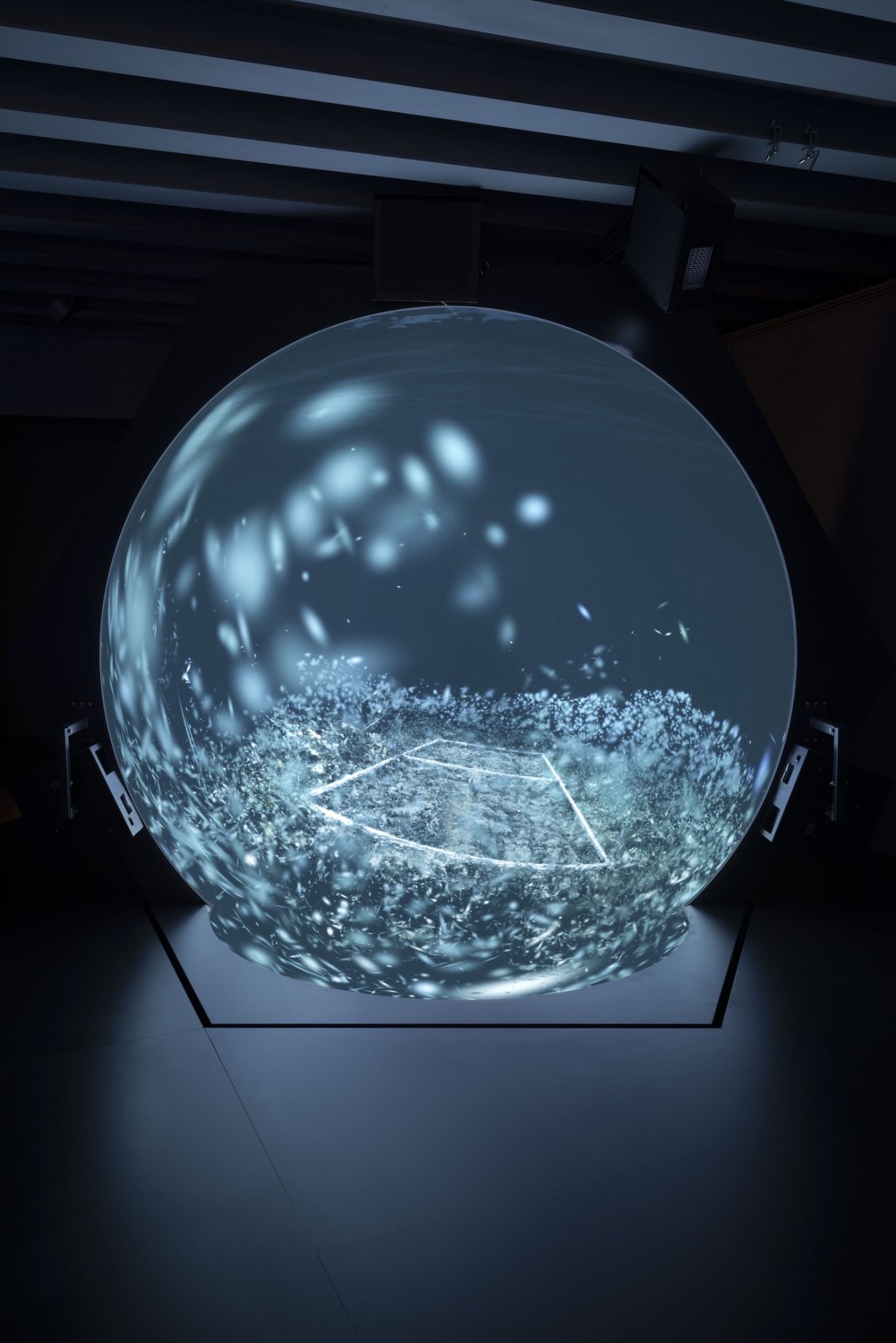
Elsewhere the quantum-physics theme is reprised in sculptures that look at once low- and high-tech: on entering the gallery, visitors are met by two large glowing, concave projection-spheres, into which looping simulations of Korčula and the underwater archaeological site appear rendered as glittering, quantum particle-like CGI artefacts. Beyond the projection screen of The Island are two-metre-plus-tall armatures of metal and driftwood, like postapocalyptic astrolabes, onto which are braced translucent hemispherical cupolas in which the same renderings of these sites flicker and swirl. Meanwhile a circle of video screens presents longer versions of interviews with those interlocutors who appear in The Island, extending and contextualising the fragments we find in the film.
For all its careening editing and spoof aesthetic, Steyerl’s film is driven by the bleak intuition that our AI-slopped culture could well be threatened with its own collapse. In a perhaps self-conscious nod to her own predicament as a ‘critical’ artist, during a sequence in which, the titles explain, Flash ‘enters the slop world to fight his AI copy’ (an AI-generated sequence in which Flash lightsabre-duels his doppelganger through the streets of Korčula, amid crowds of panicking bystanders), the comic-book-styled subtitles conclude ruefully that Flash realises he ‘cannot fight slop with more slop’. Watching further lurid AI-generated clips of the crocodile-headed bomber ‘Bombardino Crocodilo’ (a spawn of this year’s latest ironic-reactionary viral meme fad, Italian Brain Rot), one is tempted to agree.
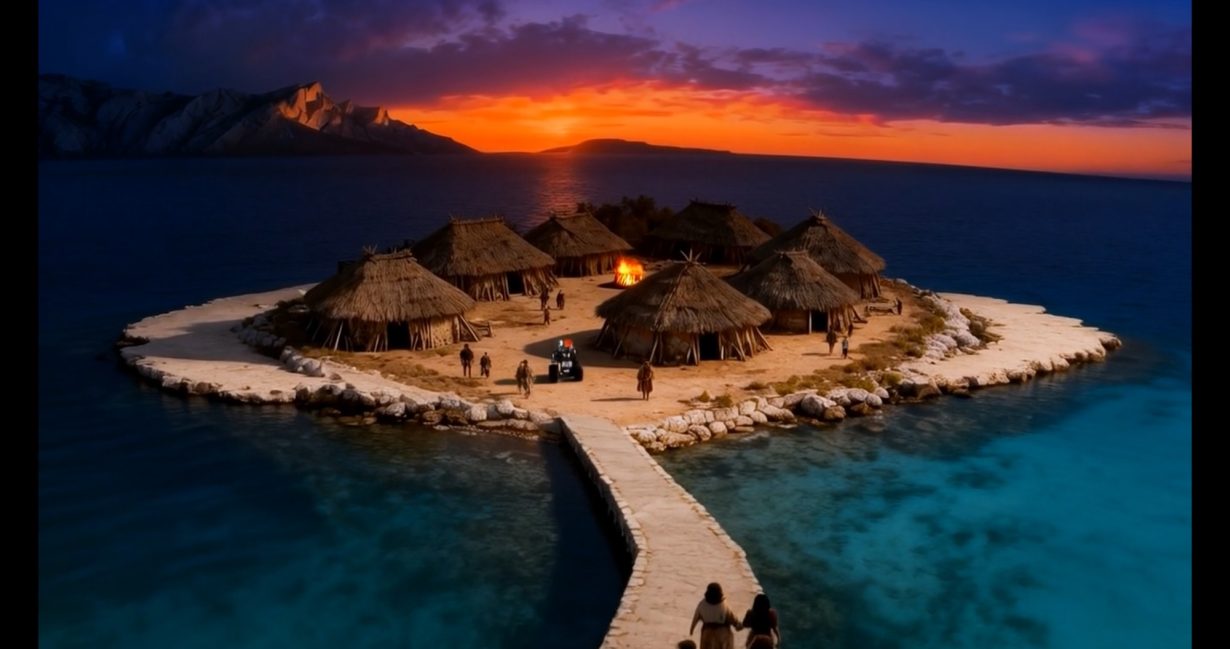
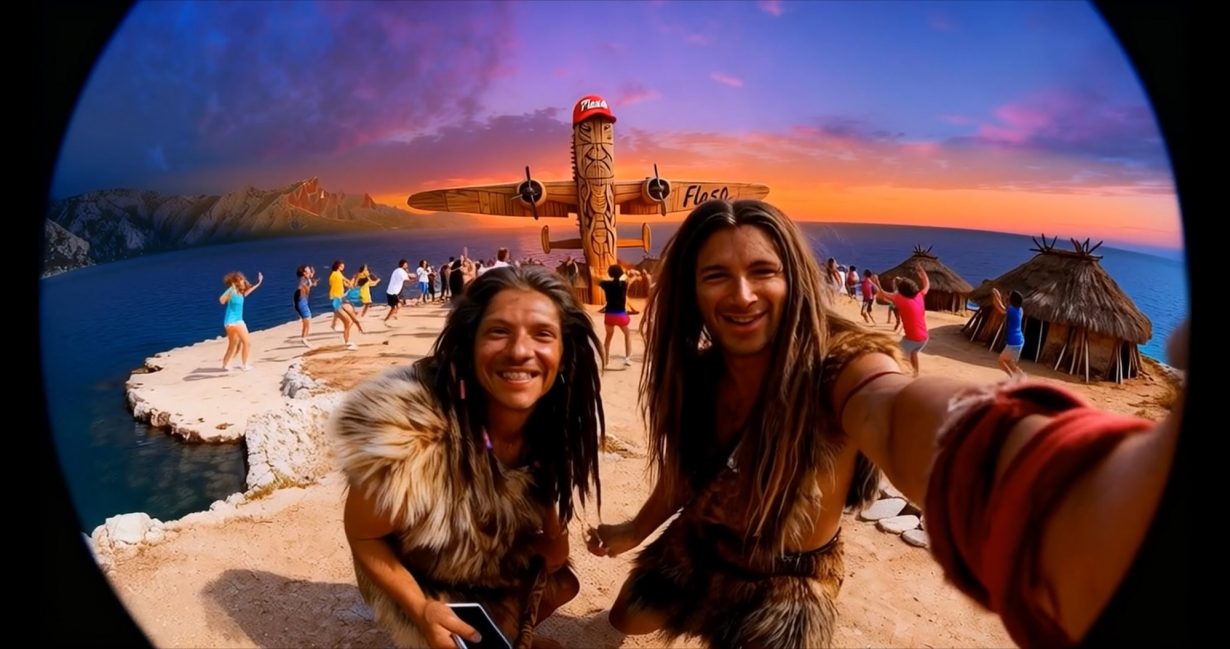
Steyerl’s way out of this hellscape depends on what we make of the other two elements that make up The Island. Archaeology and physics here stand in as guarantors of any remaining sense of reality – since science is still rooted in the principle of speculation, testing and verification – in the face of the irreality of the AI image-machine that might now be accelerating both social disintegration and cultural psychosis.
In one way The Island hardens and raises the stakes of Steyerl’s previous reflections of the entanglement of image and materiality: it suggests a greater intolerance, in the circumstances, towards the infinitely degrading world of the digital image. And if a leftist materialist politics still survives here, it does so in a desire to reassert the ‘truth’ of human reality, its rootedness in material circumstance.
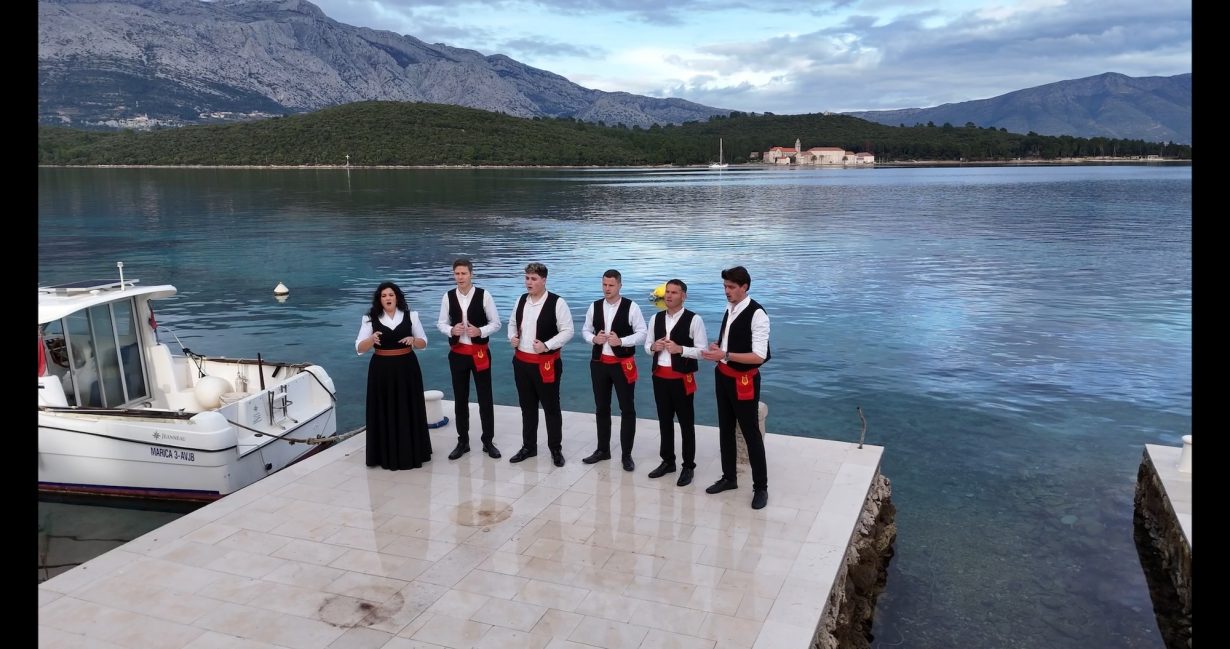
But it also renders itself in another form, which unlike the AI slop is also a human-made art. There’s an oddly conservative conclusion to The Island, though if it’s ‘conservative’ it’s in the sense of wanting to retain what is worth preserving. The Island ends with an astonishing choral finale, as six members of Klapa Ivo Lozica, standing on the quayside of Korčula, sing a paean to the sea at day’s end. Lyrically it’s steeped in folkloric traditionalism, a mythos of place and rootedness (a big shift for Steyerl, whose visual lexicon has tended to be those of techno music videos, cable news idents and online gaming). Aesthetically, the resonance of the singers’ close harmonies, shaking the gallery’s sound system, brings us back to the physical presence (though still mediated by technology) of human voices and human bodies, and the material relationships between them.
It’s odd to think of The Island as Steyerl’s ‘back to basics’ moment, but as culture drifts further into the delusional and solipsistic nihilism of mimetic AI and of isolated, paranoid individuals, the artist’s insistence on the fact of material reality, of place and people, also seems to signal the limit of a certain period of critical art, with which Steyerl has been long identified. Here instead is a shift to an idea of the art as affect and affirmation – an uncertain, perhaps positive return to the power of aesthetic experience and production, and the human agency – against the tide of slop – it implies.
The Island at Fondazione Prada, Milan Osservatorio, through 30 October 2026
From the January & February 2025 issue of ArtReview – get your copy.