The Parisian artist uses storytelling and masquerade as a form of political gesture, probing how societal scripts and identities are inhabited and continually undone
Julie Béna’s first major exhibition in France stages a tragicomic theatre of unstable truths, a carnival aesthetics rooted in autobiography. Béna constructs a world oscillating between humour, melodrama and unease, at times shading into horror. Across six galleries and Magasin’s atrium, sculptural installations and films cohere into a nocturnal carnival populated by mischievous characters – black cats and skeletal horses in welded metal, wall-mounted fabric-and-resin shoes caught mid-sneak and lace reliefs of moons smoking cigarettes – that orbit around Béna’s alter ego, the Jester, a figure who recurs in her sculptures and films. A licensed transgressor speaking truth to power, the Jester collapses sincerity and deceit into one another.
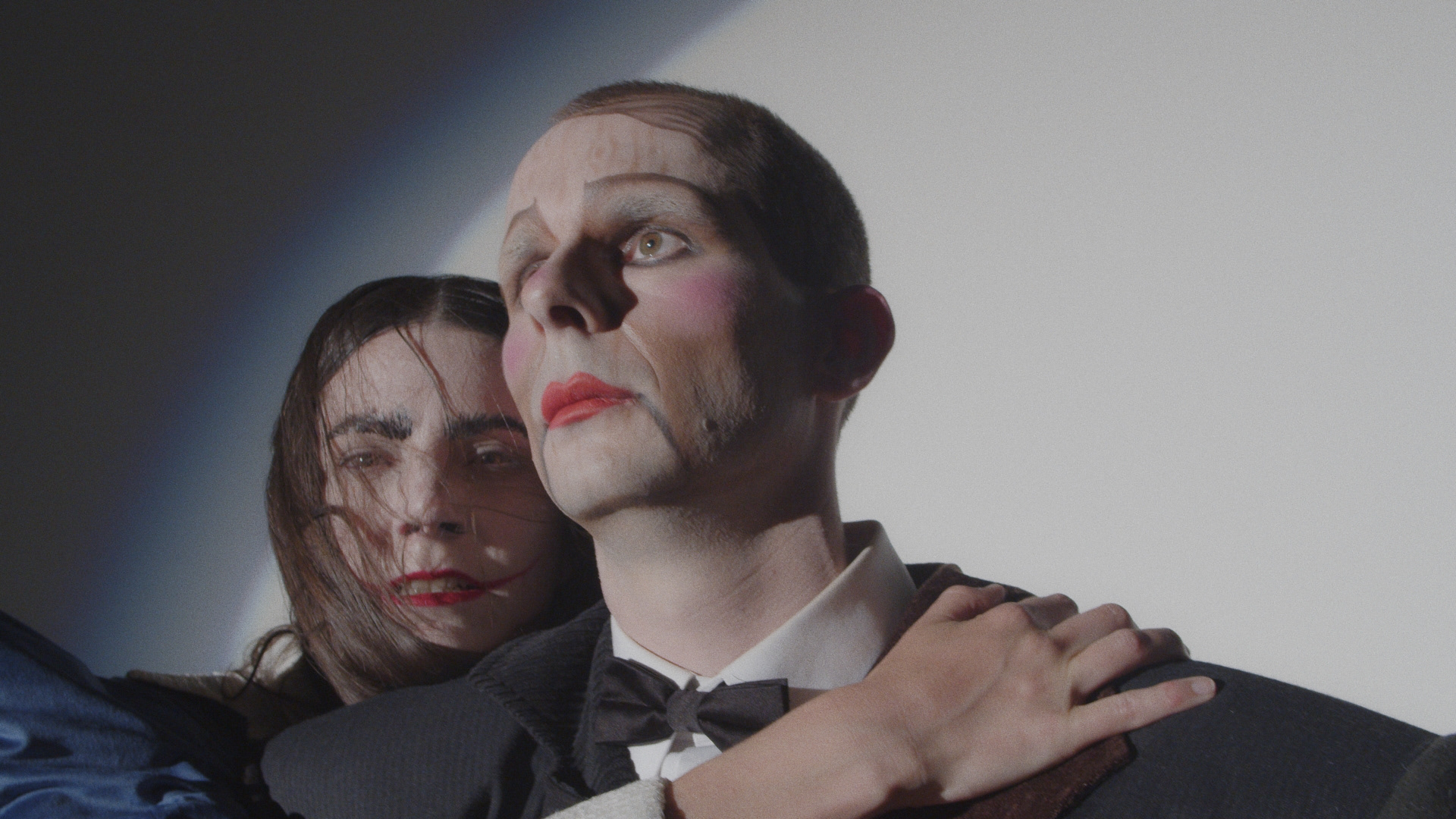
Dirty Shirley (2024), a grotesque parody of an American celebrity game show with its exaggerated theatrics and polished cheerfulness, features Béna as Shirley Temple, her exaggerated makeup and smile pitched between charm and menace. Béna appears beside her husband, also playing Temple, and their daughter as a child clown. Amplifying the entertainment industry’s garish aesthetics and mythologies of commodified innocence, celebrity and desire, the film transposes these onto the nuclear family – a stage where the self is remade through cycles of projection and mimicry.
The exhibition’s conceptual hinge, the film Strakati (2022), is installed within a skeletal black metal caravan hung with portraits of Béna’s mother, husband and daughter in clownish make-up and costume. Béna morphs into a creepy imp terrorising her family – trying to eat her husband’s face, riding her mother like a horse only to be ridden in turn, while her daughter, dressed as her double, brings her a glass of water before she collapses from exhaustion. Strakati examines how selfhood is negotiated within familial ties and the overlapping roles of mother, artist, daughter and partner, turning domestic life into a theatre where codependency and ego are held in tension.
This confessional mode culminates in the single-take film Miles (2020-21), filmed in a hall scattered with theatre props, where Béna delivers a cathartic monologue to camera. Moving between laughter and despair, she speaks of ageing, fear and the impossibility of disappearing in a manifesto on the instability of selfhood and how the line between subject and role frays under the strain of performance. Exhaustion becomes both subject and method – the labour of art inseparable from that of living – and the climax comes with her distressed daughter running unexpectedly into the frame as Béna sings along to the 1980s pop song Quand la ville dort. Béna lifts her into her arms, finishing the performance on a note both tender and heavy, the fourth wall collapsed and the conditions of artmaking laid bare.
In the atrium installation, the narrative feels more diluted. A cartoonish neon sign, Parodie (2025), flickers in bursts of colour opposite Riding Horses (2024) – two towering carousel horses with cutouts of Dirty Shirley’s characters rocking back and forth. These works alone could have made a concise site-specific gesture, but surrounding them are carnivalesque metal structures and scattered, faceless jesters. In a curtained booth, Béna’s earliest film here, Who wants to be my horse? (2018), presents a surreal cabaret featuring Béna and BDSM performer-activist Madison Young, staged in a derelict garage and mixing erotic performance, humour and feminist critique. The film’s negotiation of sexuality and roleplay feels key to the evolution of Béna’s later roles and would have benefitted from clearer curatorial positioning.
Parodie uses storytelling and masquerade as a form of political gesture, probing how societal scripts and identities are inhabited and continually undone. But its most effective moments are those of unguarded tenderness. Certain scenes seem to exist simply for Béna’s daughter – to amuse, to include, to share joy – and that impulse tells of an artist who wants her worlds to stay open and porous, offering pleasure and play as much as critique.
Julie Béna: Parodie at Magasin CNAC, Grenoble, through 5 April.
From the November 2025 issue of ArtReview – get your copy.
Read next Roots of Resilience: Tesfaye Urgessa