Where painting has historically offered the possibility of entrance, via representation, into another world, Bourgogne’s occupy the threshold between inside and outside
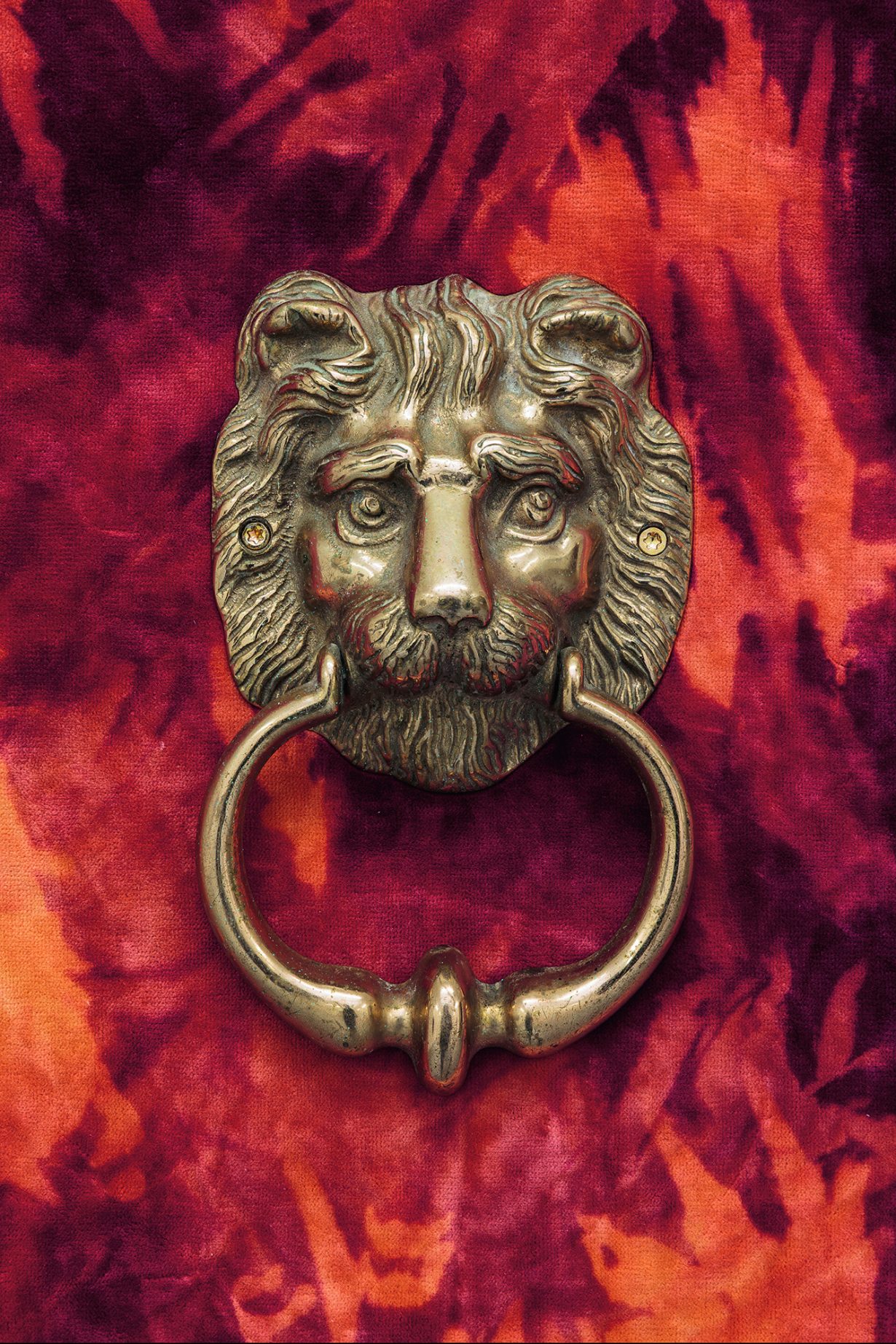
The central element of Leda Bourgogne’s solo exhibition is a series of five wall-mounted works, Safeguard (all works 2025). Velvet stretched over frames is splattered with bleach, creating tie-dye-like effects in shades of red, orange and purple, while doorknockers in bronze and brass, centrally attached to the upper regions of these sensual ‘paintings’, turn them into hybrids of image and object. Some of these knockers or rappers are figurative – a lion’s and a satyr’s head – and might historically have been used to fend off evil spirits. Yet this notion of guarding your space is ambivalent; it works not only on a psychological level in terms of nurturing and protecting your inner world, but also raises structural questions of access to property and privilege.
Where painting has historically offered the possibility of entrance, via representation, into another world, the Berlin-based artist’s loosely doorlike works instead occupy the threshold between inside and outside. In a push-and-pull dynamic, their vibrant surfaces let your gaze bounce off the material’s literalness but still attract you with the flickering hues of the fabric. Painting here is not a process of layering pigment onto an increasingly obscured ground; by repeatedly immersing her velvets in bleach, Bourgogne creates spectral shades and abstract stains through erasure – of the fabric’s colour – rather than addition. These traces of disappearance destabilise the locked surface, opening it up to chance and the subconscious in a way that is even more present in Bourgogne’s pencil drawings.
These latter works are hung on an L-shaped metal fence, separately titled Cadenas, that both structures the space and signals a boundary, though a permeable one. The barrier is adorned with love locks, their keys still in place. In Melancholia she reimagines Artemisia Gentileschi’s Mary Magdalene as Melancholy (1622–25). In both works, we see a woman with half-closed eyes, her tired head resting on her hand. Her hair – tidy in Gentileschi’s version – escapes control in Bourgogne’s drawing, forming an autonomous web that proliferates over the body and out of the picture, surreally taking possession of the figure and its surroundings. This morphing of form – abandoning clear legibility in favour of a dreamlike formlessness that seems to be driven by some unnamed force of longing or desire – also animates the drawing Outcasts, apparently inspired by images from the Rebel Dykes Archive (which records the activities of lesbian and punk women groups politically active in 1980s London). In Bourgogne’s drawing, one only recognises a pair of high heels, from which several upright figures dissolve across the picture, intertwining in abstract free-flowing forms. Losing their distinctive borders, they merge into a collective fluid body, one that underlines the need for community.
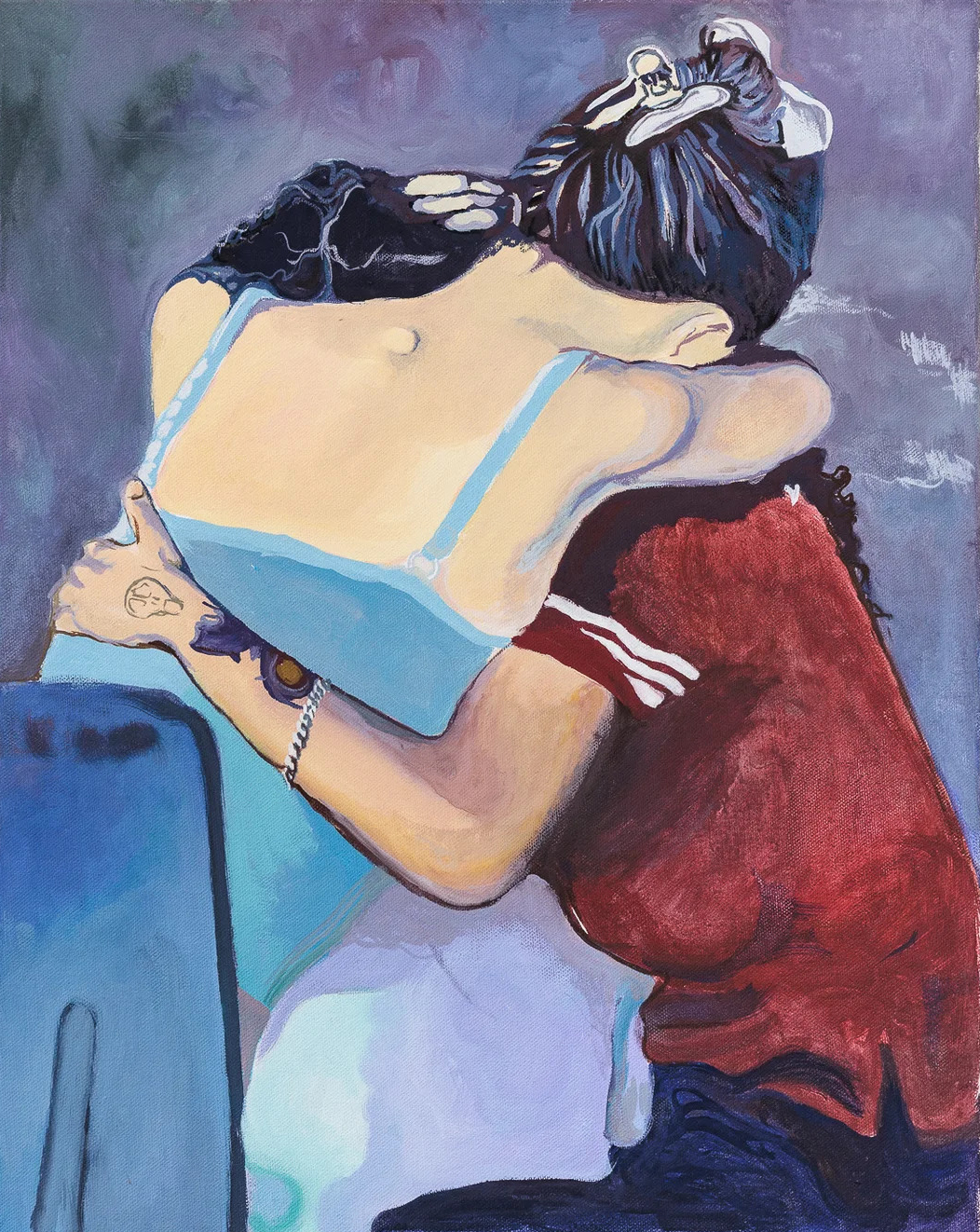
The exhibition’s title references Yael van der Wouden’s 2024 novel, The Safekeep, whose reserved protagonist Isabel lives alone in a family home, obsessively tending to her heirlooms. Not merely the story of Isabel’s discovery of her own desires, as she enters into a queer love affair, the book is also about ownership, generational guilt and who we let into our house and heart. In Bourgogne’s exhibition, the possibility of intimacy, too, is a porous state of negotiation. At the entrance, the small painting PDA acts a prelude to the show: it is based on a paparazzi photo of actor Lily-Rose Depp in a tight embrace with her partner, American musician 070 Shake. Whereas the painting might be read as a comment on both the overstepping of privacy and the increasing visibility of queer love, it may also be a plea that one stay attuned to vulnerability itself, and remain open to what might still touch you.
Safekeep at Gianni Manhattan, Vienna, 6 November – 20 December 2025
From the January & February 2025 issue of ArtReview – get your copy.
Read next Etel Adnan and Simone Fattal’s forms of intimate documentation