The artist and writer’s book highlights how humans find, reinvent, deconstruct and reconstruct ourselves through technologically mediated feedback loops
In machine learning and chatbot interfaces, in production lines and ergonomics, the ‘human-in-the-loop’ (HITL) describes any system that requires human interaction. The rising prominence of machine learning and AI has narrowed that definition – ‘a collaborative approach that integrates human input and expertise’, per Google Cloud – and further shifted its centre over to the machine and away from the humans who label training data, evaluate performance and generate feedback. But artists like Tyler Coburn, working within and against technology, enact narratives that highlight, rather than obscure, how we humans find, reinvent, deconstruct and reconstruct ourselves through technologically mediated feedback loops.
In NaturallySpeaking (2013–15) Coburn repurposed the training copy from Macintosh’s speech-recognition software to write a script about voices without bodies. Because speech-recognition software can only understand what is ‘actually spoken’, the training copy names the punctuation marks. The relation between the clauses and phrases has to be articulated rather than expressed; described, instead of felt: ‘Language is most itself COMMA he claims COMMA when it leaves OPEN QUOTE the terrain of its sound and sense COMMA CLOSE QUOTE opening itself to the surrounding babble PERIOD’. When Susan Bennett, the voice actress who served as the unwitting voice of Apple’s Siri, performed NaturallySpeaking at Judson Memorial Church in 2015, the human from the loop that gave our phones their voice became the human in a loop that teaches them how to listen.
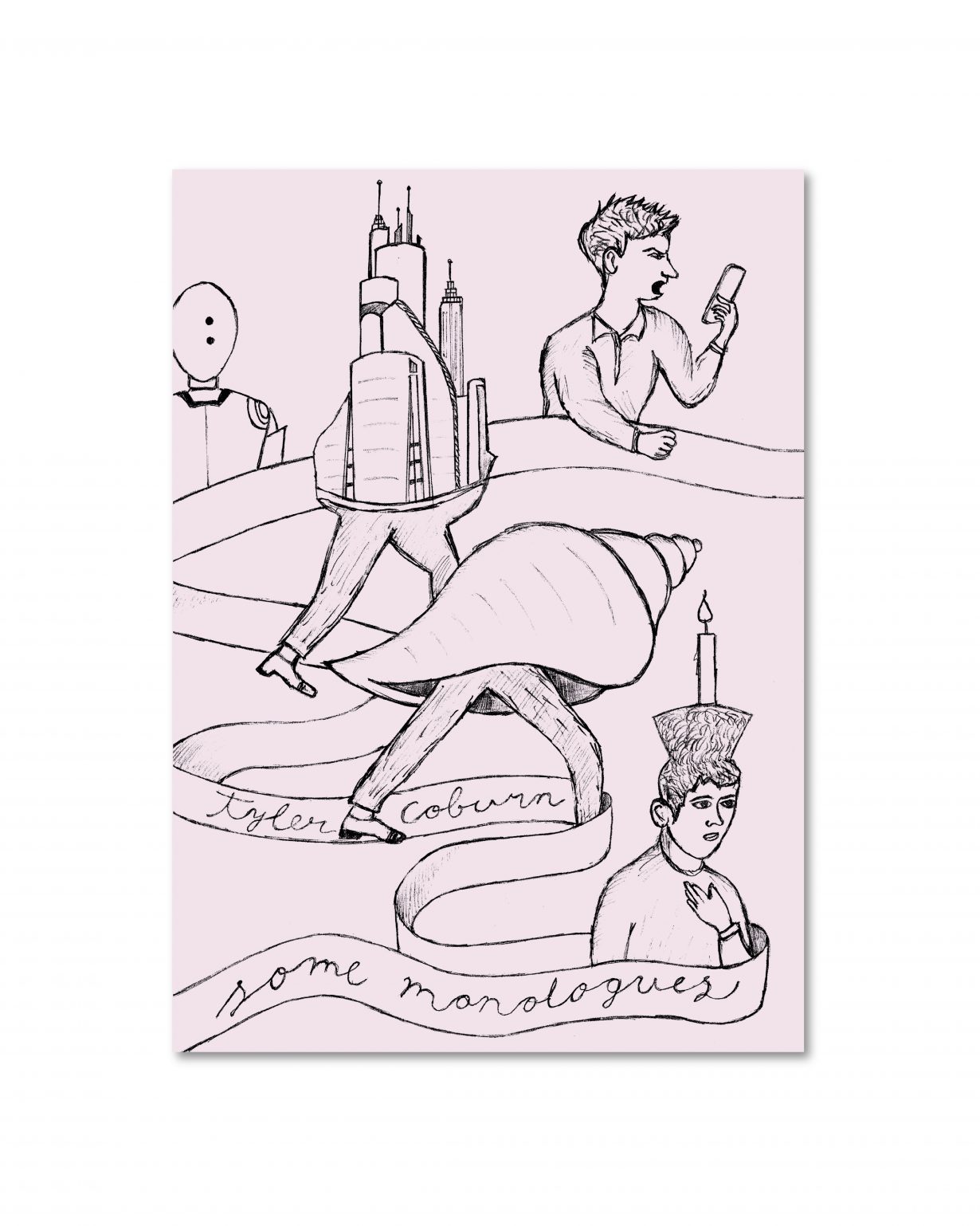
Coburn revisits that and ten other works in Some Monologues, which compiles the scripts and supplementary materials from his performances of the last 15 years. Sequenced out of chronological order, they are arranged so that each section references the last: beginning with an excerpt from I’m that angel (2011–), in which the human yields to the diffusing and disarticulating effect of ‘the cloud’; followed by NaturallySpeaking, in which the human must speak clearly and unambiguously to interact with the software; then Tratteggio (2018), a script that considers the titular preservation technique’s ‘noisy, pointillist grain’; followed by Candlestick Man (2023), its pages thickened by a grainy texture that makes a satisfying zipping sound; and so on. What feels like progress folds back into its precedent before darting forward again. This book is a loop that builds towards one of its final questions: ‘Is it possible, sometime between now and oblivion, that our bodies experience such a degree of evolutionary change that the biological, ontological, and legal criteria of the human come undone – that the kernel of anthropocentric egotism is ground down beyond repair?’
Indeed, the human in Coburn’s loops barely holds its shape. References to primordial matter recur throughout the book: the cloud is ‘miasmatic’; the body is a ‘profane mud’. The first-person ‘I’ is a ‘germ’, born from the darkness between the word and the flesh, its parts extractable from ‘vats of goo’. There is ‘flotsam and filth’, glue, epoxy and more mud; the speaking ‘I’ is born from language itself.
The human-in-the-loop cycles through a self that is undone and undefined. It melts into the noise and the babble, always looping, never fully emerging from its primordial matrix. It lingers in the indeterminacy of the amorphous, but it doesn’t reject the well-formed body. Coburn writes that ‘the body is in protest against our diffuse, master metaphor’, while acknowledging that ‘the network is far too complex… for the struggle to only play out in physical space’.
It’s obvious that Coburn rejects the old Cartesian dream of a unified self. But he avoids what Sven Lütticken, in one of 11 supplementary texts included in the book, calls the ‘cringy sub-Latourian parliament of things’. Instead, Lütticken describes Coburn walking around the room, dropping ‘sheets of paper that either contain part of the script or drawings of shells; cracking the “shell of personhood”’. Like a snail, the speaking ‘I’ of Coburn’s scripts peeks out of the shell before coiling back in. His osseous scripts give the human-in-the-loop just enough form to appear as a figure, voice or stream of consciousness.
Some Monologues by Tyler Coburn. Wendy’s Subway, US$25 (softcover)
From the January & February 2025 issue of ArtReview – get your copy.
Read next AI is nothing without its theatre