Rachel Ashenden crisscrosses the city in search of artists and organisers persevering within a precarious landscape
In March 2026 I peer through Glasgow’s Centre for Contemporary Art’s darkened window, patchworked with protest posters, and find little signs of life. CCA’s liquidation and closure followed three years of tumultuous management, including a winter shutdown in 2024 due to financial precarity and a peaceful protest organised by Arts Workers for Palestine Scotland in June 2025. That protest escalated into arrests, during which activist Lindsey Murray was injured by police. With the linchpin of Glasgow’s visual-arts scene at risk, I crisscross my way through the city in search of the artists and organisers persevering within a progressively precarious landscape.
The tension between artistic experimentation and ephemerality has a longstanding precedent in Glasgow. In her 2014 essay ‘The Key Material is Time’, Sarah Lowndes observed that Glasgow artists’ practices are ‘bound up with ideas of performativity’ and transience. Hers was a rare and astute critical study of Glasgow’s art scene during the 2010s, and the material conditions for its success. She noted that 13 artists associated with the city were nominated for the Turner Prize between 1996 and 2014; six of those artists won. Indeed in 2014 CCA reported a record number of visitors (over 320,000) and hosted a flurry of exhibitions for both established and emerging artists. Lowndes’s essay and book Social sculpture: The Rise of the Glasgow Art Scene (2010) capture a self-organised arts infrastructure that is ‘deliberately non-permanent, short term’ and rooted in working-class resilience. But over a decade on, Glasgow’s ambition to democratise visual art is increasingly undermined by funding challenges and insecure tenancy arrangements. There are pressing questions ahead: what becomes of Glasgow’s art scene when artists lose access to vital exhibition spaces? Without opportunities to test and refine ideas in experimental venues such as the CCA, might the city’s reputation for nurturing some of the world’s most celebrated artists decline?
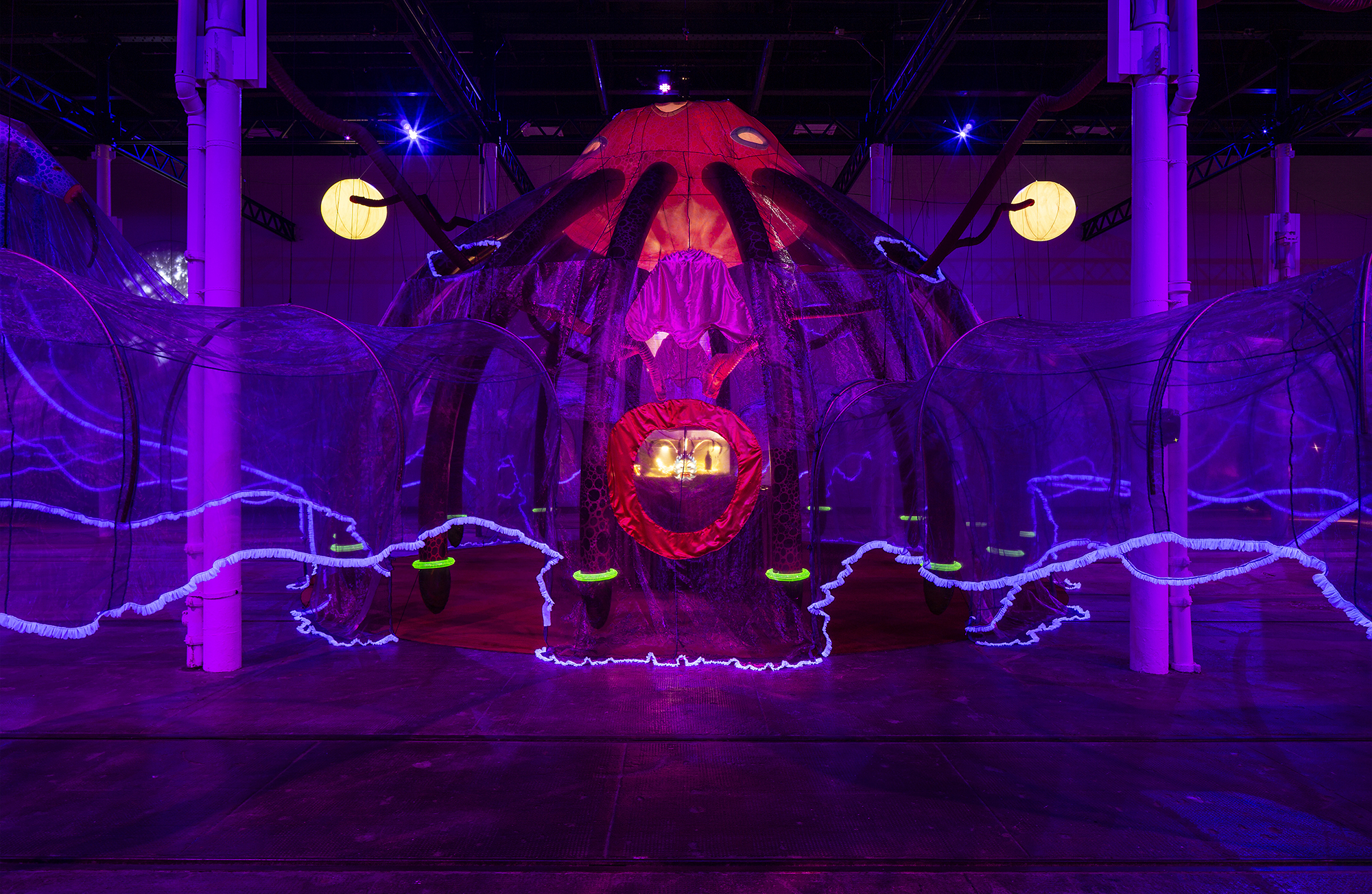
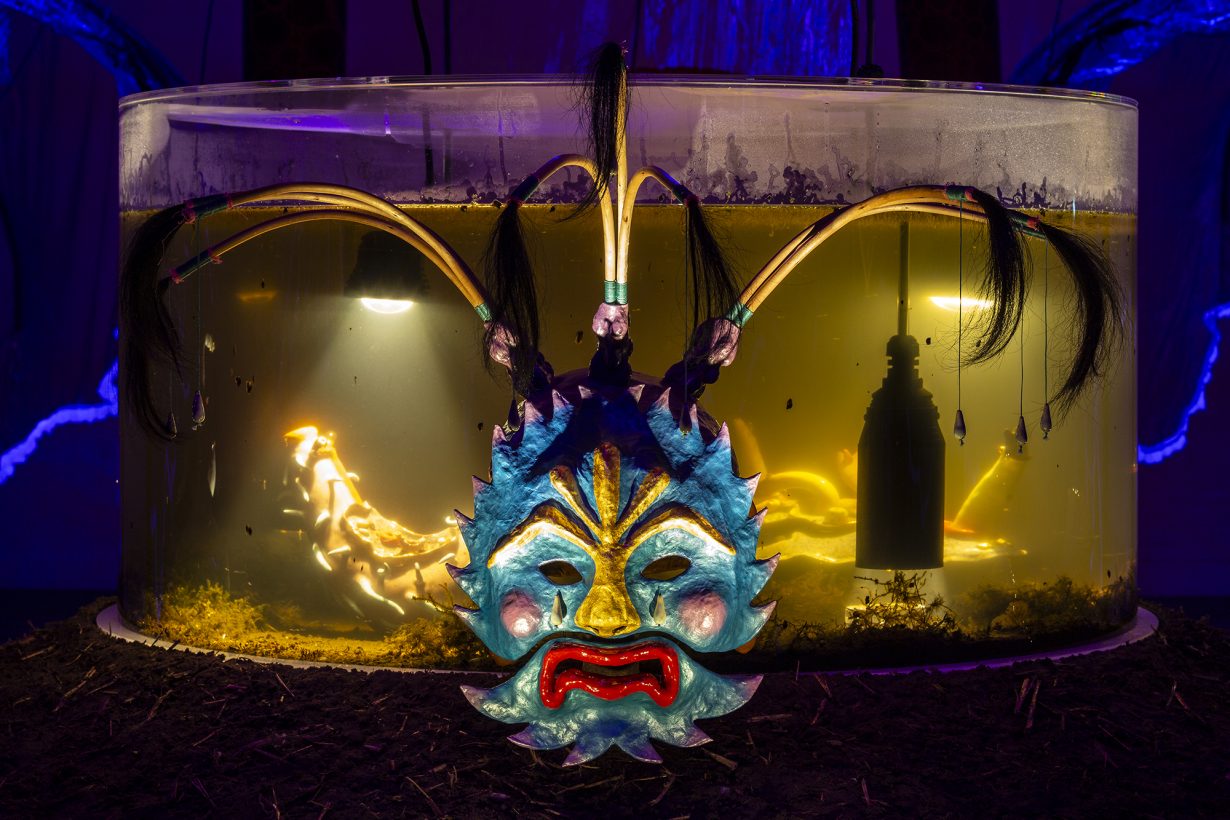
Across the River Clyde, Rae-Yen Song’s exhibition •~TUA~• 大眼 •~MAK~• occupies Tramway’s cavernous gallery 2. Here the artist melds the influences of Daoism, ancestral stories and science fact-fiction into a multilimbed creature who nests a murky pond of spawning microscopic creatures; through motion analysis, the microscopic creatures influence the exhibition’s lighting and soundscape. The artist conceptualised this sculptural work during the course of life-bestowing cadaverous soooooooooooooooooooot, a 2024 research exhibition held at CCA. There Song served as artist-curator, inviting over 20 artists and thinkers to work along the theme of speculative world-building. Song used CCA’s exhibition space as a testing ground, which was vividly reflected in the accompanying live programme, with the artist hosting a fermentation tasting and knowledge exchange while ideas for the subsequent Tramway exhibition percolated.
Tracing the evolution of Song’s ideas from CCA to Tramway suggests a compelling case for exhibition-based artistic development, which requires sustained long-term investment and stable management. The concept of exhibition-based artistic development leads us back to Transmission: Glasgow’s first artist-led gallery, with connections to artists like Douglas Gordon, Carol Rhodes and Martin Boyce. Founding member Alastair Strachan tells me that, before Glasgow earned the title of European Capital of Culture in 1990, emerging artists had nowhere to exhibit. He acknowledges the irony of thanking Thatcher for putting emerging artists “on the dole”, and creating “a culture where artists, musicians and writers were subsidised to do their thing”. Over 50p pints, a committee of artists conceived of Transmission in 1983. The gallery has occupied the same premises on King Street since 1989, and since 2009, as part of the multi-arts centre Trongate 103. But just weeks after CCA’s closure, City Property (an arm’s-length council company) terminated Trongate 103’s tenancies. The arts organisations were handed an ultimatum: to sign a new lease with rent increased to four times the current level, or face eviction. The ‘Save Trongate 103’ campaign followed, which saw a lively protest held outside the City Property offices on 27 March and a petition signed by 22,000 contesting the untenable rent hikes. Despite the public appetite for sustainable arts infrastructure, City Property will not back down.
Across my conversations with artists and arts organisers, a widespread antiestablishment attitude emerges: characterised by distrust of the charity Glasgow Life and the public body Creative Scotland, both of which are regarded as cultural gatekeepers incapable of equitable resource allocation in the sector. Concurrently, however, artists and organisers are structurally dependent on governing bodies for funding, creating a palpable tension between ethics and material necessity. While Lowndes points out that Glasgow’s antiestablishment attitude goes hand in hand with its ephemerality, the current fragility of the scene poses a greater threat to DIY cultural production than such a model can reasonably absorb and transform.
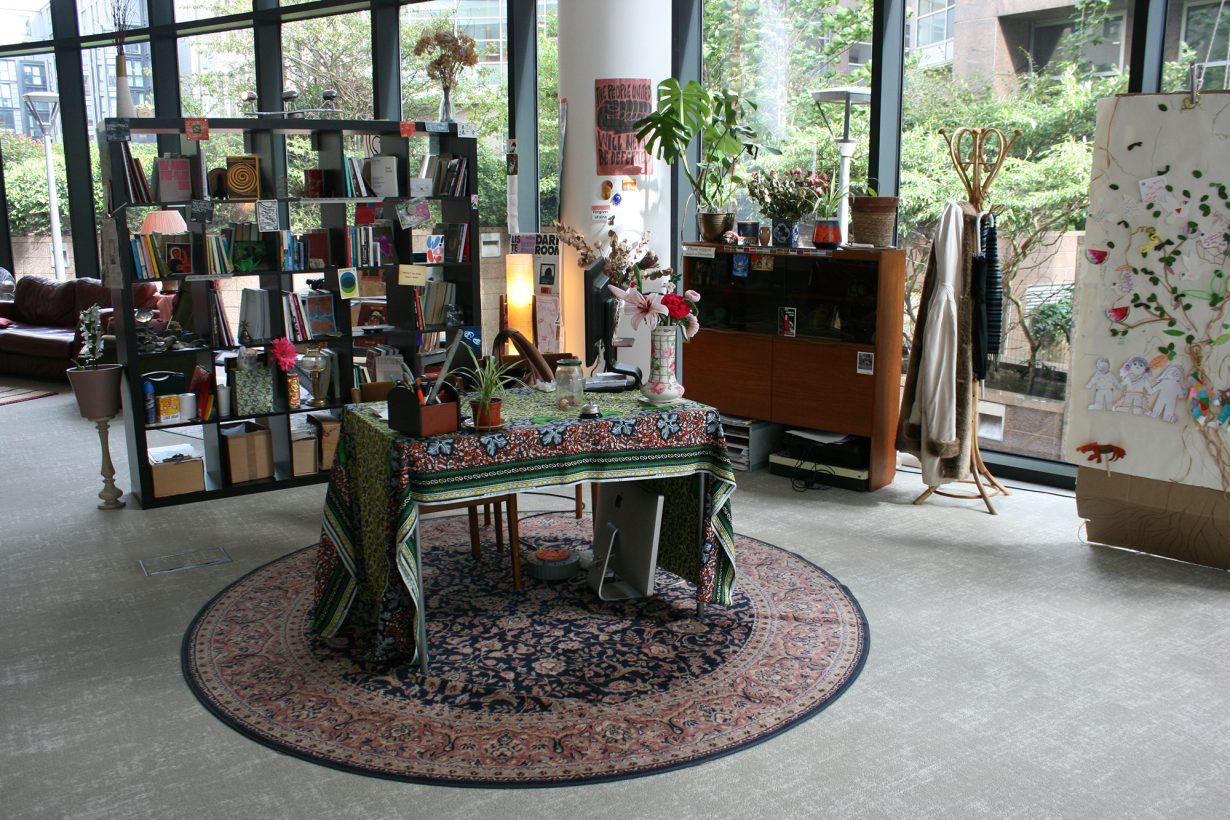
In the city centre, I find Listen Gallery, an experimental sound arts and community initiative, in a slick office block. To the hum of kinetic sculpture, founder Riah Naief offers me tea and asks me if I have any cardboard boxes going spare; she recently received the news that Listen Gallery must leave the premises at York Street – and fast, within 20 days. The visual arts charity Outer Spaces provided Listen Gallery with this vacant office space, leased from a commercial landlord (who receives reduced business rates through the partnership), on a temporary basis with an unknown end date. “The DIY scene here has such a short lifespan. I love that people big it up, but we’re working to a five-year maximum [cycle]. That’s what I’m worried about,” she reflects. Naief estimates that around 80 percent of her work with Listen Gallery is unwaged, as the gallery operates without regular funding, and participating artists typically secure funding for the programme through their own grant applications. The visual-art programme is only part of the picture: Listen Gallery exists as a contemplative community space. With rest spots, refreshments and records on offer, Listen Gallery’s curatorial emphasis is on convening and slow looking.
The 16 Collective, by contrast, had seven days to vacate their Outer Spaces venue in the East End (the minimum notice period the charity provides) at the start of February. The notice came two days into an exhibition run. The feminist curatorial collective was so determined to keep the doors open to the public that they resisted packing up until the last possible moment. Despite this sobering experience, when I meet with Nell Cardozo and Kelly Rappleye of 16 Collective, they are buoyed by the prospect of their first presentation with Glasgow International, Scotland’s biennial festival of contemporary art. By June, 16 Collective will be up and running in a rented space at 5 Florence Street, a former school now used for artist studios and creative businesses. They tell me how their GI presentation will be a research-led exhibition that investigates the River Clyde as a site of critical geography. The exhibition, River is/as, has been in development for two years; with three years’ worth of funding from Creative Scotland, 16 Collective can afford to plan ahead. In their mission to support female-identifying, LGBTQ+ and class-marginalised artists, 16 Collective intervenes and supports artists caught between art school and largescale, international opportunities. Drawing on her experience of developing support for artist mothers, Rappleye positions intersectional feminist practice as an ongoing and evolving process that requires time and space for learning.
I finish my day at Still Glasgow, a group photography exhibition programmed to celebrate the city’s 850th birthday, at the Gallery of Modern Art (GoMA) until 13 June 2027. Like Tramway, GoMA sits within Glasgow Life’s institutional portfolio. Steeped in monochrome nostalgia, the exhibition puts forward a nonchronological search for the city’s postindustrial identity. Joan Eardley, the beloved twentieth-century chronicler of Glasgow’s tenement streets, is inevitably there, adjacent to Matthew Arthur Williams’s brooding portrait of Charlie Prodger, who represented Scotland at the 58th Venice Biennale the year after she won the Turner Prize. Arthur Williams’s portrait is part of an ongoing series documenting Glasgow’s artists, but its future feels tenuous as the city could be on the precipice of losing its cultural influence, as ephemerality slips into fragility.
Read next After The Complex: The Dublin Art Scene