Lacanian psychoanalysis saturates contemporary art and theory, shaping how artists and writers think about desire, language, subjectivity and the mechanics of meaning. It is everywhere: invoked in exhibition texts, often misquoted; cited in essays, often annoyingly mobilised as shorthand for sophistication. The authority of Lacan’s work rarely undergoes scrutiny, and his writing almost never reveals the contradictions, absurdities or personal eccentricities embedded in its own logic. Sharon Kivland confronts this head-on, dragging the French-man out of the seminar room and into the intimate, messy terrain of correspondence.
Kivland’s practice as an artist and writer has long occupied the space between psychoanalytic theory and fiction, treating writing as material to be shaped, disrupted and reconfigured. Letters, in particular, have been central to her work. In her Freud on Holiday (2006–13) series of experimental travel writings, she reimagined and inserted herself into Freud’s journeys to European sites of archaeological significance, while These Are Addressed to You (2025) treated letter writing as a site of childhood alienation and adult attachment. Envois pushes these methods of appropriation further, presenting a sequence of letters from Lacan to her that trace a supposed love affair from 1953 to his death in 1981. The correspondence never existed.
The book is structured around Lacan’s yearly seminars, presenting dense and allusive lectures that return insistently to questions of language, desire and the formation of the subject. Kivland collapses this material into epistolary form – as if Lacan were addressing the seminars to her alone – excising explicit theory while preserving his cadences, stylistic rhythms and persistent authority of voice. From the outset, Lacan’s promises unfold in obsessive, looping lists: ‘You will obtain from me the answers I am in a position to give you… You will find happy chance… I will introduce a bouquet.’ The language twists between generosity, sharp command and occasionally aggressive charm.
Each section begins with a note on the state of the ‘relationship’, establishing a sense of forward motion that is always deferred, a structure that echoes the endlessly prolonged analyst–analysand relation characteristic of psychoanalytic practice. Promises are made, postponed and remade; repetition, sometimes wearying, mirrors desire itself, always for what is lacking, never fully grasped. In 1968, Kivland writes, ‘We were seeing each other less frequently. My activist engagement kept me away; his abstract reasoning, his insistent polemics, his assertion that sex was irreducible to any truthful relation, was wearing me down.’ The absence of resolution in these exchanges allows the reader to dwell in anticipation, where theory becomes affective, understood less through exposition than through rhythm, cadence and the subtle architecture of Lacan’s complex linguistic insistence. In this careful reading of Lacan’s work, understood as an act of writing and creative editing, Kivland performs a literary critique, reshaping Lacan’s seminars through selective interventions that illuminate interpretive possibilities and bring the subtleties of his discourse into sharper focus. She interrogates Lacan’s voice, his rhetorical authority and his pedagogical methods, producing a more pointed engagement than recent purely fictive reimaginings of writers, such as the appropriation of Kathy Acker’s writing and identity in recent works by Chris Kraus and Olivia Laing.
Envois shows that engaging with Lacan is less about mastering a stable theory than inhabiting a language that illuminates lack, repetition and the persistent labour of desire, while also exposing the pressures, contradictions and many foibles of the man himself. Shedding light on a figure whose personal life was at times as fraught and theatrical as his clinical and philosophical output, the book also makes concrete Kivland’s methodological making, positioning reading itself as material. Accidentally or not, it provides a more approachable path into Lacan’s seminars than many canonical readings, blending his key ideas with the pleasures of Kivland’s endlessly mischievous, intimate literary play.
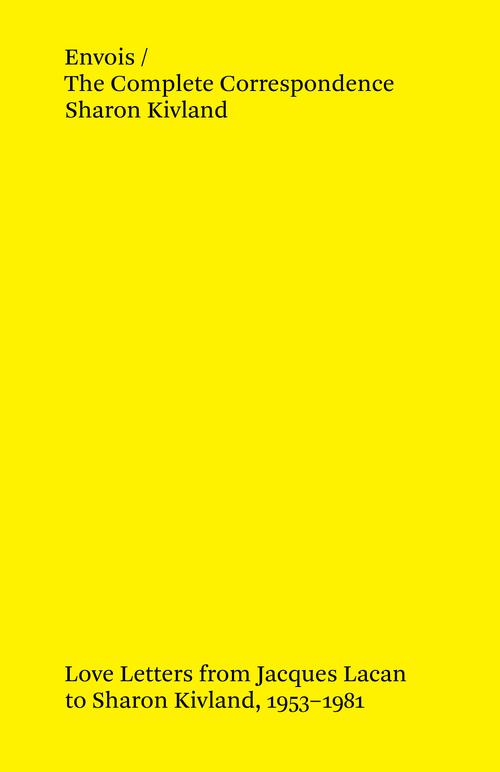
Envois/The Complete Correspondence: Love Letters from Jacques Lacan to Sharon Kivland, 1953–1981, by Sharon Kivland. Tenement Press, £20 (softcover)