In an exhibition at Pinault Collection, the Brazilian artist fuses the corporeal and the abstract via text-based works and installation
The first solo exhibition of Lygia Pape in France underscores the historical significance of artists from outside Europe who built intellectual foundations beyond the continent’s authority – not merely absorbing the dictates of Eurocentric modernism, but forging circuits of exchange and invention, as occurred among Pape and her peers of Grupo Frente, such as Lygia Clark. The works thrive within the vast galleries of the Bourse de Commerce, a cogent and finely curated selection – some three dozen works dated between 1955 and 2003, from video performances and visual poems to installations and woodcut prints – that encapsulates Pape’s inventive, radical, rigorous practice. The Brazilian Pape merged social encounter and abstraction, understanding the dissolution of boundaries between spectator and work beyond discussions usually limited to phenomenology, and moving towards sociopolitical practices during years of a democratic instability in Brazil.
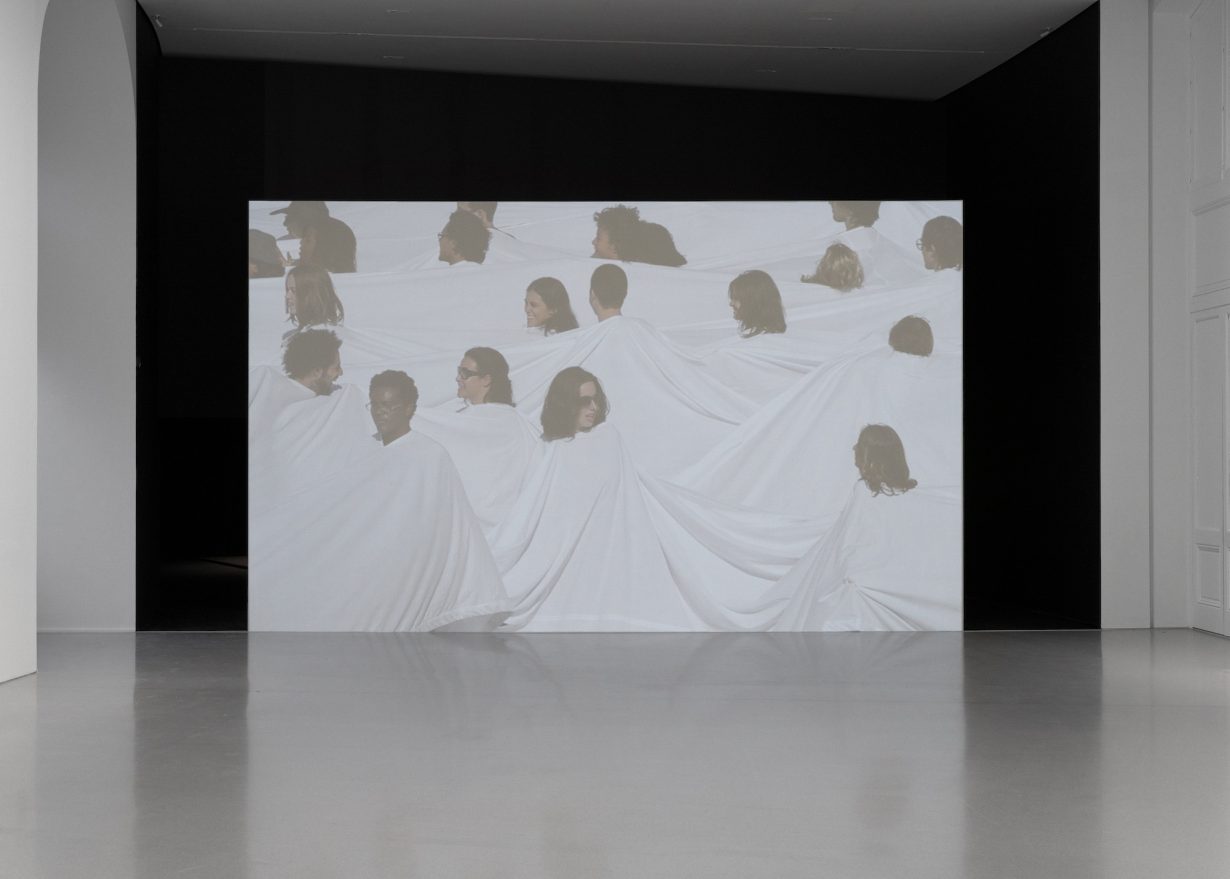
Weaving Space opens with text-based works, such as the typewritten visual poems of the 1960s. Here, Pape treats language not simply as medium but as matter, fusing graphic vitality and conceptual rhythm – close to Neo-Concrete peers such as Willys de Castro and Hélio Oiticica. One poem, ‘aranha / no ar / aranha’ (‘in air / spider / weaves’, c. 1960s), seems to anticipate her later Ttéia installations, begun during the late 1970s: the luminous thread-sculptures that dominate the show. Her engagement with poetry foregrounds participation and intersubjectivity, and resonates with Divisor (Divider, 1967–68), a videorecording of a performance, projected across an immense wall: in it a white sheet stretches over hundreds of people in Rio’s streets, only their heads visible, forming a living grid – an ephemeral geometry of collective motion, fostering connections between nonhabitual art audiences and the conceptual debates usually limited to erudite realms.
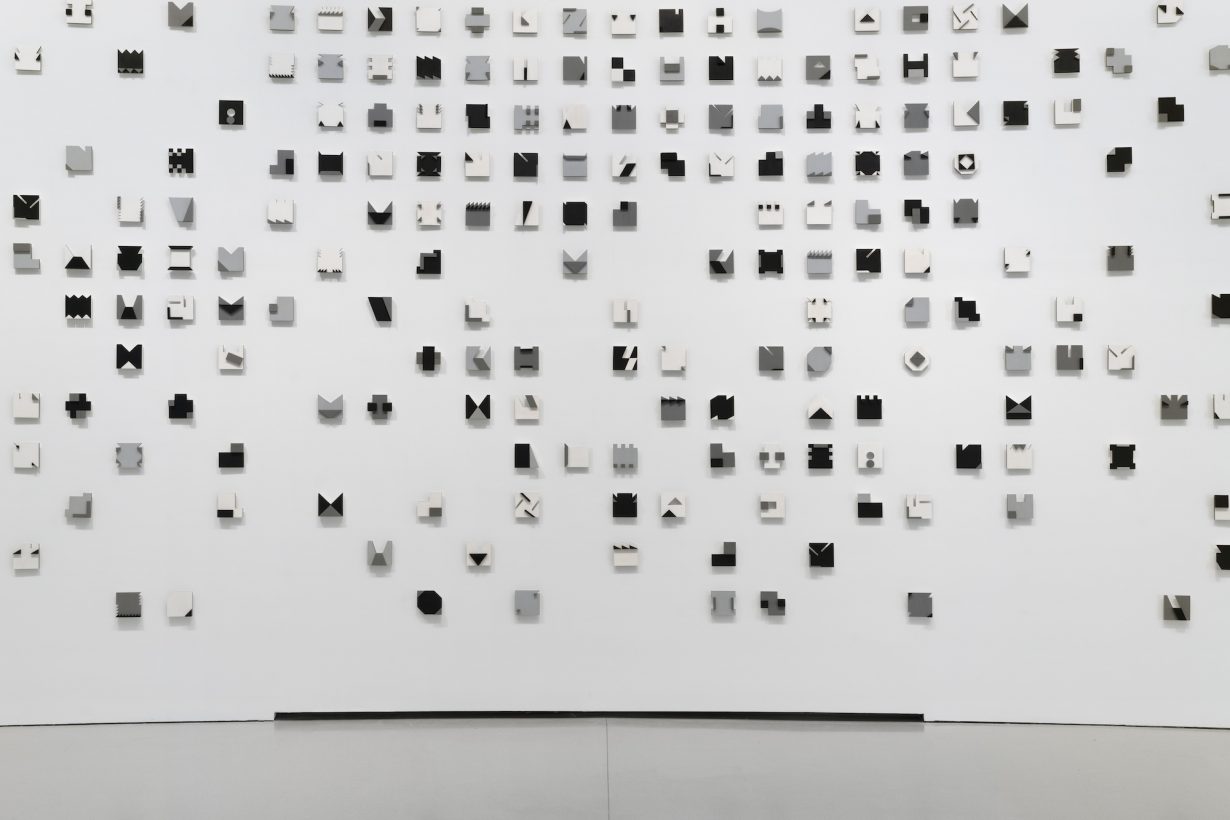
Nearby, Livro Noite e Dia III (Book of Night and Day III, 1963–76), a suite of 365 square variations on wooden geometrical cutouts painted black, white and grey, proliferates across Tadao Ando’s vast concave concrete wall, a striking display of work usually presented on a flat surface. Suggesting the circadian rhythms evoked by its title, the sequence morphs like folded or cut forms in motion – the iterations of squares and diagonals, folds and zigzags part algebraic, part lyrical. In a smaller room, Tecelares (Weaving, 1956), woodcuts on Japanese paper in which rectangular forms expand concentrically, articulate Pape’s thinking on cultural interconnectedness and the constructed genealogies of art; historically they succeed Josef Albers’s 1942 lithograph Sanctuary, while preceding Frank Stella’s comparable Black Paintings (1958–60). Rejecting the notion of a finished work, Pape conceived each print as a living proposition, accumulating meaning through the viewer’s reading.
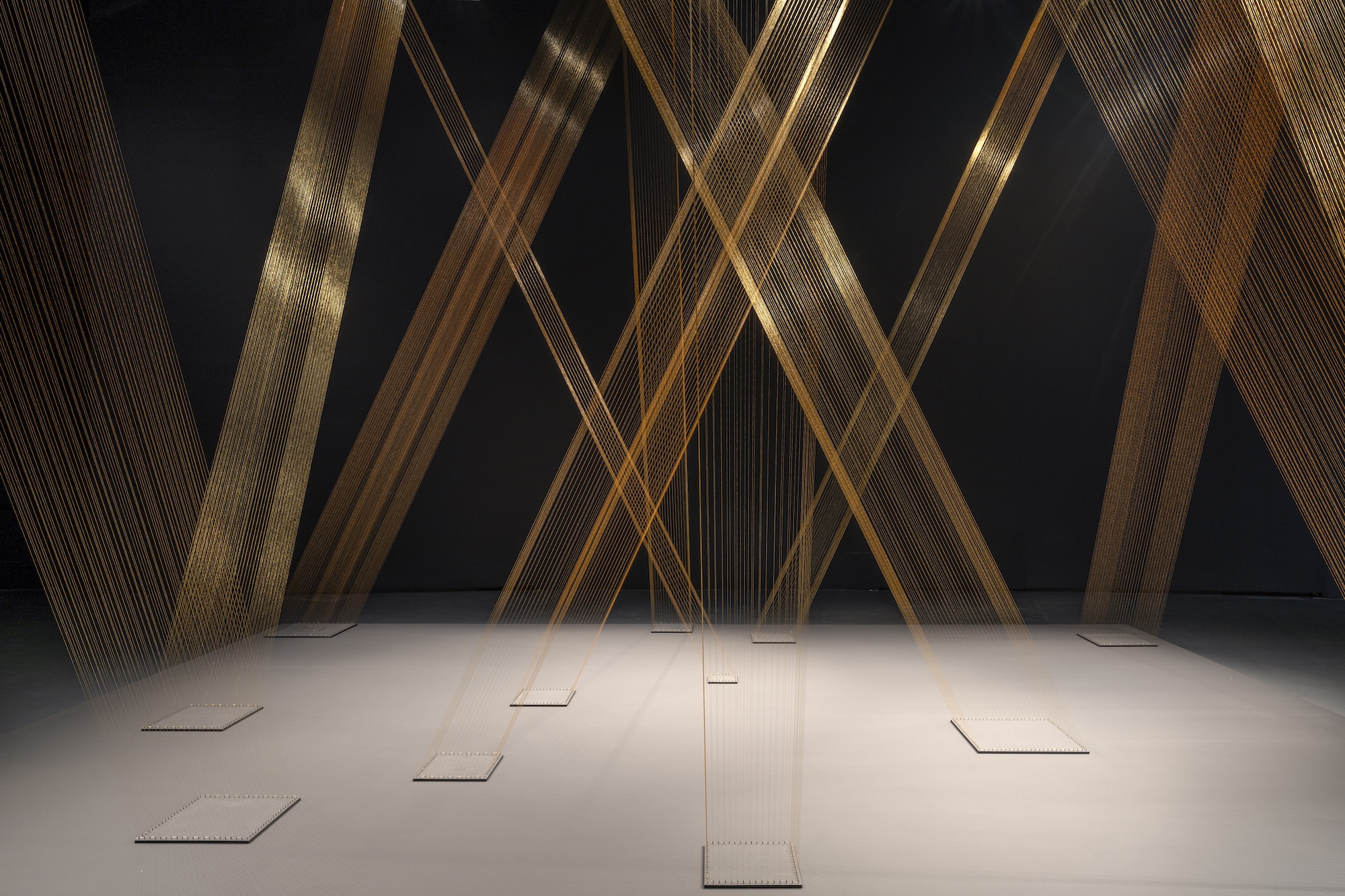
The enormous and seductive Ttéia 1, C (2003/2025) occupies an entirely black room, its taut golden threads rising and descending between floor and ceiling, precisely lit by oblique spotlights, forming intersecting square-sectioned inclined columns that reveal volume as illusion – space rendered tangible by glimmer. When one looks upward and sees the black squares where the threads are tied, fastened to a white metal framework, a characteristic black-and-white geometric composition emerges – one Pape had earlier materialised in her untitled wooden reliefs of the Livro dos Caminhos (Book of Paths) series (1963–76, not included).
While Ttéia 1, C captivates through scale and spectacle, its smaller, older counterpart Ttéia 1, A (1978/2025) stands as the exhibition’s most impressive work. Silver threads pinned horizontally across the corner of two white walls, creating a zigguratlike stack, glitter under focused light, vanishing and reappearing with each shift of view. Their fleeting presence invites the eye to recall the shimmer that flashed a moment earlier, visible only from a precise, unrepeatable angle. The piece distills Pape’s fusion of the corporeal and the abstract – her tactile act of weaving space into thought.
Lygia Pape: Weaving Space was at Pinault Collection, Paris