The artist’s exhibition in London lets us feel what trusting historical and colonial documentary has always cost
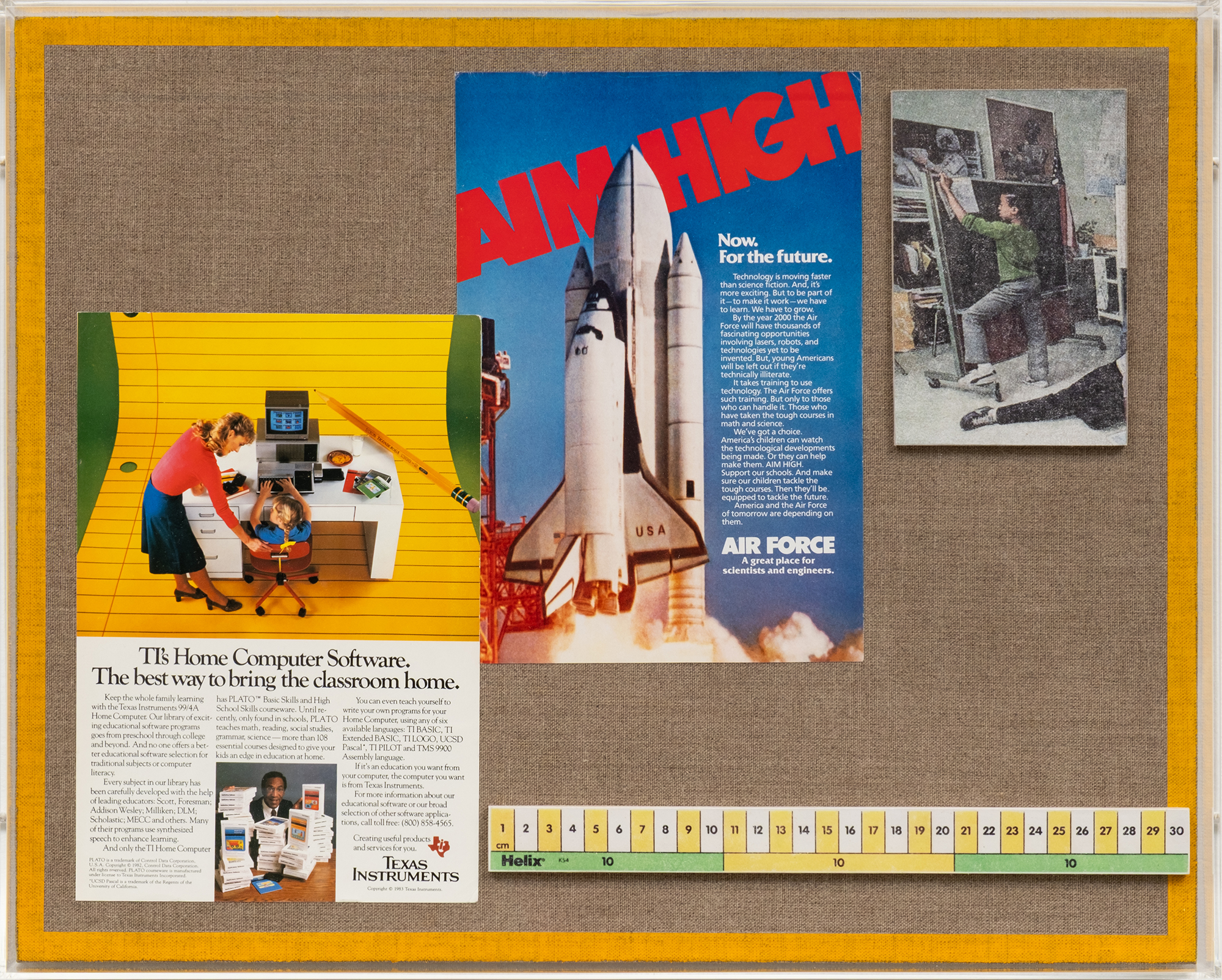
Three drawings of a photographer cast eye and camera across Alma Pearl. In the case of Celestino (RGB) (all works 2026) the exhibition text identifies its central character as the protagonist of Roberto Rossellini’s La Macchina Ammazzacattivi (The Machine to Kill Bad People, 1952), versioned in crisp red, green and blue. In the film, Celestino wields the gift of a magic camera that functions as a gun, killing only ‘bad people’ – one reference among the many Lyndon Barrois Jr. pulls across the exhibition, from the mining of National Geographic magazines to citations across cinematic history. The coolly rendered photographer means little until supplied with its murderous backstory, at which Celestino’s blank affect curdles into something threatening. In multiple works, appropriated National Geographic advertisements are central: in Aim High, cuttings sit on raw linen bordered by a painted yellow edge (mimicking the magazine’s iconic cover); images of home-computer software and a NASA Space Shuttle stage capitalist aspirations and futurity, offset by a patinaed solvent-transfer of a child in a classroom. Elsewhere, rulers, colour charts and archaeological and surveying equipment recur: instruments that lent documentation its claim to objectivity are placed against advertisements that perpetuate ideas over facts, exposing these systems as arbitrary.
A triptych of oil paintings, Unrest (RGB), reproduces a sign from Cyril Schäublin’s film Unrest (2022), set in a Swiss watch factory, another reference revealed by the extensive exhibition text. In muddy shades of red, green and blue is the decree, ‘Soyez bref, vos minutes sont aussi précieuses que les nôtres’ (be brief, your time is as precious as ours). Barrois Jr. frames his concerns with authority and verification by abstracting the sign from its source. However, like the Celestino drawings, the piece asks a fluency of the viewer to fully participate in the show’s network of references. This demand feels intentional: an exhibition interrogating ‘who’ gets to classify and document can hardly avoid implicating its own reliance on specialist knowledge. The artist’s own erudition becomes another perpetuating system asking to be taken on faith.
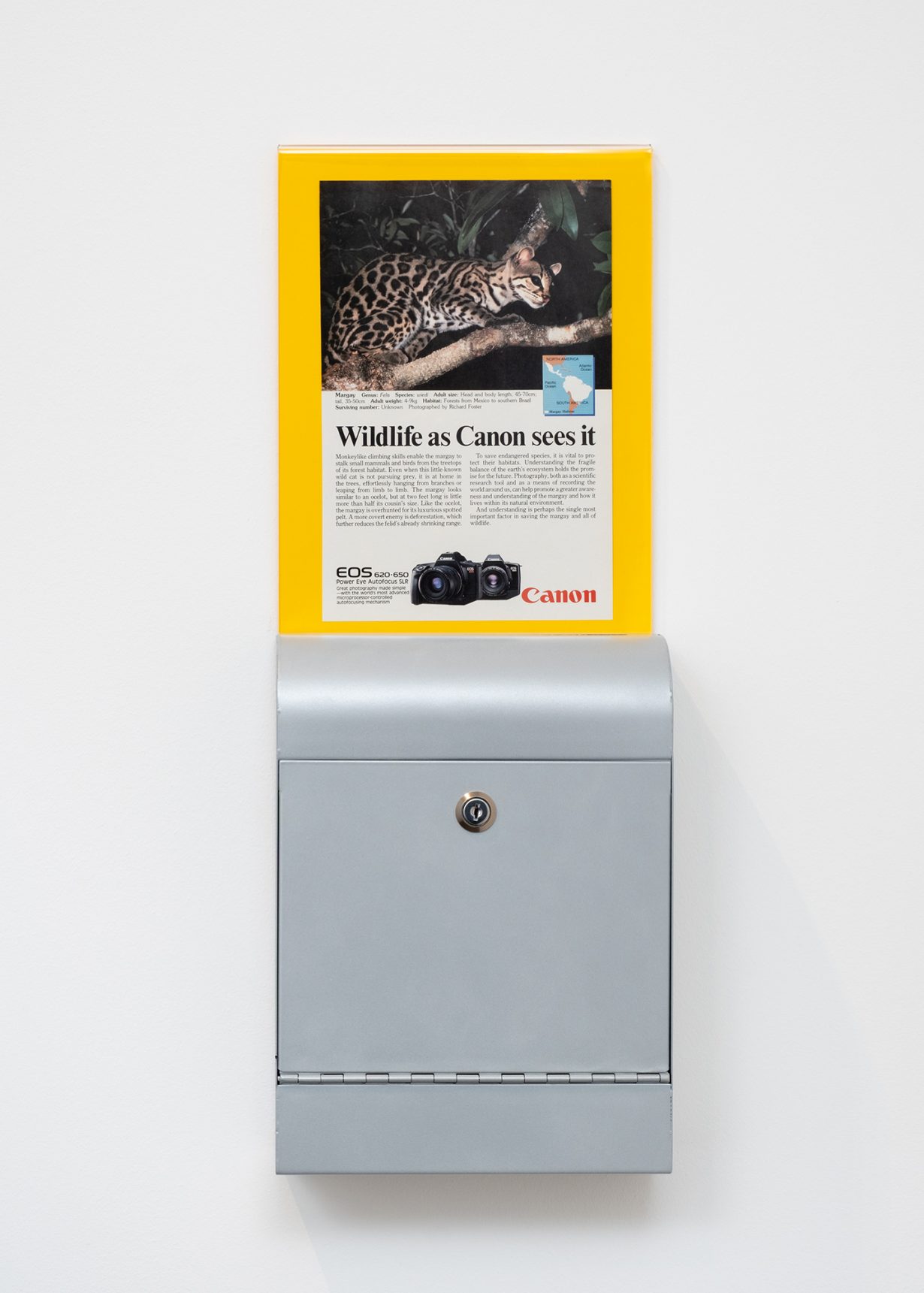
Source Material (Promise) holds a series of National Geographic magazines, heavily thumbed, inside a grey archival box, atop a cerulean film canister caressed by a limp conservation glove. Its theatrical staging imbues the sculpture with an uncanny tang: the yet-to-be-altered objects let us metabolise the idea that the artist will continue to extract from this material, as the magazine’s original photographers once extracted from the globe. But where the wall-based works reframe their source material more fully, the sculptural readymade doesn’t need this archival cosplay. Appraised away from the orientation of the wall, the effectiveness of these objects and Barrois Jr.’s particular dialectic of assembling disparate referents falls away, exposing how much of the associative work is done for the viewer by the conventions of display. In contrast, To save endangered shines in its austerity, a National Geographic DSLR cameras advertisement, held behind a plexiglass enclosure protruding from a nondescript suggestion box. Alluring in its simple fusion of disparities, it is indexical: the advertisement protruding from an actual suggestion box, physical systems under scrutiny, not the image of them. This directness lets us feel what trusting historical and colonial documentary has always cost, without the explanatory apparatus the show leans on elsewhere.
Lyndon Barrois Jr.: Desert of Promise is on view at Alma Pearl, London, 10 September – 24 October