Why the prosthesis is at the centre of explorations around body, technology and identity
The prosthetic and the posthuman have become staple terms in contemporary art concerned with the body’s interaction with technology. Feminist scholar Donna Haraway in her 1985 text ‘A Cyborg Manifesto’ calls upon the figure of the cyborg – ‘a hybrid of machine and organism’ – to generate new practices of embodiment and defines prosthesis as not just a mechanical extension, but the social and psychological processes through which bodies, technologies and identities interface. In this context, the posthuman does not signal a body beyond or after the human, but rather a condition in which the boundaries of the human are understood as contingent, distributed and sustained through technological, social and material relations. For artists, this framing opens up the prosthetic as a tool: a way to think through how bodies are made by systems of support, mediation and repair. It enables a critique of the autonomous body by foregrounding dependence, interconnection and adaptation as constitutive conditions rather than failures.
Yet the very flexibility that Haraway proposes gives the prosthetic its semantic complexity and also makes it vulnerable to misuse. When detached from the specificity of disabled experience, many artistic interventions centred on the prosthetic unconsciously mobilise disability as nothing more than a metaphor – borrowing its vocabulary while erasing its lived meaning. This manifests as the use of prosthesis to signify loss, trauma or abjection. In this framework, the disabled body is reduced to a stand-in for notions relating to the universal or ‘normal’ human condition.
Multidisciplinary artists Mari Katayama, Park McArthur and Jesse Darling recognise the metaphorical potential of prosthetics, since it sets into motion imaginative analyses and interpretations, while also critiquing and redressing what media theorist Vivian Sobchack has called the ‘displacement of the prosthetic through a return to its premises in the lived-body experience’. Crucially, this return is not only representational but formal: it asks how the structures, supports and dependencies that shape disabled life might actively determine the shape and logic of the artwork itself. In doing so, the question is posed: what would it mean for the prosthetic and the posthuman to move from a reductive abstraction to a representation of the day-to-day realities of disabled experience?
Katayama, who uses prosthetic legs, became interested in sewing from an early age, not just a practical skill but a philosophy of selfmaking. Using her own body, clothing and found materials in her later artmaking, she often positions her decorated walking aids – which she paints with ornate motifs, including flowers and birds – beside the rest of her body rather than attached to it. In photographic works like shell/beast (2016), her prosthetic legs gleam amid cascades of embroidered pillows and lace. The result is neither compensation nor camouflage. It is a sculptural bloom of fabric and flesh, in which ornament becomes anatomy and vice versa. In the series caryatid (2024), Katayama’s prosthetics are used as aesthetic and conceptual devices that reimagine the boundaries of the posthuman. The work stages the prosthesis as both an intimate and tentacular structure within which she alternately shelters and emerges from, drawing on Donna Haraway’s notion of the tentacular as a form of embodied entanglement rather than a literal appendage. In this sense, the prosthesis operates simultaneously as support, insofar as it enables posture and presence; as surface, offering a site for decoration, inscription and display; and as a means of self-fashioning, through which identity is assembled, styled and continually remade. The title’s reference to the caryatid – a stone carving of a draped female figure, used as a load-bearing pillar in classical Western architecture – links Katayama’s body to histories of classical form, gendered labour and display. By inserting her body into this lineage, she exposes the exclusionary logic of their architectural ideals. Like Haraway’s cyborg, her self-portraits and installations unsettle the boundary between organism and machine, body and object. However, whereas Haraway’s posthumanism imagines hybridity as a universal condition of techno-organic existence, Katayama insists on the specificity of her own embodied experience. Her prosthetic extensions are not abstract symbols of fusion but lived interfaces – stitched, worn and inhabited. Here, form becomes ethics: the visibility of seams, joins and embellishments refuses the fantasy of seamless integration that often accompanies posthuman discourse. Materially, she grounds posthuman theory in the textures of lived disability, recasting the prosthetic as a site of agency, desire and creation rather than lack or supplementation. In doing so, she resists readings that define her solely through disability, positioning her work instead within a broader dialogue about self-construction, visibility and the politics of representation in contemporary art.
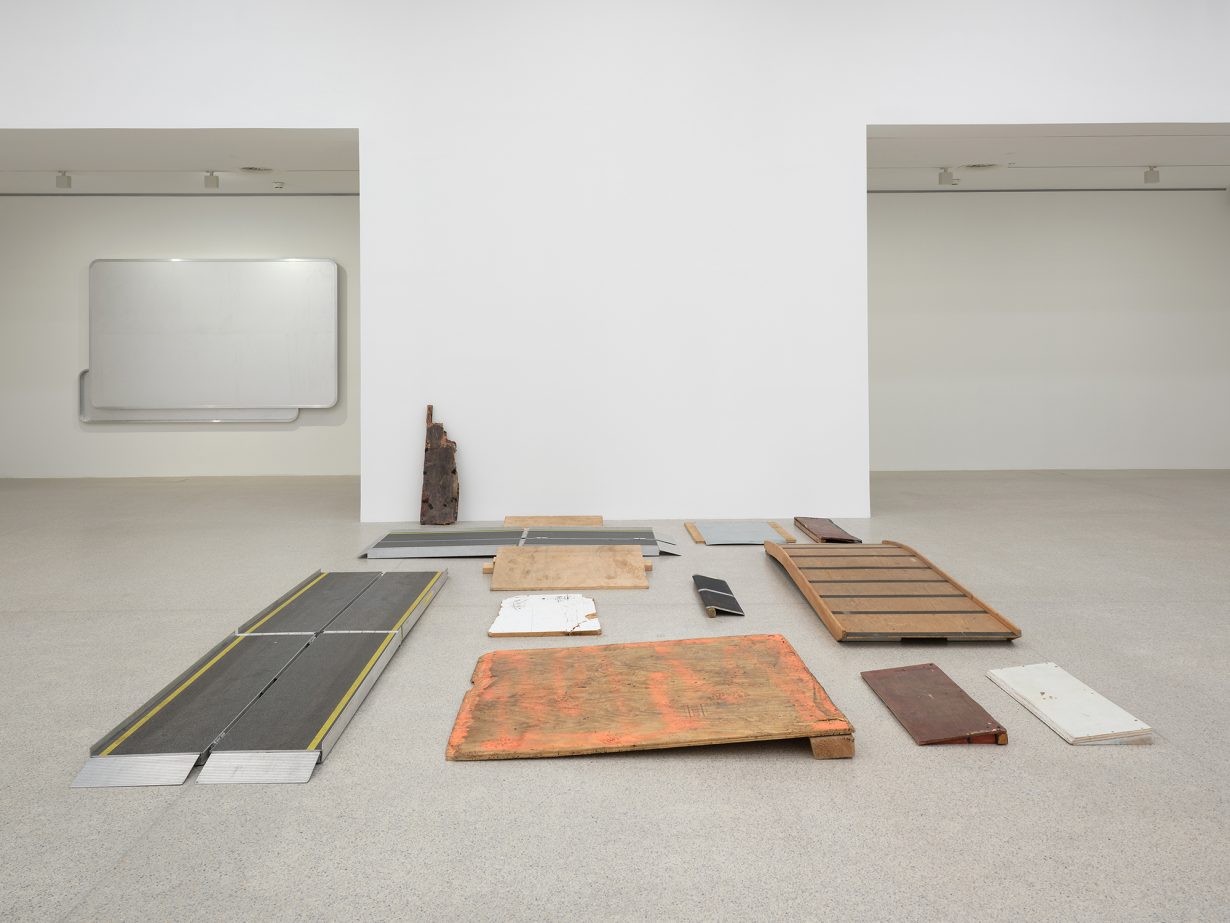
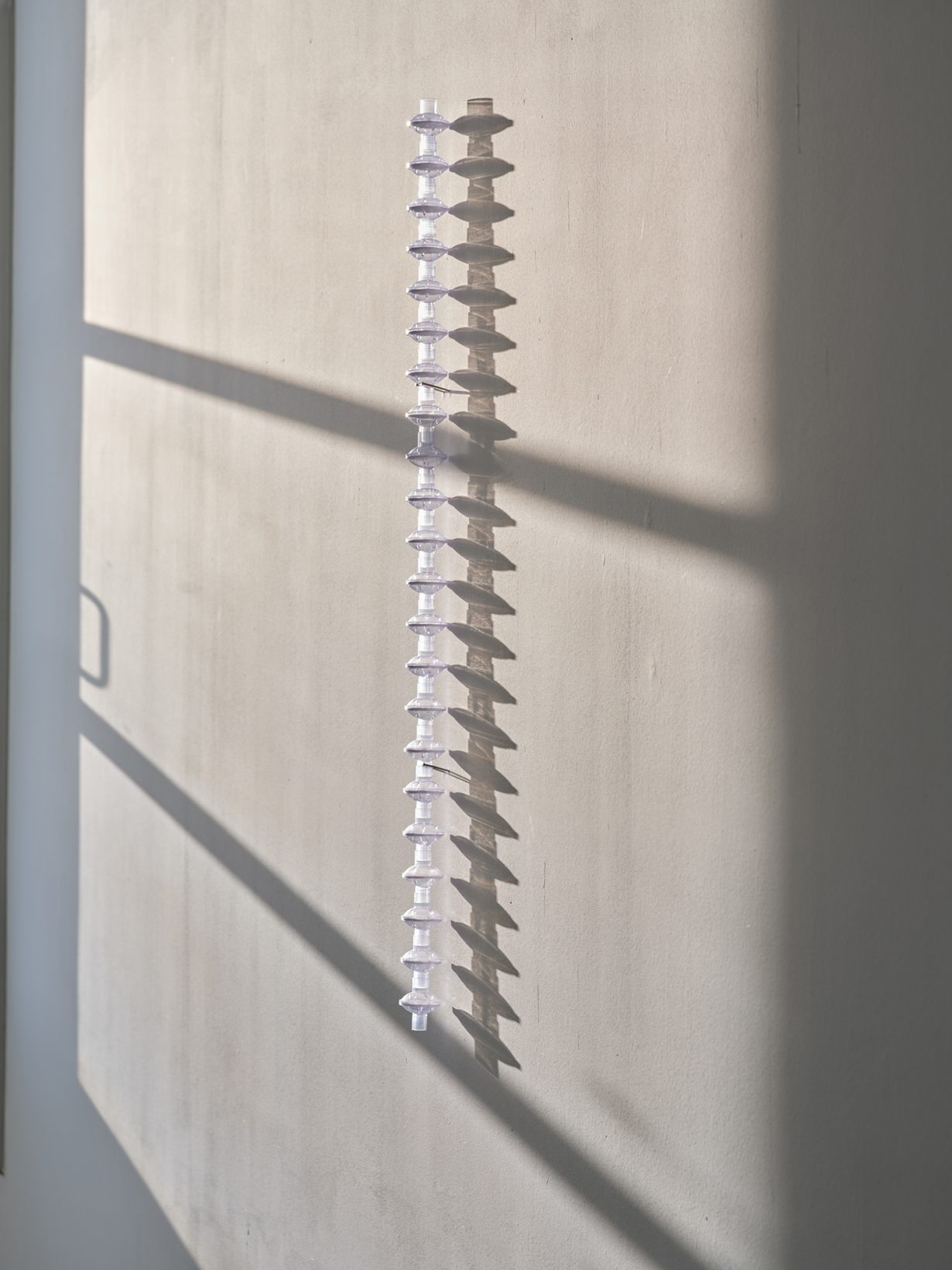
Park McArthur shifts the focus to infrastructure. Her works from the 2010s and 2020s coalesced in her exhibition Contact M at Vienna’s Mumok and Museum Abteiberg in Mönchengladbach last year. Her installations of medical equipment – heel protectors, bandages, ventilator filters – foreground prosthetics as social supports rather than simply supports for the individual. In Ramps (2014), a collection of ramps made of woodchip and rusted metal lie across the gallery floor. As infrastructures of movement, ramps form the ground on which participation becomes possible, structuring how bodies move through space. McArthur’s choreography of ramps is rendered unusable, exposing the conditions under which access is permitted or denied. In her 2024 exhibition Twice, the artist created a 153cm stack made up of 22 clear plastic, disposable viral and bacterial filters used by the artist to filter air coming into her ventilator. These works do not simply repurpose the materials of dependency as sculptural matter; they make dependency itself the organising principle of the work’s form. By foregrounding repetition, accumulation and maintenance, McArthur reframes reliance not as a personal deficit but as a shared condition that shapes space, time and attention. The work resists spectacle in favour of endurance, insisting that care, access and survival are slow, ongoing processes rather than moments of resolution. By critically looking at dependency as an experience filled with aesthetic possibility and formal invention, McArthur’s use of prosthetics reveals how space itself is organised through regimes of access. In this sense, her work gestures towards a broader redefinition of the prosthetic as a relational system that binds bodies to environments and to one another. As artist and writer Johanna Hedva reminds us in her essay ‘Sick Woman Theory’ (2016), ‘You don’t need to be fixed, my queens – it’s the world that needs the fixing’, and in this sense, McArthur’s prosthetic aesthetics become a speculative mode that rethinks the body as relational, contingent and socially mediated.
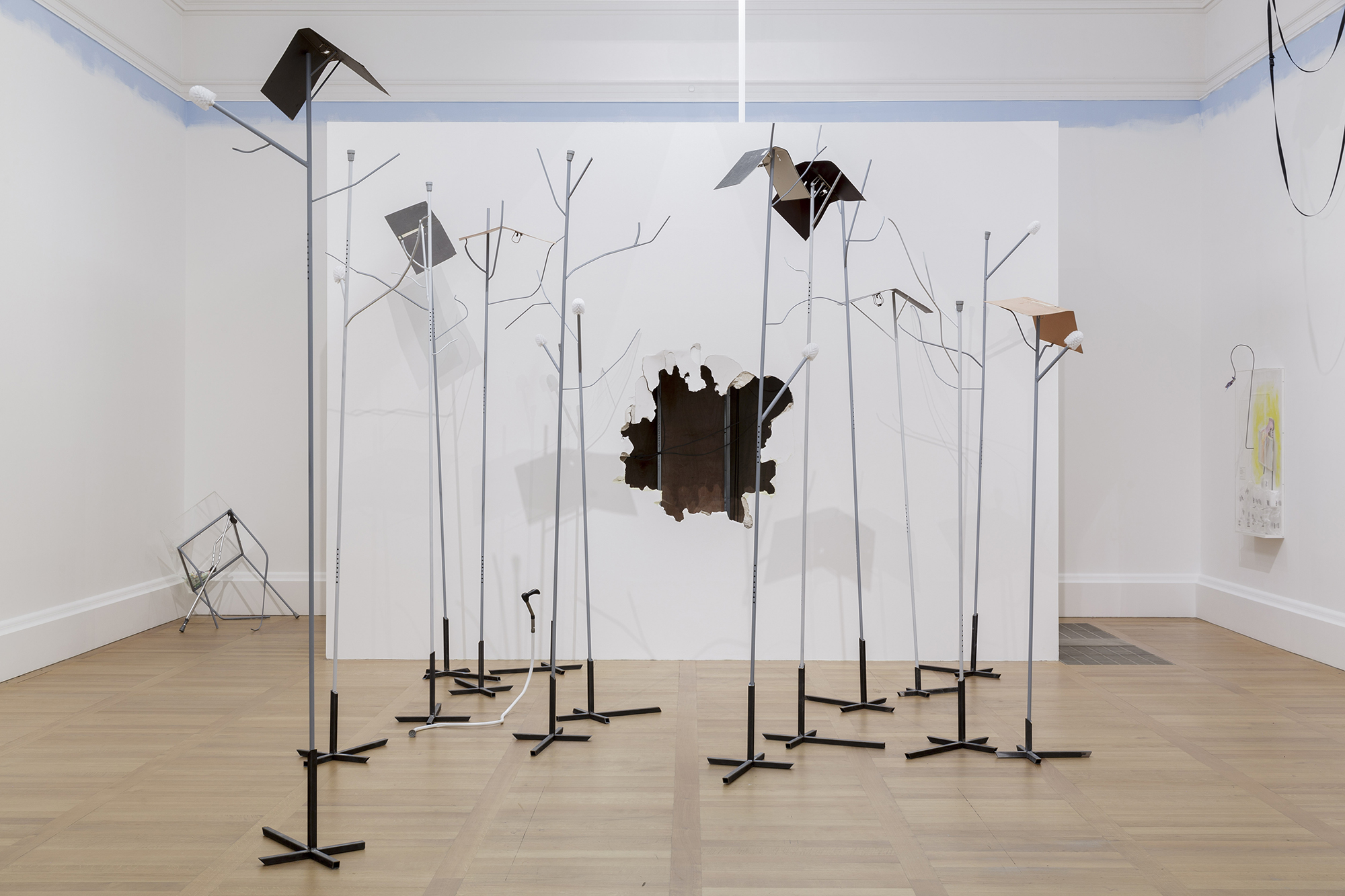
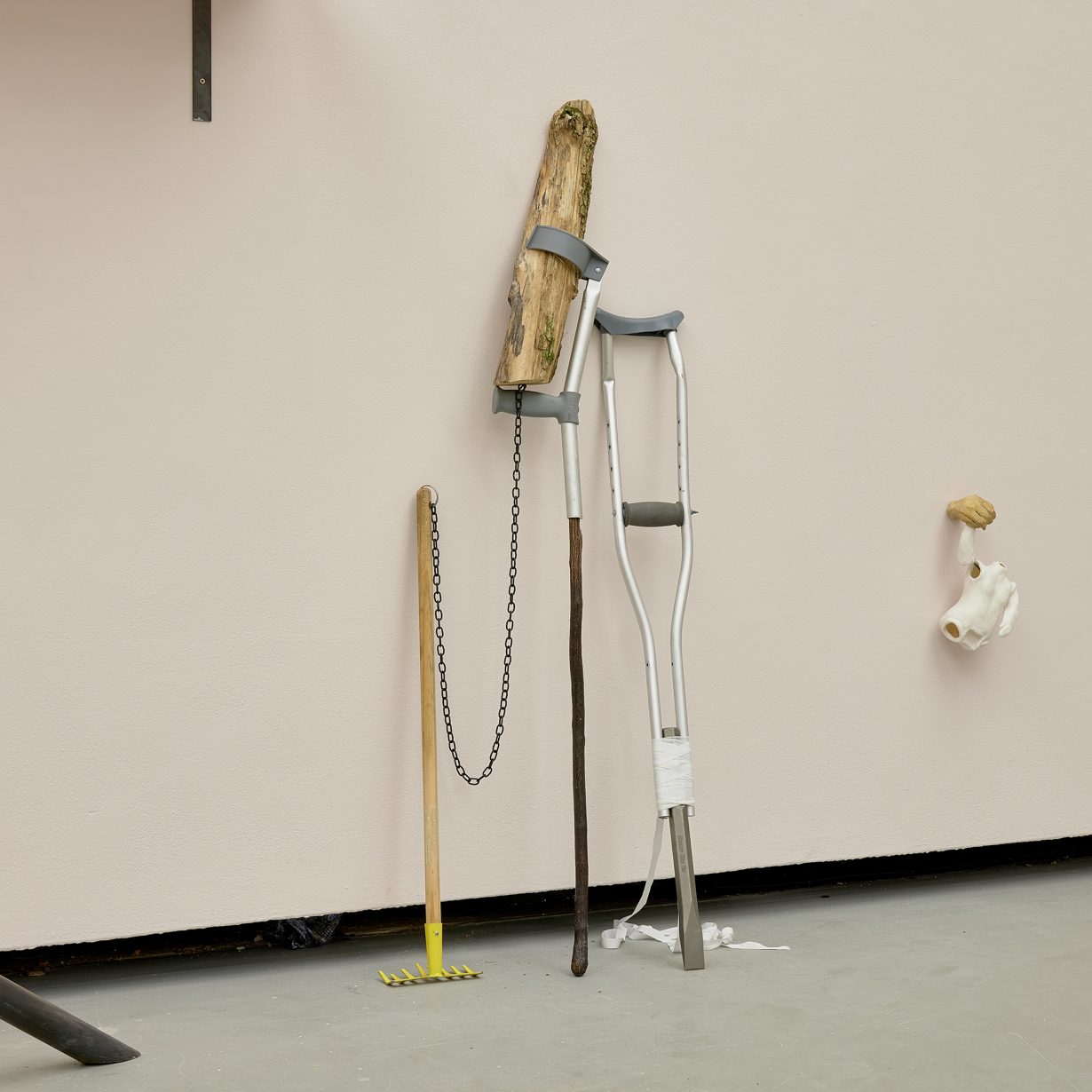
Where Katayama revels in ornament and McArthur rethinks infrastructure, Darling turns towards collapse. His approach can also be read through the lens of the posthuman – not as a celebration of technological transcendence, but as a critique of its promises. Rather than projecting a speculative future, Darling situates the posthuman firmly in the present, locating it within the everyday materials and systems that already sustain, fail and entangle bodies. In this sense, his work speaks directly to a world shaped by austerity and institutional breakdown, in which survival depends less on innovation than on improvisation. Darling’s sculptures – assemblages built from twisted crutches, knotted metal tubing and repurposed everyday objects – reconstruct a vulnerable world in which the body’s dependencies become collective rather than individual burdens. In Saint Jerome in the wilderness (2018), 15 freestanding sculptures made of prosthetic steel, lacquer, toilet brushes, rubber ferrules and archival binders form a sparse forest of mobility aids. The objects lean and tremble, their thin metal frames suggestive of exhausted bodies. Composed of recognisable, functional materials drawn from healthcare, domestic and institutional contexts, these works refuse the futuristic imagery often associated with the posthuman. Instead, they insist that the posthuman condition is already here, embedded in the ordinary infrastructures that govern care and mobility. They read as prosthetics for this collapsing posthuman world, their materials evoking both life’s precarity and the fragility of health systems meant to sustain it. In Grandad I (Ploughman John) (2023), this atmosphere is scaled down to bodily proportions. Slumped against a wall leans a piece of wood, a rake, two crutches and a chain – bent, buckled and reassembled into a landscape of failed supports and exhausted infrastructures. Here, dependency is not resolved through design but exposed as an unstable, improvisational condition. Darling’s posthumanism emerges not through technological excess but through material depletion, casting the contemporary world itself as a site of ongoing breakdown rather than progress. In Darling’s material world, corroded elements cling together like connective tissue, their fragility embodying an ethics of dependency. The prosthetic body is not augmented but entangled; revealing the shared condition of dependence and exposing how the dream of autonomy is sustained by fragile systems of care and support that are increasingly strained in the present.
This critical awareness of how prosthesis operates both as material object and metaphor finds a parallel in the work of disability studies scholar Katherine Ott, who complicates Haraway’s theory of the posthuman. As Ott observes, Haraway’s vision of the posthuman risks abstracting the material conditions of disabled bodies who have been made to speak for a cyborgian experience without being allowed to speak up – as evidenced by Haraway’s choice as her witness not the actual lives of disabled people but characters from the pages of science-fiction literature, where cyborg figures such as RoboCop or the Borg function as speculative metaphors. Ott’s intervention seeks a visual language of prosthesis that holds multiple, shifting significations. The prosthesis, she argues, is too often reduced to ‘a synonym for common forms of body-machine interface’ that ignore – whether consciously or not – the historical, cultural and material realities of prosthetic users. If Haraway’s cyborg gestures towards liberation through hybridity, Ott’s critique exposes a crucial tension: how do we reconcile the lived, embodied experience of disability with its political framing as a symbol of the necropolitical marginalisation of nonnormative bodies? That is, how do social and political systems decide which bodies are allowed to live and flourish, and which are rendered disposable? Thinking through prosthetics in this way throws the posthuman body’s supposed coherence into question: what does it mean to ‘complete’ a body, who defines what counts as ‘whole’ and can a body ever truly be ‘complete’ if it is always in flux, always forming and reforming?
From the January & February 2026 issue of ArtReview – get your copy.
Read next Berenice Olmedo’s Transhuman Futures