The surrealist fashion designed maintained that ‘clothes must be as modern as the world we live in’. A new exhibition at the V&A attempts to meet the moment

Coco Chanel famously hated Elsa Schiaparelli. When she wasn’t trying to set her alight at parties, she was busy dismissing her as ‘that Italian artist who makes clothes’. Coco had cut, snipped and stitched her way from poverty into becoming one of the most powerful couturières in Paris; she had strong views about what serious fashion looked like and stronger views still about who deserved to make it. Elsa, or Schiap to her friends, born into a Roman family of intellectual aristocracy, who had fallen out of a bad marriage and into an extraordinary career, was a threat to those ideals.
The V&A’s newest blockbuster exhibition sets out its argument in the title. Schiaparelli: Fashion Becomes Art is the first major UK retrospective of her work, bringing together more than 400 objects: garments, accessories, jewellery, paintings, photographs and archival material, many drawn from the V&A’s own substantial Schiaparelli holdings. It follows the increasingly cosy relationship between these two worlds by returning to one of the first grand doyennes of cross-disciplinary creativity. However, it being a V&A blockbuster exhibition, the story is allowed to begin with the founder, but it cannot end with her. Instead, it inevitably must set up a conversation between what the house was and what it now is; drawing a wider arc that reaches into the present, and ensuring that Maison Schiaparelli in its current incarnation gets all the institutional legitimacy and visibility it would expect in return for its much-publicised support.
The show welcomes visitors with two sentinels. First, Schiaparelli’s famous 1938 skeleton gown: padded silk crepe ribs and pelvis trapunto quilted to press up from beneath, like bone bursting through flesh. Its creepiness is exquisitely subtle, crafted all in black so that the full memento mori effect only comes into focus at certain angles. On the other side of the entrance stands a design by Daniel Roseberry, Schiaparelli’s creative director since 2019 – a deep scoop-necked black gown overlaid with metallic lungs, originally worn by Bella Hadid at Cannes. Both pieces work the same territory – the body made vaguely alien by bringing its interior to the light – but they do not do it in the same way, or with the same restraint.

Plastic zips close the shoulder seams and side of the skeleton dress. They are the kind of jokey-but-pragmatic gesture typical of Schiaparelli, intended first for the wearer and only second for the beholder. The exhibition’s category-based hang, moving between daywear and evening wear and surrealism and Roseberry, makes such a nuance hard to grasp. Without a real arc, the show cannot build a coherent picture of who she was or what was at stake. Her personality is abundant at every turn – you feel her intelligence, her refusal to be solemn, her incredible business acumen – but the person herself remains oddly ghostly. The exhibition gives you Schiaparelli in full; it cannot quite give you Schiap.
This is partly a problem of biography. The V&A is not obliged to recount Meryle Secrest’s superb 2015 account of the designer. An exhibition can illuminate a life obliquely, through objects and juxtaposition, without following it chronologically. But a little of the tension and complexity so plentiful in Schiaparelli’s story would bring many of the designs to life with greater force. One wall text informs us that ‘after returning to Paris from New York in July 1945, Schiap designed collections for the next eight years’. What goes unmentioned is that, during the war, Schiaparelli was under suspicion from all sides – British, French, German and American intelligence services had all noted her movements – largely as a potential Vichy collaborator. She was never charged and returned to a city keen to move on, pre-war whimsy and wartime practicality replaced with Christian Dior’s ultra-ornamental, ultra-feminine silhouettes. She closed her house in 1954. One could argue this is best saved for the catalogue – where it is mentioned – but the casual visitor, told this, would be more gripped rather than less. They might even look at the clothes differently.
Take two jackets she presented during her 30-city American lecture tour in 1940: one in embroidered crepe with large practical pockets, the other featuring enamel globe buttons, which, the wall text tells us, ‘represented a united world at a time of war’. The label frames the tour as cultural diplomacy, Schiaparelli promoting French couture while also licensing select designs to American manufacturers (though she was emphatic on French fashion’s superiority to her stateside counterparts). To do so, she had sailed from Nazi-occupied Paris weeks after its fall. On arrival, America’s most famous columnist publicly accused her of spying. Throughout the early war years, she travelled freely between occupied France and America at a time when such movement was virtually impossible without the right protections – and it was far from clear who was providing them. Was it patriotism, ambition or collaboration that drove her? These readings aren’t mutually exclusive, but the ambiguity gives the jackets a charged aura that goes above and beyond utility or symbolism.
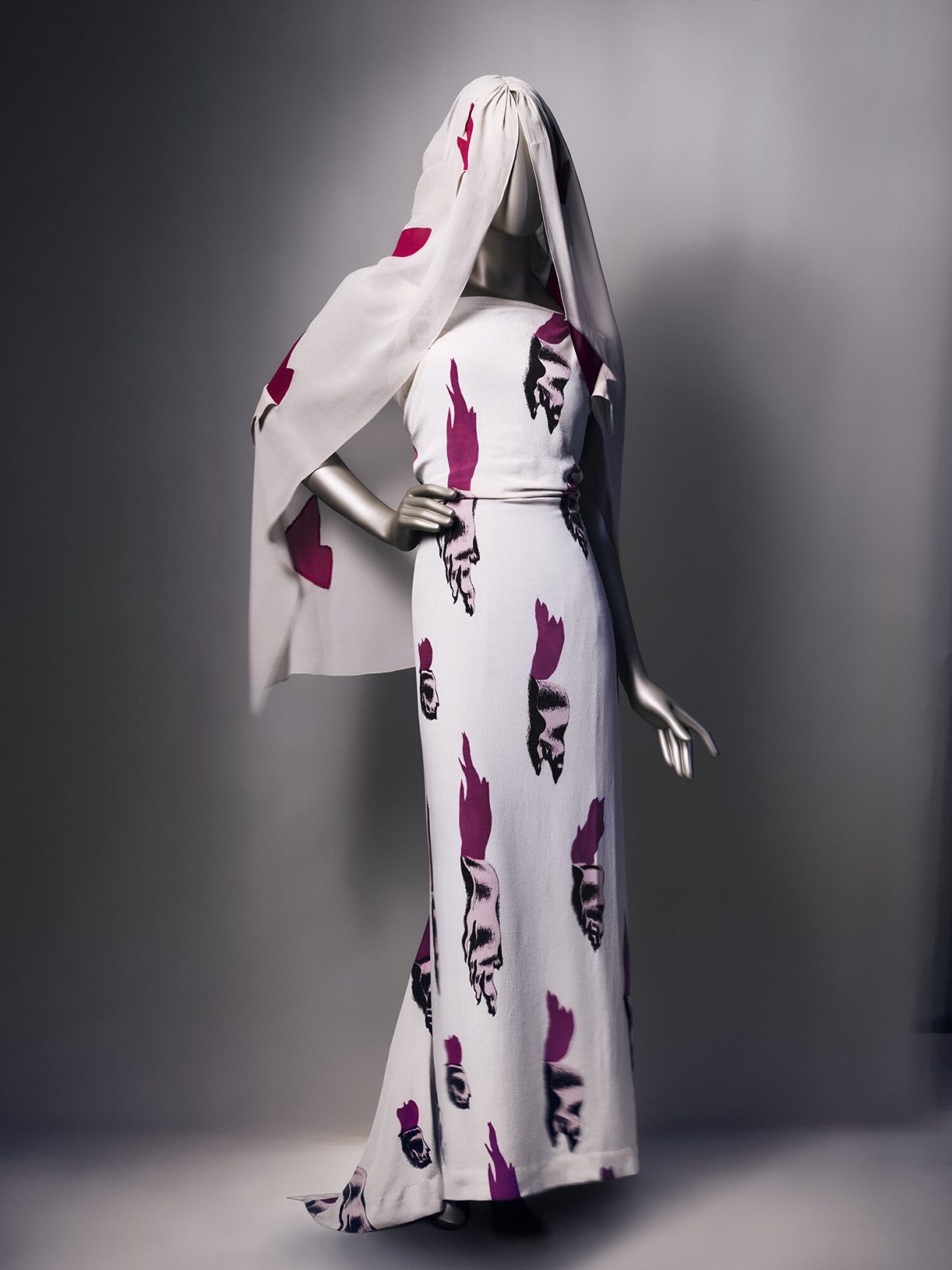
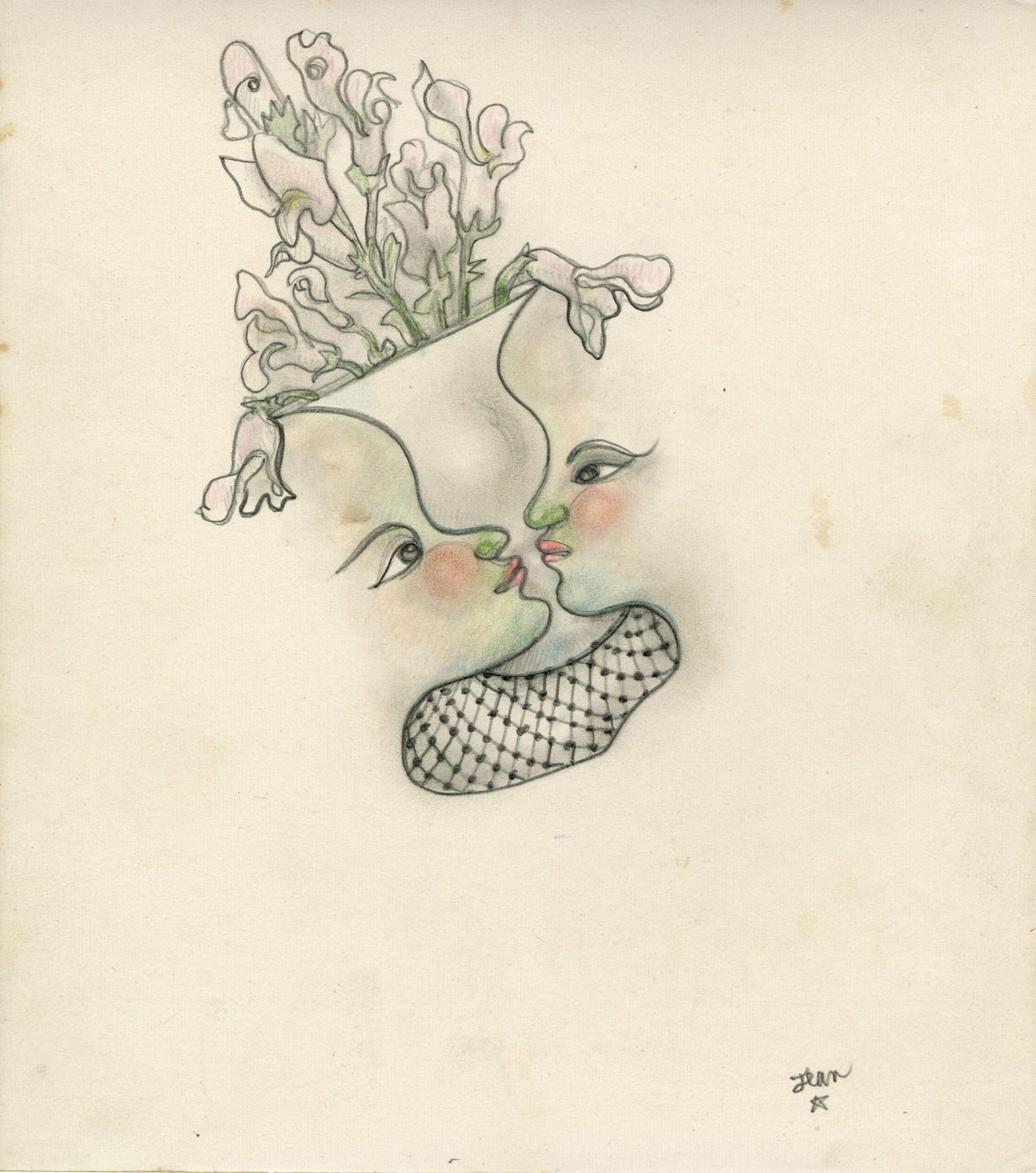
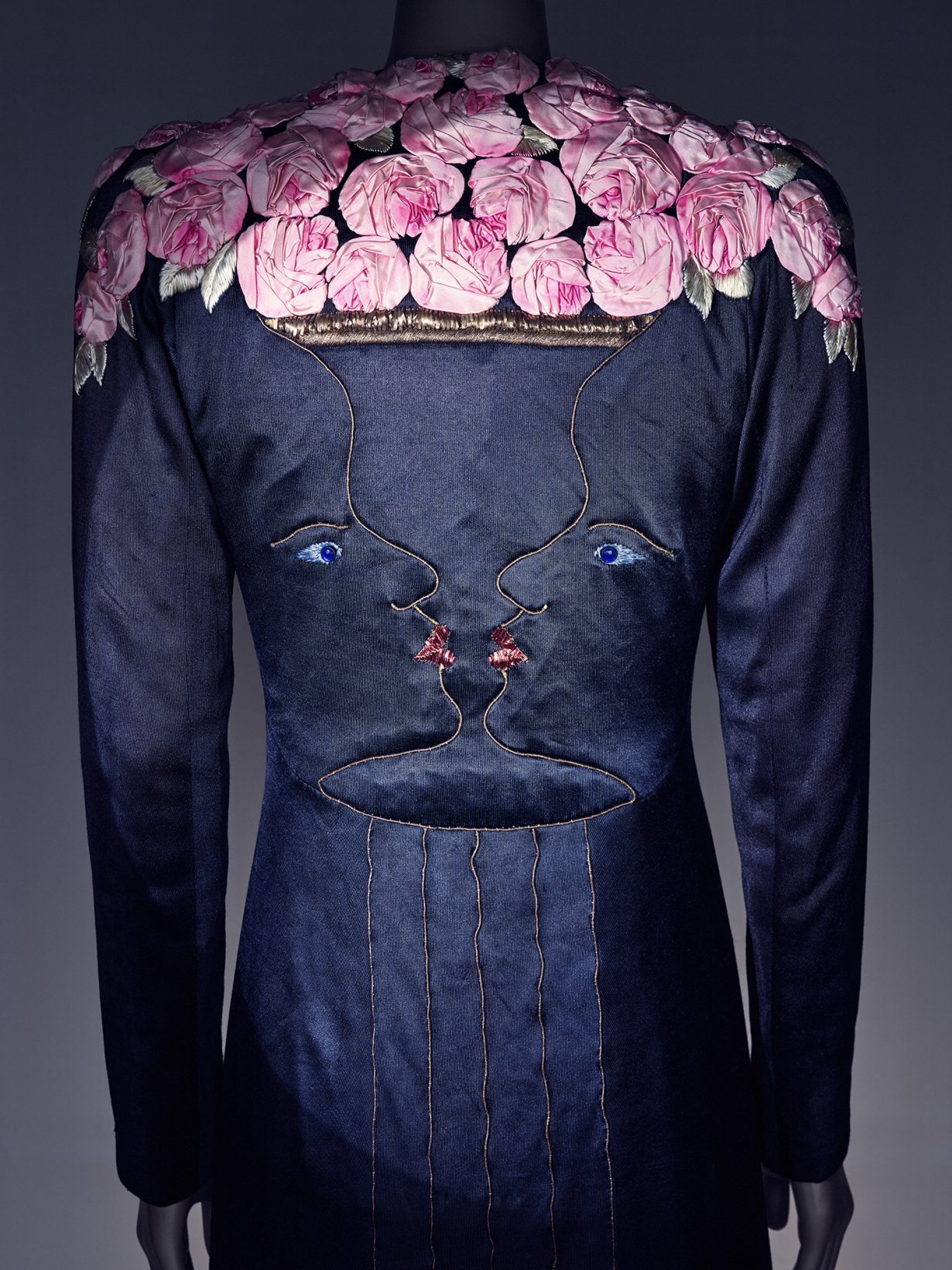
What is clear is that Schiaparelli was ruthlessly driven, and inspired fierce devotion in her clients and collaborators alike. Chief among them was Salvador Dalí. The 1938 tears dress – a pale silk gown printed with rips and gashes, as though the fabric had been clawed open – is shown beside Dalí’s Necrophiliac Springtime (1936), the painting that inspired it, which Schiap also owned. You can see the ideas moving back and forth, the painted tears becoming trompe l’oeil print becoming real apertures in the veil. She edited him as often as she deferred to him; when he suggested adding a dollop of mayonnaise to the 1937 lobster dress, its white silk skirt featuring a crimson crustacean, tail placed strategically between the legs, she refused. Elsewhere, a Jean Cocteau drawing of facing profiles has been adapted to form a rose-filled vase, embroidered by Lesage on the back of one of the show’s most beautiful coats.
More delights abound. The circus collection: printed trapeze artists, horsehead clasps and acrobat fastenings; the zodiac collection, all planets and astrological symbols picked out in embroidery and mirror; her gorgeously creepy insect necklaces and snail brooches. A cabinet full of buttons is pure pleasure, a dazzling taxonomy of the imagination featuring stags, beetles, ducks, dragons, fossils, cat’s eyes, black leather stars and a loping hunter by Giacometti. The dedicated section on her London connections is also genuinely illuminating – not only tracing the establishment of her Mayfair salon which catered to an independent-minded British clientele including Harper’s Bazaar editor Frances Rodney and art collector Maud Russell, but revealing that it was Schiaparelli that introduced surrealism to London a full three years before the landmark International Surrealist Exhibition of 1936.
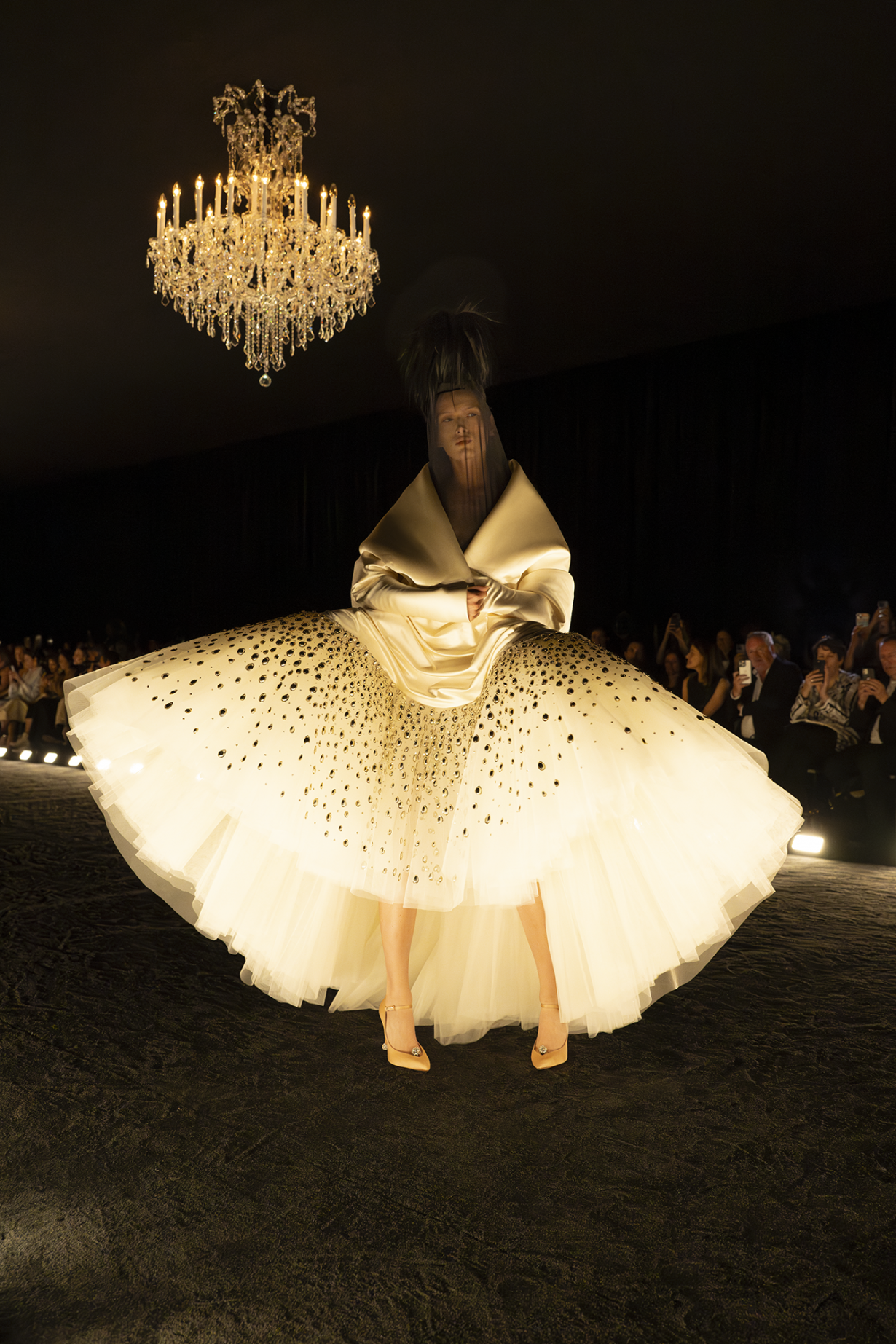
Roseberry’s presence is harder to place, more unwelcome interruption than dialogue. The technical accomplishment is real, as are the oohs and aahs of fellow visitors. But the work is very gaudy and very gold, overly reliant on a select set of Schiap motifs (body parts and locks, all quite Bluebeard by way of Liberace). One look, an encrusted asymmetric jacket, calls to mind a one-boobed matador wandering around Versailles. It’s too self-serious to be Moschino-silly, too costumey to have lasting artistic impact. Fashion is now a global industry of staggering scale, couture its most visible theatre, and Roseberry navigates this landscape shrewdly, everything turning on the spectacle. Schiap, by contrast, was dressing women who want to live in her clothes, enjoying them in all three dimensions.
Elsa Schiaparelli was not a surrealist by aesthetic preference but by instinct, always reading the room and finding the precise gesture to make it stranger. The skeleton dress appeared in 1938, the year Europe was holding its breath – and it appeared inside the circus collection, with all its jolly acrobats and elephants, gaiety and horror inseparable. She told the Fashion Group of Great Britain in 1939 that ‘clothes must be as modern as the world we live in’, and weeks later closed her London doors as the world became something else entirely. Chanel called her an artist as an insult. Which was fair, and unfair, and Elsa, always three steps ahead, would have found that distinction beside the point entirely.
Schiaparelli: Fashion Becomes Art is on view at V&A South Kensington, London through 8 November
Read next In Fashion, Is Vulgarity Ever Worth It?