Conversations about cultural infrastructures, or the lack of them, contradict the Dublin art scene’s broadly positive reputation
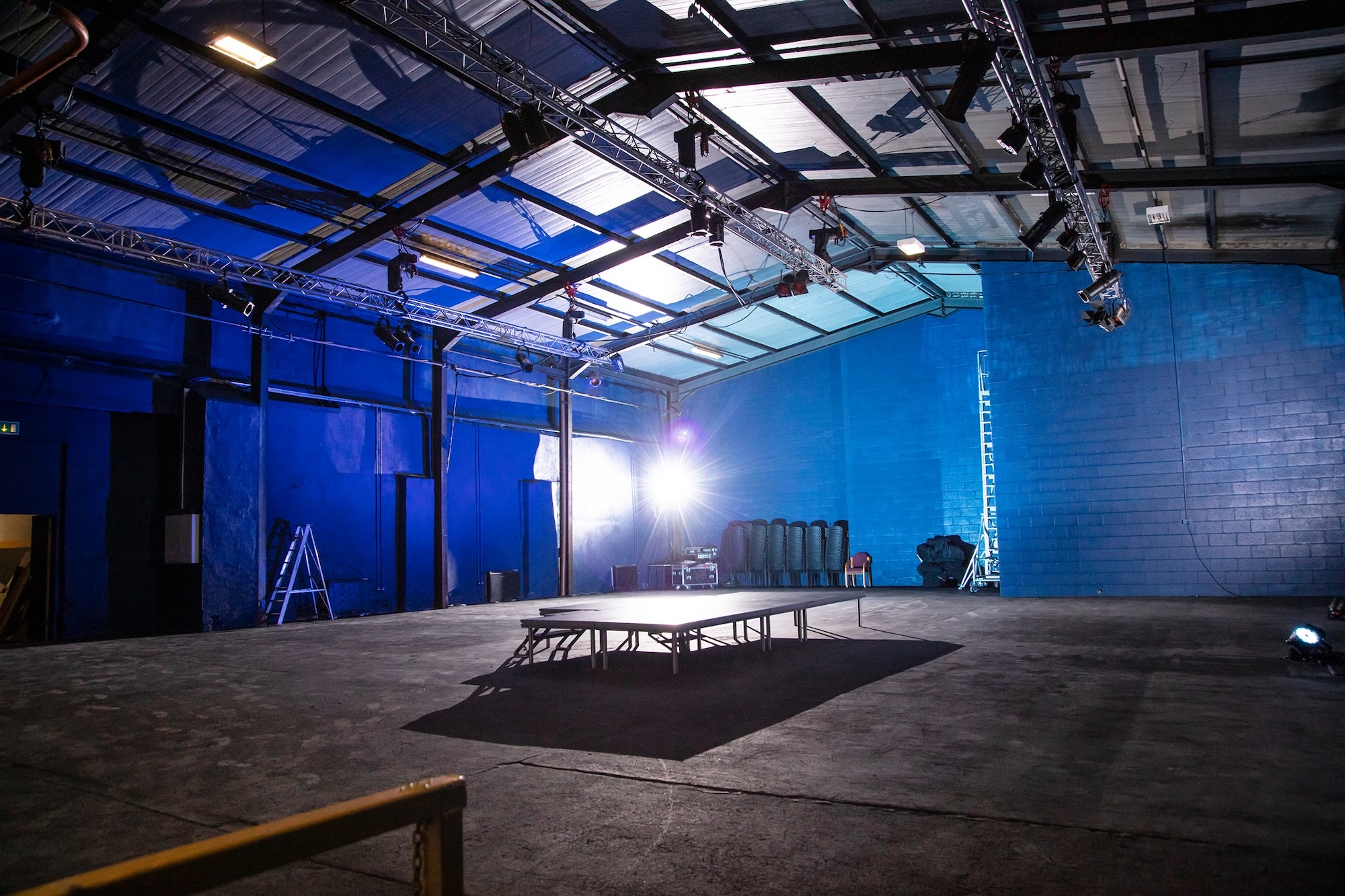
On 3 December 2025, the Complex – a large multi-artform organisation in Dublin’s north inner city – announced that they had been served just over a month’s notice to vacate the large repurposed warehouse building they had occupied since 2017. Laid out over a sprawling set of interlocking spaces within a repurposed but more-or-less unrenovated warehouse building at the corner of Arran Street East and Mary Street, the organisation encompassed artists’ studios, rehearsal spaces, a gallery and a large auditorium. A campaign was started to halt the eviction, but on 15 January 2026 the building’s lease expired and its large spray-painted doors were shuttered.
The campaign had been energetic, drawing support from several local and national politicians and prompting supportive statements from the City Council, the Arts Office, as well as the Minister for Culture, Communication and Sports. What became clear in the process is that no legal mechanism exists to intervene and protect grassroots cultural organisations. The Complex had not been immune from certain problems – including logistical health and safety issues – over the years, and like any arts organisation it had its share of critics, but it indisputably played a key role in the cultural life of the city. Originally housed in a vacant ground-floor space on nearby Smithfield Square, it was one of several organisations established in the brief period after the 2008 recession, when galleries, artist-led spaces and studio complexes were able to occupy vacant office and warehouse spaces with relative ease. Of course, it is not the first such closure in Ireland. Gradually, almost all of these artist-led initiatives have folded, most recently (announced in the same week as the Complex) Ormond Studios, a few blocks away.
There are real consequences for the cultural landscape in the loss of an organisation of this size and character, serving both as a large venue and a space run with an artist-led ethos, open to experimentation and also often a showcase for other small arts collectives and organisations without buildings of their own. The Complex played an important role in this regard, in a city whose visual art infrastructure encompasses a larger national museum, several medium-sized publicly-funded spaces, and a handful of private galleries (with varying levels of interest in the local scene). With few other physical spaces available, except for temporary use, artist-led activity is articulated through occasional, and fugitive events, performances, publications. The Complex provided an outlet for some of this activity.
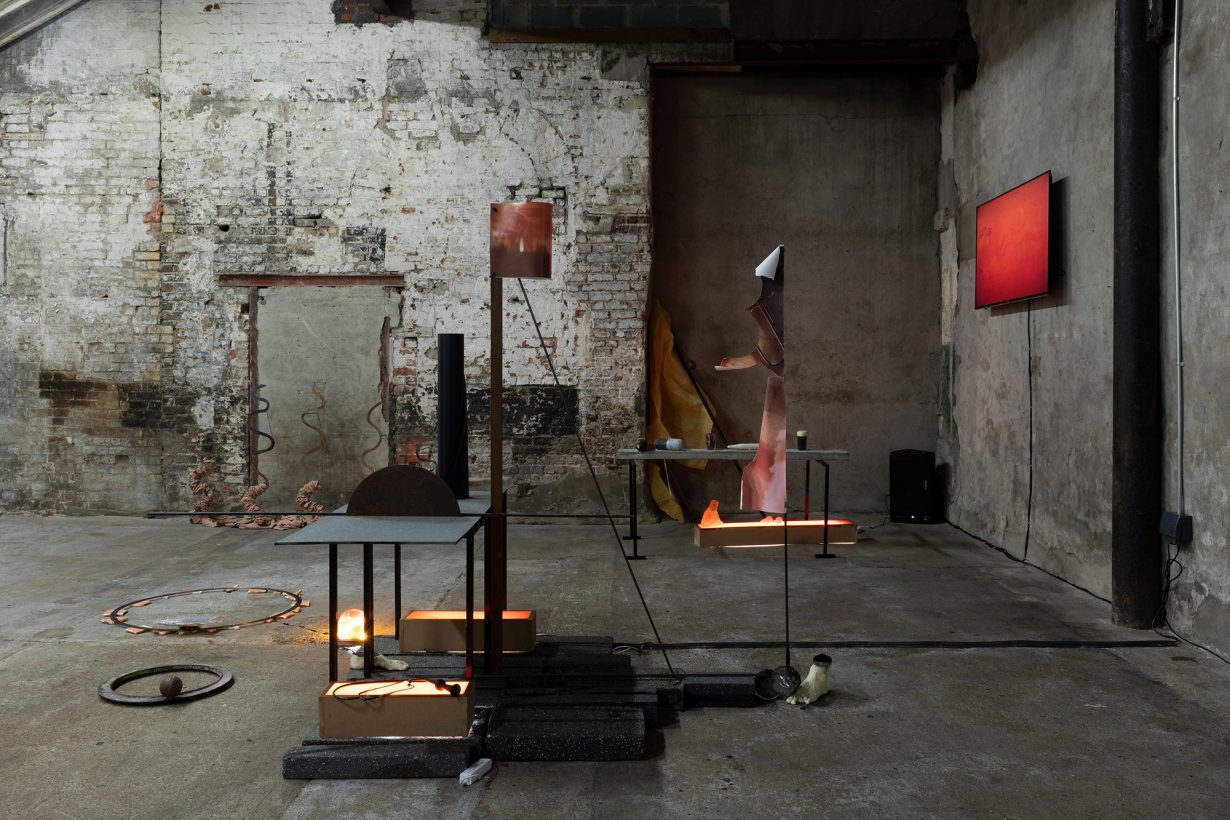
Its closure thus represents a palpable loss to live music, experimental film and many other grassroots performance and sound-art practices, which found a receptive and permissive home in the slightly grungy eclecticism of the former fruit warehouse in the north inner city. In addition, a number of practising artists from a range of backgrounds have been left without studios. Before the gallery space opened in 2019, the organisation had been running occasional once-off visual-art performances, screenings and installations for about a year, but once the gallery and its curator, Mark O’Gorman, were in place, a more substantial programme became possible. The small room in which it was housed, with bare walls of raw concrete and crumbling brick, and an old rusted beam frame, did not offer the most promising or flexible conditions for the exhibition of visual art, but O’Gorman embraced the specificities of the space, curating a programme that included several shows that explored and responded to the history and context of the building and the local area.
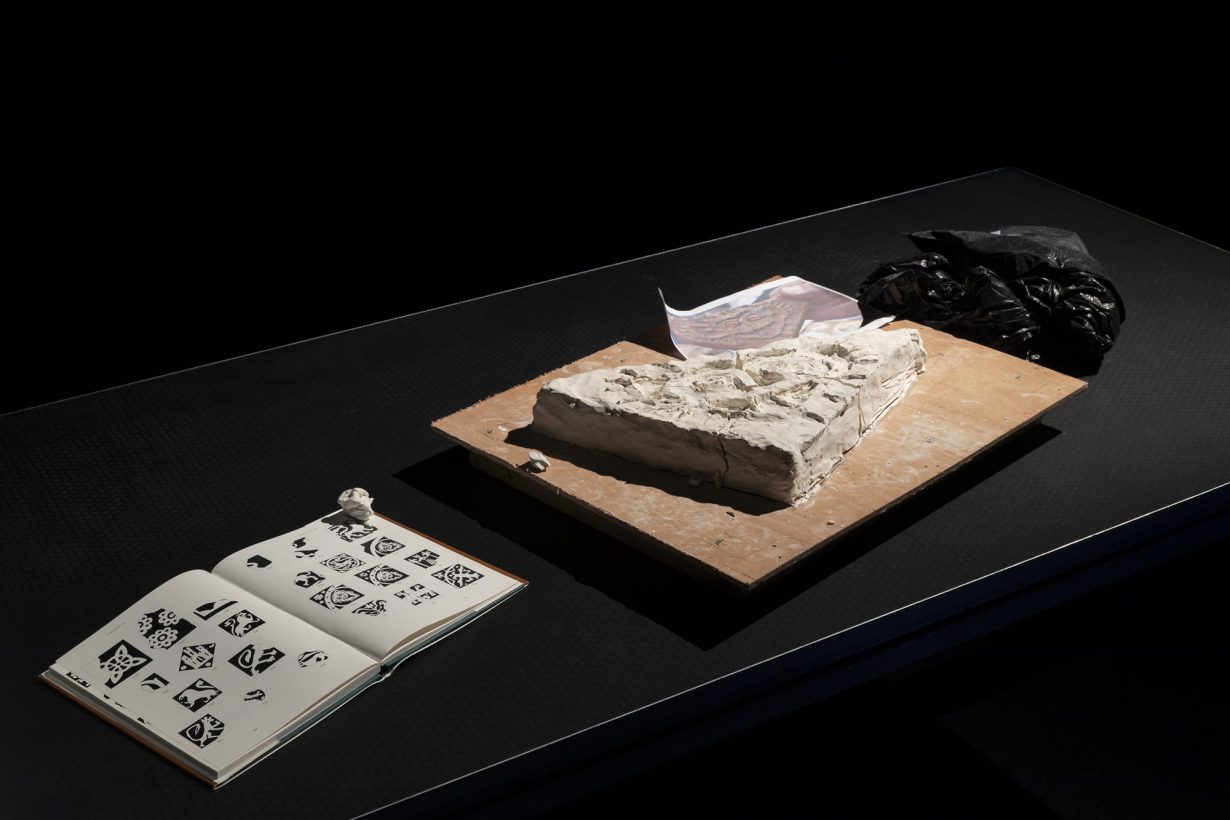
The exhibitions took alternating formats, but in time the model of the two-person exhibition came to the fore, becoming a sort of signature approach for the gallery, and for O’Gorman. Interestingly, these pairings tended to be engineered by O’Gorman, rather than the artists, including a number of joint exhibitions by artists who had never previously met. The results have been startling, unexpected, often joyously surprising. This conjoining of artists with completely different practices – formally, conceptually – has yielded some of the most striking and galvanising exhibitions in the city in recent years. These included exhibitions in which the paired artists worked in dialogue around a research theme – such as Sean Lynch and Laura Ní Fhlaibhín’s Banana Accelerationism (2024), which probed the history of the site itself – as well as shows in which two artists produced discrete bodies of work that revealed and illuminated one another, for instance in the compelling cross-currents of Bea McMahon and Conor McFeely’s God (2025).
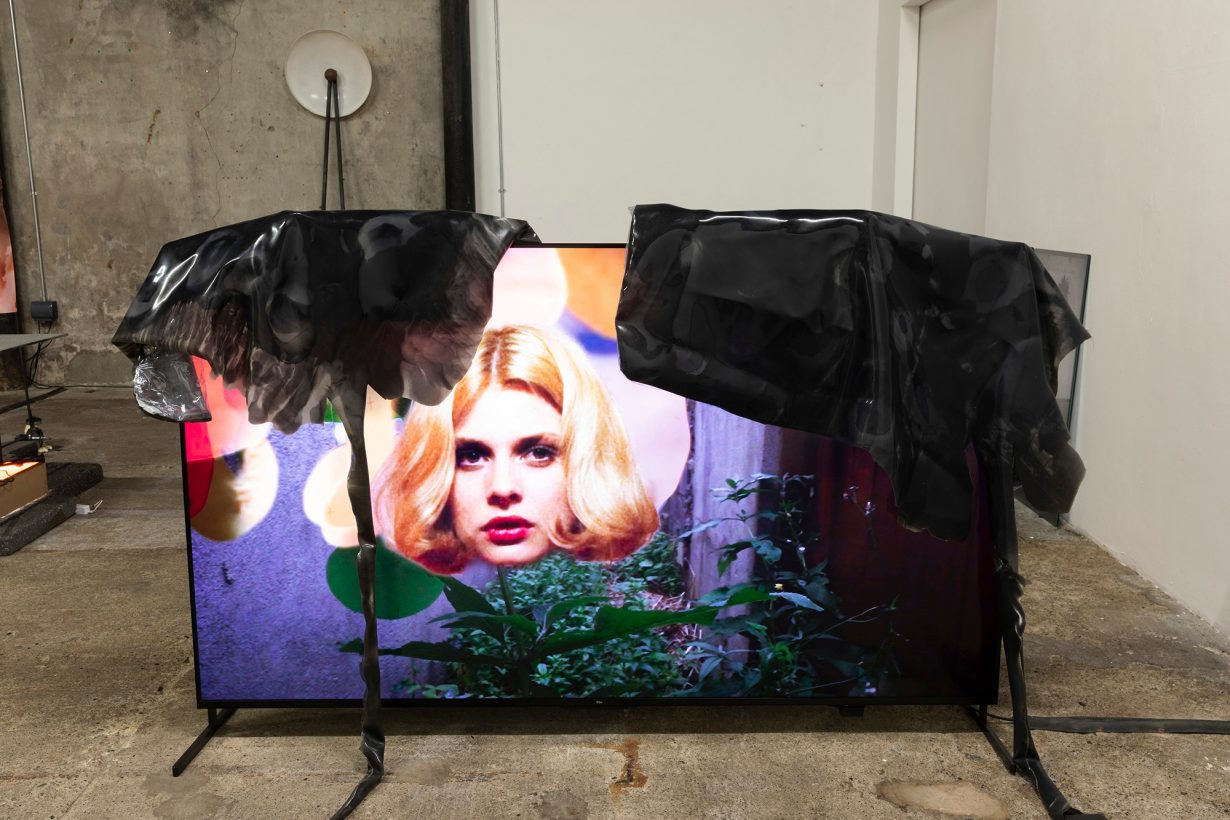
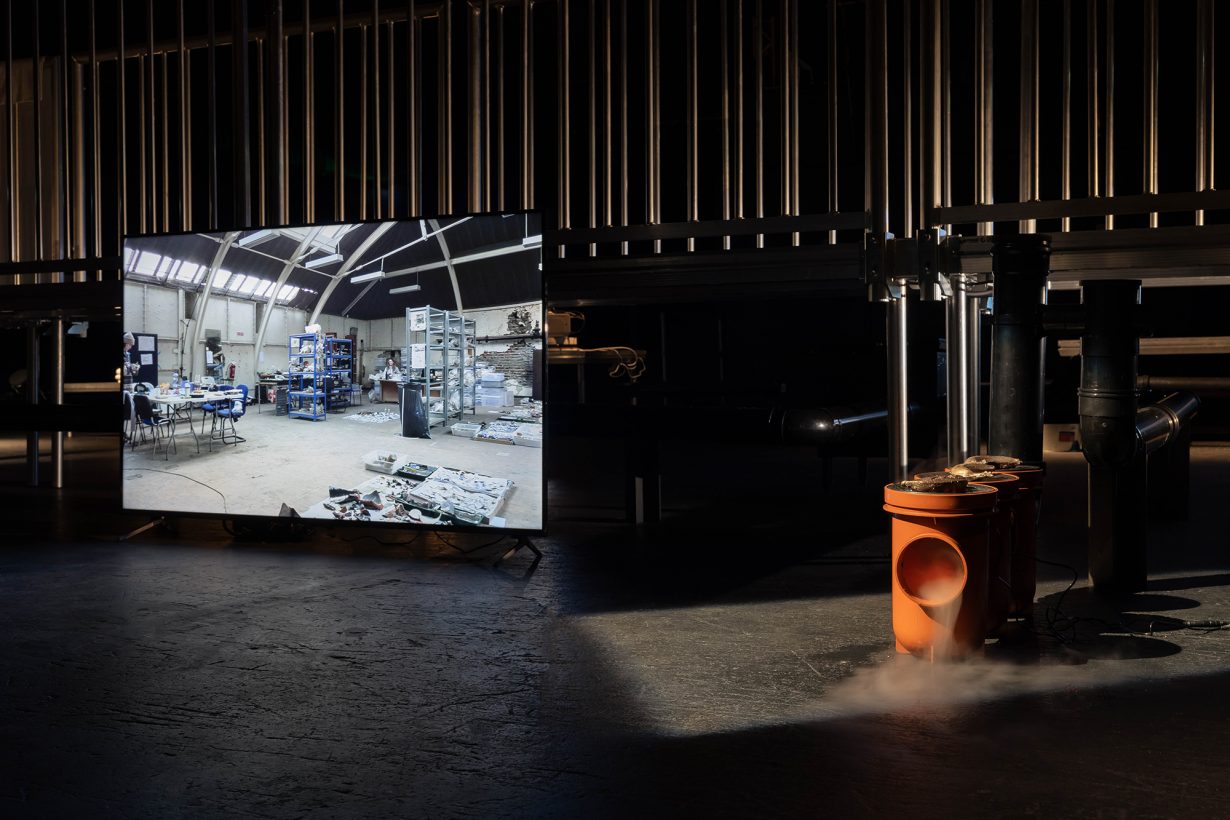
O’Gorman has described his process as that of an ‘instigator’; he is interested in chance and improvisation and the collision of artist’s practices, approximating the spirit of a rehearsal studio. It is not surprising that one of the Complex exhibitions that caught most public attention involved two artists, Jaki Irvine and Locky Morris, both of whose practices, in quite different ways, encompass music, sound and improvisation. They worked collaboratively, through a series of field trips, to gather material which they arranged, for the exhibition, as an arcadia of looping footage – screened on monitors, some wall-mounted, some standing on the floor – accompanied by an orchestrated arrangement of incidental sound.
The sense of looseness and scrappiness encountered at the Complex was unusual for a publicly-funded gallery or institution. Even some artist-led initiatives are now couched in a vernacular of high-end connoisseurship: recent openings have featured live classical musicians and extravagant hors d’oeuvres. Ten years ago, artists would have been embarrassed at such ingratiating gestures; today they seem understandably – if dispiritingly – pragmatic. Over the past decade, there has been a gradual but distinct shift in the atmosphere. There is far less of the experimentation and contingency that used to characterise art-making in the city. These are qualities that tend to decline, of course, in a landscape so encroached by commercial interests. Visual art in Dublin is hampered not by the nature of its art market but by a grotesquely inflated property market, the voraciousness of which leaves little room for risk or provisionality. This is not a new observation. Nor is it confined to Dublin. It has become all too exhaustingly familiar.
There have been many conversations recently about arts infrastructures, or the lack of them, in Dublin and nationally. These conversations might come as a surprise to an outsider, given the generally positive international coverage of arts funding in Ireland. And on the whole, it is true that budgets for arts funding have increased in recent years, with particular expansions in direct bursary support for artists. The Basic Income for the Arts scheme, trialled for three years and recently made permanent, has also contributed to a general improvement of living conditions for a certain number of artists. (The scheme, which was established by the previous arts minister to provide a living income for artists, is currently limited to 2,000 recipients, awarded on a three-year cycle, so its impact on the sector is, for now, necessarily constricted.) Reading the international press, you might imagine Ireland to have transformed into a sort of benevolent haven for the arts. On the ground, however, the closure of studios, the dearth of artist-led spaces, and the limitations of institutional and project funding, have all contributed to a serious shrinking of opportunities for work to be produced or shown. The resulting situation has more than a touch of absurdity, with visual artists in Ireland being supported to develop work, but finding fewer and fewer outlets to exhibit it.
Read next An Irish take on the Kunstverein model