The career of Nicholas Pope, whose death was announced last month, can be divided into two: before and after a long hiatus from the early 1980s, after he contracted viral encephalitis in Tanzania.
Pope emerged in a generation of British artists who reacted to the austerity of US minimalism, with a warmer, more organic sensibility, while still adopting many of its facets. Peers included Tony Cragg, Richard Deacon and Antony Gormley, with Pope producing a series of columns made up of roughly-hewn blocks of wood tied together with rope. Oak Tree Column (1973) curved slightly, like a charmed snake; Drooping Column (1975) saw the almost two metre structure bend at the top; and in The Arch (1973), the column curved back to the ground. In 1980 Pope’s sculptures were shown in the British Pavilion at the Venice Biennale and he was included in the US touring show British Art Now: An American Perspective.
Pope went to the Ruvuma valley in Tanzania to learn from the Mbawala sculptors. He was undiagnosed with encephalitis for several years, resulting in serious brain damage.
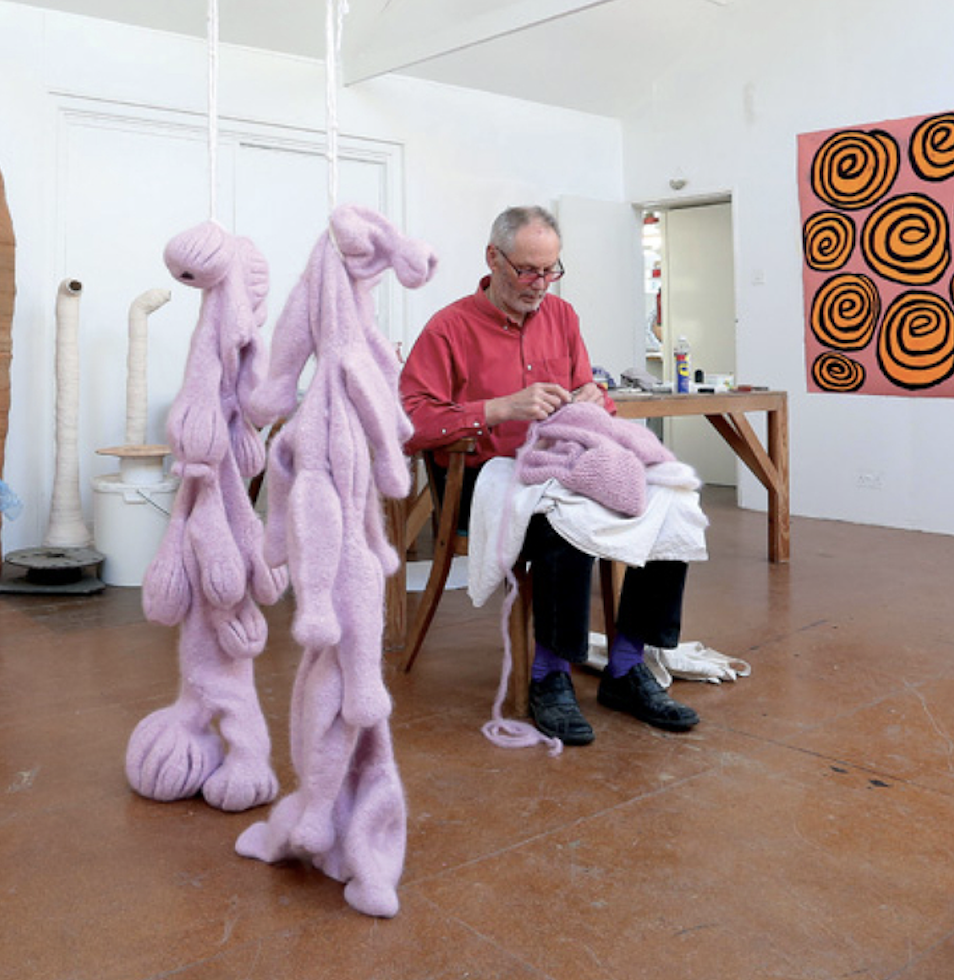
Gradually he learned to draw again, graduating to sculpture that was far brighter and brasher than his early work. The Apostles Speaking in Tongues Lit By Their Own Lamps (1993–96), shown at Tate Britain in 1996, featured the disciples as terracotta columns, their heads replaced with burning live flames. Mr and Mrs Pope knitted, shrunk and hung (2012) featured two felted mohair figures, floppy like unused puppets, one of several self-portraits with his wife. The Conundrum of the Chalices of the Seven Deadly Sins and Seven Virtues (2015), made with James Maskrey, featured a row of fourteen hand blown garish glass chalices, alien-like in their form, which was one of several works dealing with religious iconography in ceramic, epoxy resin and oil pastel.
In 2021 Pope, suffering from Parkinson’s, told Studio International ‘It’s enormously interesting getting towards the end, and being aware of life and that life ends, and being pleased that I have managed to make work all the way through and it’s there, the difficult things you can’t change. You begin to see earlier work next to the old work and you can’t go back and make it any different. And that’s wonderful.’
Read next David Terrien reviews Nicholas Pope: Sins and Virtues at The Sunday Painter, London