Simnett’s works find the beautiful in the horrible, the animal
in the human
A giant illuminated swan spreads its wings and opens its beak in ecstasy as it mounts a panting hyena whose red-hot erection pokes out between his legs like an ice lolly. Marianna Simnett’s florid sculpture Hyena and Swan in the Midst of Sexual Congress (2019) is a rude and raunchy greeting to her show, anticipating what we find inside: enchanting combustions of fairytales and legends, a preoccupation with animals and some very freaky sex.
Moving across film, painting and sculpture, Simnett favours tales of delusion and fantasy, less interested in narrative logic than she is in disorientation, confusion, the dappled phantasmagorias of reverie. The films Leda was a Swan (2025) and Blue Moon (2022) in particular play havoc with coherence and indulge in sludgy, AI-assisted visuals; in the former, Leda, who according to legend was raped by Zeus in the form of a swan, is recast as a swamp-green hag in a wedding veil, masturbating laconically with a swan-shaped glove. The films are woozily miragelike, shifting in and out of focus, and recall the stories of Angela Carter with their mischievous, feminist subversion of source material. Blue Moon is a riff on the tale of Athena and the flute, in which the goddess of war picks up, then casts away the instrument because it causes her cheeks to puff, disfiguring her beauty, but in the soothing tones of Simnett’s version she appears to play because it does so. Similarly, her Leda is a pleasure-seeker who hallucinates, rather than resists, her lover. Both films find Simnett manipulating stories of female abjection and repression, focusing instead on their subjects’ ability to startle and disgust.

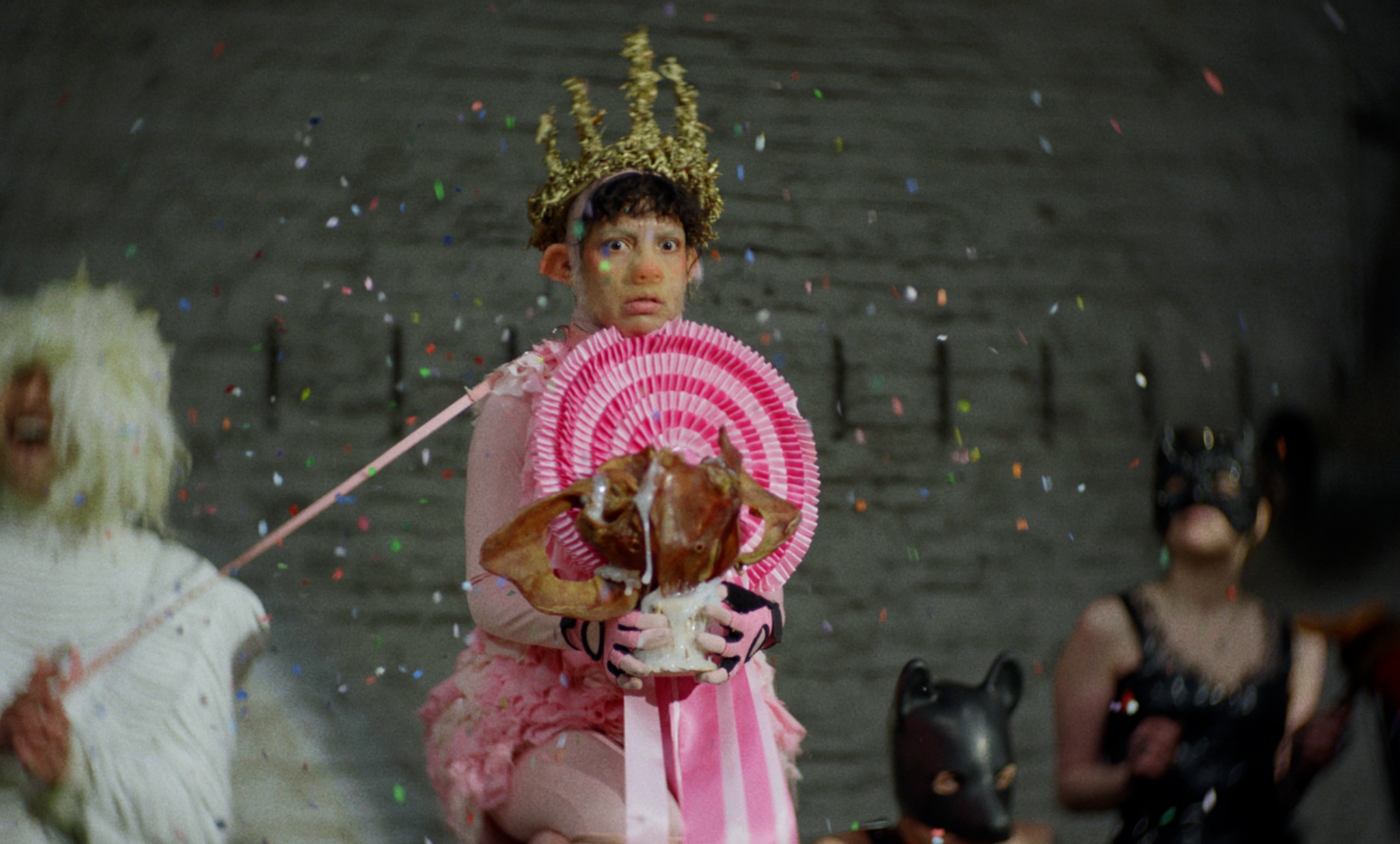
Fairytales and legends serve Simnett well in her pursuit of the strange, open as they are to interpretation while remaining sealed against explanation. The stop-motion video Prayers for Roadkill (2022) reimagines the domestic lives of taxidermised animals with a cast of anthropomorphic badgers and foxes acting out their encounters with Madam Death in a kind of grim, zoological Emmerdale. In The Severed Tail (2022), a live-action short, a piglet getting its tail nipped (a process known as docking) acts as an initiation ritual into an underworld of BDSM pageantry, in which creatures are kept in cages and forced to parade around for the pleasure of humans. It’s a body-horror extravaganza, with grotesque prosthetics, intestinal tunnels, fake blood and nods to Cronenberg. Simnett may not be a subtle storyteller but she does have a knack for gut-wrenching detail: when a dog in Prayers for Roadkill accidentally drives over an elderly badger, the car bucks upward, then slams down hard, and in the resulting mess the badger’s woolly red entrails have burst forth and spilled across the ground, mingling prettily with her groceries.
Simnett’s fascination with animals is matched only by her boredom with humans: even when they do appear, they are immediately sucked into vortices of Ovidian transformation. In three sculptures accompanying Prayers for Roadkill, a triad of animals in the shapes of chairs – a unicorn, a rabbit and a bird – have ensnared their human sitters in various states of distress, one of whose legs protrudes from the unicorn chaise longue, while in the live-action film The Bird Game (2019) a gaggle of children are coerced into performing increasingly violent and sexualised acts (taking drugs, bathing, inappropriate touching) by a tyrannical talking crow, who tells of how she herself was transformed into a bird when fleeing a predator. “What is a crow anyway?” one of the brats inquires. The same spirit of insatiable curiosity runs throughout Headless, which, with the exception of a handful of wispy, vaguely ‘surreal’ and ultimately forgettable paintings, manages to find riddles in the everyday, the beautiful in the horrible, the animal in the human.
Marianna Simnett: Headless at Max Ernst Museum Brühl of the LVR, through 5 July
From the April & May 2026 issue of ArtReview – get your copy.