Claudia Ross went to Dataland and all she got was a lousy L’Oréal-induced face rash
“This is a room built for stillness, where the collective presence of everyone in the room and the emotional currents of your whole experience transforms the artwork into a living portrait.” This is how a disembodied female voice greets attendees inside Dataland, Turkish media artist Refik Anadol’s new brick-and-mortar platform devoted to tech-based art made, so far, by Anadol himself, or at least by his studio team. If the greeting sounds AI-generated, that’s because it is – and proudly so. With substantial contributions from Google, LG, NVIDIA, Epson and others, Dataland’s inaugural exhibition, Machine Dreams: Rainforest, presents Anadol’s proprietary ‘Large Nature Model’, or LNM – an artificial intelligence trained on information culled from natural ephemera that transforms, or ‘dreams’, rainforest-inspired images and videos. These are displayed across five galleries in the Grand LA hotel and shopping complex. Dubbed a ‘living museum’, Dataland lofts a vision of art tailored to each viewer using data, images and technology designed by Anadol and his Silicon Valley backers. But the resulting artworks, spawned from a thin set of live biometric responses, are far from singular.
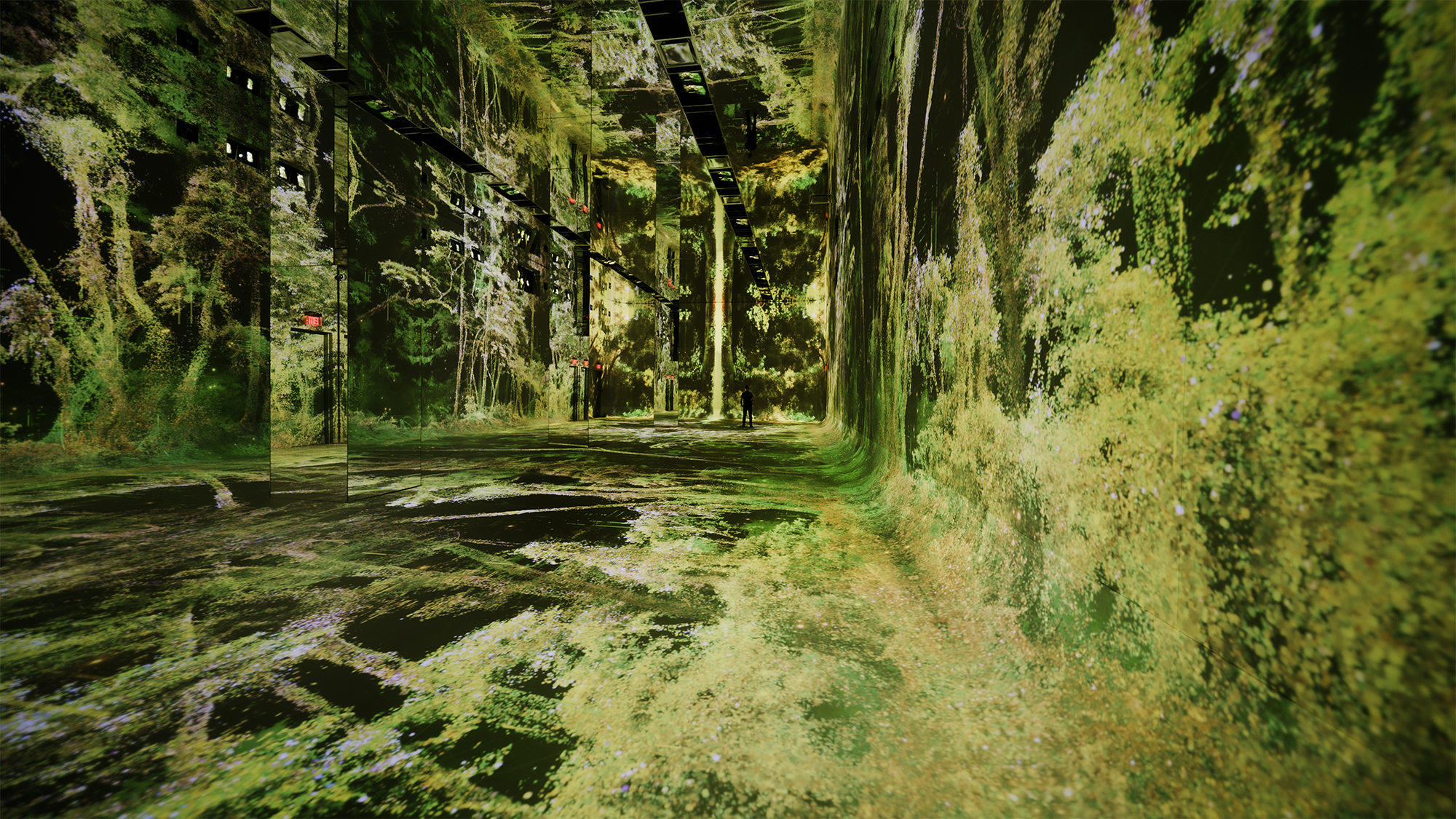
Escalators deliver attendees into the first section of the exhibition, ‘Data Pavilion – Latent Forest’. The large gallery features AI-generated imagery of flowers and trees blossoming across a thin black material laid over the walls, ceiling and floor. This surface, lined with LiDAR sensors, tracks viewers’ movements, but other than starry lights that occasionally bloom from my footsteps, it hardly reacts. A few enthusiastic visitors wave their hands at the walls, garnering some mild shifts in the flowers’ movement or shape. While these efforts at bespoke art are lacklustre, other aspects of the exhibition are invasive; as I traverse the room, a neck device given to me in reception blasts an astringent perfume made by L’Oréal, which is closer to porta-potty disinfectant than the ‘scent of rain’ described in the exhibition materials. This may be because it perceived my displeasure: every aroma is derived from attendees’ ‘unique internal rhythm’ as determined by a wristwatch – another Dataland amenity – that measures heartrate, body temperature and skin conductivity.
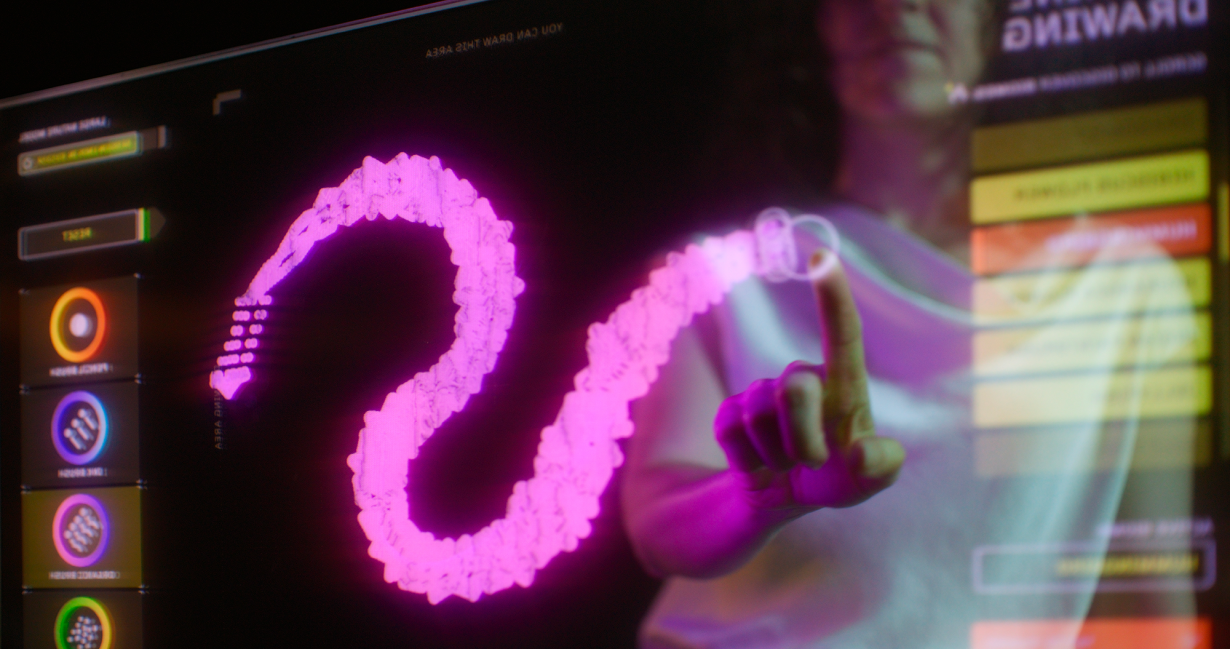
Later galleries favour displays that feel like halfhearted science projects, reducing the natural world – and visitors – to a series of quaint spectacles. After ‘Latent Forest’ comes ‘Latent Gallery’, where viewers face transparent touchscreens, select types of rainforest flora and read brief factoids before manipulating their icons into new shapes with a ‘thinking brush’ (their hand). The adjacent ‘Sanctuary’ presents visitors’ biodata on floor-to-ceiling screens with chaotic graphs that depict, among other metrics, each person’s emotional response to the exhibition, calculated as a percentage. How this is determined, or what emotion is sensed, is not specified. The subsequent AI-generated artwork – a profusion of tropical flowers – is supposedly a representation of this data, but the relationship between the two remains unclear.
Elsewhere, Anadol’s focus turns towards his own experience in rainforests. Visitors slip into a small gallery displaying a narrative, 360-degree video – one that, notably, doesn’t respond to interaction. It tells the story of a glass hummingbird Anadol saw in a dream during a stay with the Amazonian Yawanawá Indigenous group, a vision later interpreted by a tribal leader as Ruwe Pinu, a mythic spirit that visits a dying tree to seek knowledge. As the bird flits through an Avatar-like landscape, the story’s vague call for environmental protection is undercut by the grainy, cheesy graphics, which seem to endorse the conservation of fake rainforests more than real ones. Oscillating frantically between AI doctrine, nebulous environmentalism and the art’s own adaptability, the exhibition’s climate rhetoric feels unconvincing and even woefully ironic (energy- and water-intensive AI is one of the world’s fastest-growing environmental threats). But Dataland’s real shortcomings lie in how it mistakes biometric surveillance for individualisation. Upon exiting, I noticed the show’s first truly tailormade effect: a L’Oréal-induced face rash.
Machine Dreams: Rainforest is on view at Dataland, Los Angeles through 31 January
From the September 2026 issue of ArtReview – get your copy.