A new translation of an alien-inspired comic from the 1980s sheds light on our unreal present, finds Jamie Sutcliffe
Throughout the 1970s the Belgian cartoonist Jean Pleyers witnessed a series of UFOs that would explode his comprehension of humanity’s place in the universe while propelling his art towards the heavens. These orange-hued ‘second suns’ would float above Brussels or spiral into orbit as lucent DNA helixes, broadcasting their secret truths into the artist’s mind.
Known for their lucid ligne claire style, Pleyers’s works had been well regarded for their historical rigour. His celebrated Xan (1978), loosely based upon the life of the fifteenth-century French knight and serial killer Gilles de Rais, had been written with Jacques Martin and published by Le Lombard’s wildly popular Tintin magazine. But following his extraterrestrial contact, he began work on a story of cosmic ambition, Les Êtres de Lumière, serialised between 1981 and 1983 by French science-fiction anthology Métal Hurlant.
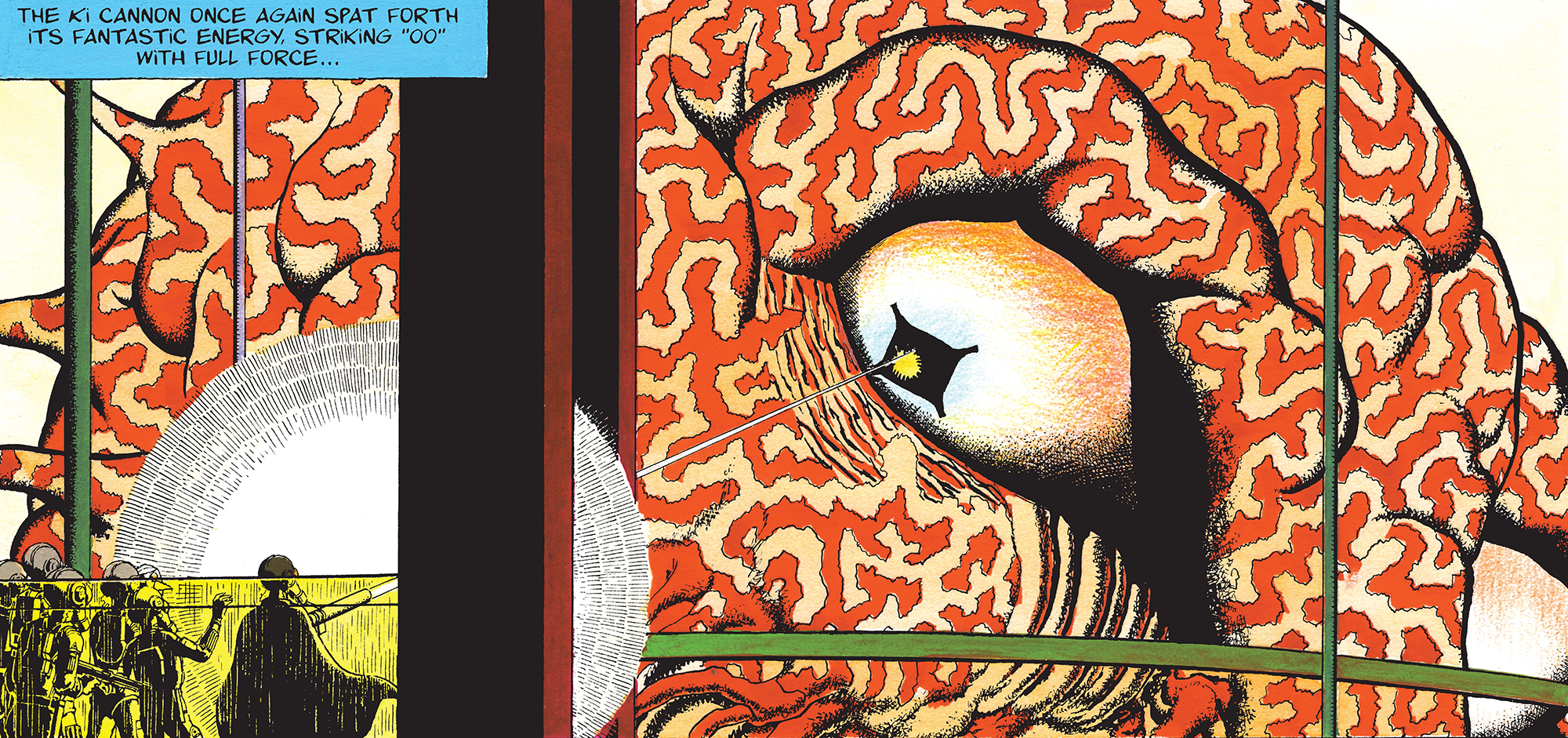
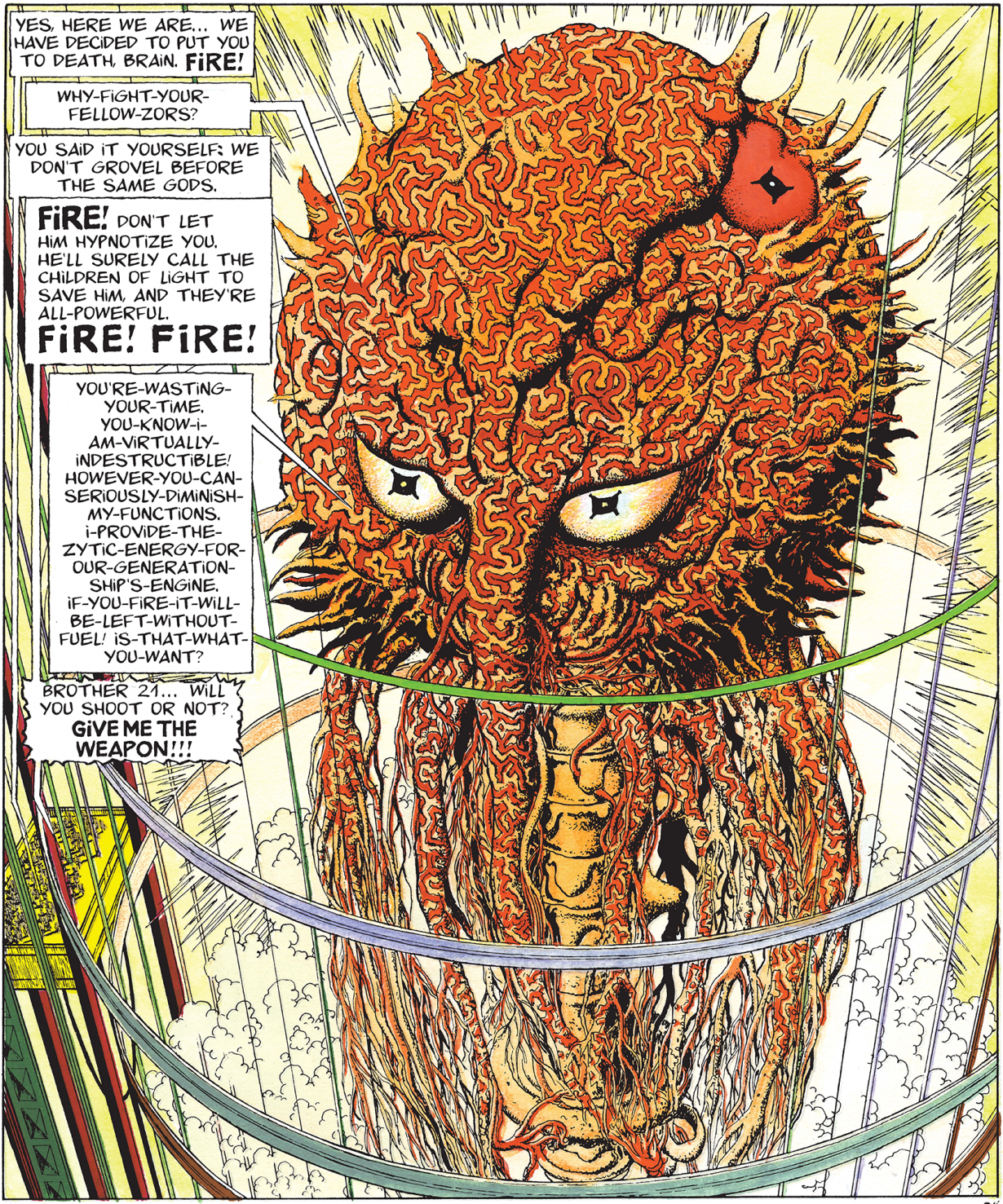
A galaxy-spanning odyssey of ancient astronauts and cosmic pilgrimages, Les Êtres de Lumière is reissued in July as The Children of Light, translated for the first time into English. It tells the story of the Zor, an alien race whose planet is fated to collapse, sending them starward in pursuit of a new home. A moon is repurposed as a mobile colony for deep-space exploration, rival factions compete to determine the future of the species and an ‘omniscient overmind’ is dethroned by insurrectionists. What elevates Pleyers’s strange book above these genre trappings however is its timely allegory of disclosure: who gets to know what, and to what ends? How are secrets and their strategic divulgence viable tools of social engineering? Just as the engineer Buckminster Fuller once considered his writings an ‘Operating Manual for Spaceship Earth’, might The Children of Light present an instructive parable for an age of ‘conspirituality’ in which suspicious fantasies temper political unrealities?
Aliens are certainly in the air right now. Back in February, former US president Barack Obama all but confirmed his own belief in the possibility of otherworldly civilisations during a casual interview, while the Trump administration continues to bait a crumbling MAGA base with the piecemeal release of declassified documents from the Pentagon’s UFO files. In a recent talk for the London Fortean Society, my colleague the writer Mark Pilkington described how UFOs are pliable tools of mass deception and distraction, providing cover for secret weapons development or destabilising faith in media and governmental institutions by ‘flooding the zone with shit’, as a phrase from political strategist Steve Bannon has it. But I’d add that UFOs are also coming into focus as remarkably malleable metaphors for revealing otherwise incomprehensible systems. For Bogna Konior, author of The Dark Forest Theory of the Internet (2025), the alien provides an opportunity to rethink the opaque traceries and coercive deceptions of the internet or artificial intelligence. For Marek Poliks and Roberto Trillo, it colours a theory of ‘exocapitalism’ in which capital has detached itself from its fleshy human substrate and ‘lifted off’ into a world of computational finance and algorithmic speculation, leaving us behind in the burning exhausts of an economic delirium headed elsewhere.
Of course, none of this is particularly new. In 1958 C.G. Jung described the flying saucer as a modern mytheme that betrayed mankind’s technological anxieties. These were visual metaphors that revealed the unseen objects of an ambient discomfort that couldn’t be glimpsed directly. The Children of Light’s reemergence over 40 years since its original publication illuminates how unwaveringly these metaphorical aliens are already among us, inhabiting our language, minds and political cultures, populating a hall of mirrors as alluring, illusory and timeless as the gleaming facade of any UFO.
Pleyers’s work remains fascinating because it is at once a compelling science-fiction fantasy and a contactee testimony, birthed by Cold War paranoias and inexplicable encounters. As such, it echoes a theory of artistic production described by the religious-studies scholar Jeffrey J. Kripal in his 2011 book Mutants and Mystics, in which he suggests that mysterious forces have guided the likes of novelist Philip K. Dick or comic book author Barry Windsor-Smith into acts of coauthored creation and cosmic revelation. Kripal isn’t naively credulous of works produced in this manner, such as The Transmigration of Timothy Archer (1982) or The Uncanny X-Men (1969–87), yet neither does he reduce them to solipsistic epiphanies. Instead, he offers a third way of thinking about the paranormal, where popular culture and perceptual strangeness might work through each other to reveal the fundamental nature of ‘disclosure’ as a tendency that continues to animate human behaviour. For Kripal this is nothing short of a new religious perspective in which we perceive that the alien might have really ‘been us all along’. But wherever religions emerge, orthodoxies commonly follow. And if the aliens truly are here to stay, what matters most might be our insight into the causes they’re enlisted to serve.
From the Summer 2026 issue of ArtReview – get your copy.