The exhibition demonstrates how persistently animals have populated the artist’s imagination as proxies through which to explore human emotions, desires, fears and forms of intimacy
Something bad has happened. At the entrance of the Musée de la Chasse et de la Nature, a soft toy has been pinned to the wall, legs, tail and ears outstretched, its belly cut wide open to reveal its plush, colourful insides. The work is titled L’Opération (2011) but the tools placed at each of its extremities – a wrench, a pair of scissors, a screwdriver – suggest something grimmer than surgery. It’s a delicious mix of innocence, horror and deadpan (not unlike the cute-and-gory brand of humour of the cult animated series Happy Tree Friends), which speaks to humankind’s schizophrenic relationship to other animals.
This serves as a dramatic introduction to Annette Messager’s exhibition, a bestiary of cartoonish and taxidermied creatures developed over the past five decades that feels right at home amid the hunting-themed collections and baroque rooms of this seventeenth-century hôtel particulier. Appearing in the form of hard and soft sculptures, readymades, drawings, photographs and installations, some 80 works ranging from the 1970s to today demonstrate how persistently animals have populated the French artist’s imagination – not as subjects in themselves, but as proxies through which to explore human emotions, desires, fears and forms of intimacy.
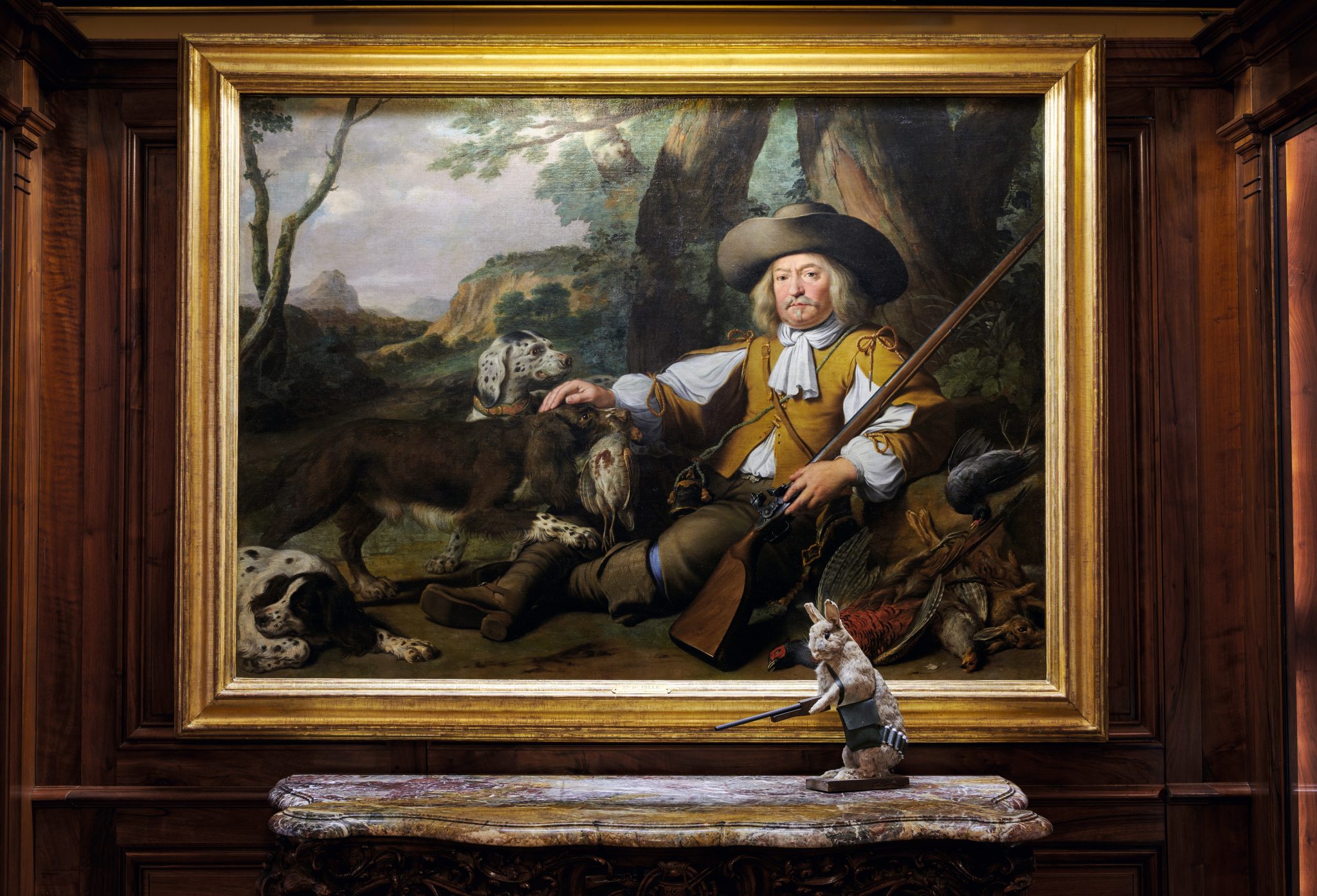
Like most exhibitions in this quirky museum, the experience feels like some kind of scavenger hunt over three floors, trying to spot the artist’s works amid the actual hunting trophies, curiosities and paintings. Messager makes the journey entertaining by punctuating it with light and mischievous fun, with various laugh-out-loud visual gags: a taxidermy dachshund emerging from its kennel wearing a facemask, or a stuffed squirrel in a Zorro mask standing trapped beneath a black net. My favourite might be Le Lapin chasseur (undated): a taxidermy rabbit standing upright on its hind legs, carrying a miniature rifle, satchel and ammunition pouch. Messager found it in a garage sale, we’re told in the exhibition material, and it’s been keeping guard in her living room ever since. Here, displayed on a marble counter in front of a seventeenth-century portrait of a hunter posing proudly with his dogs and gamebirds, it appears to have stepped out of the painting to enact a cartoon revenge fantasy – one that French audiences may recognise as an echo of Chantal Goya’s cult 1970s anti-hunting song Un lapin, in which a rabbit shoots the hunter.
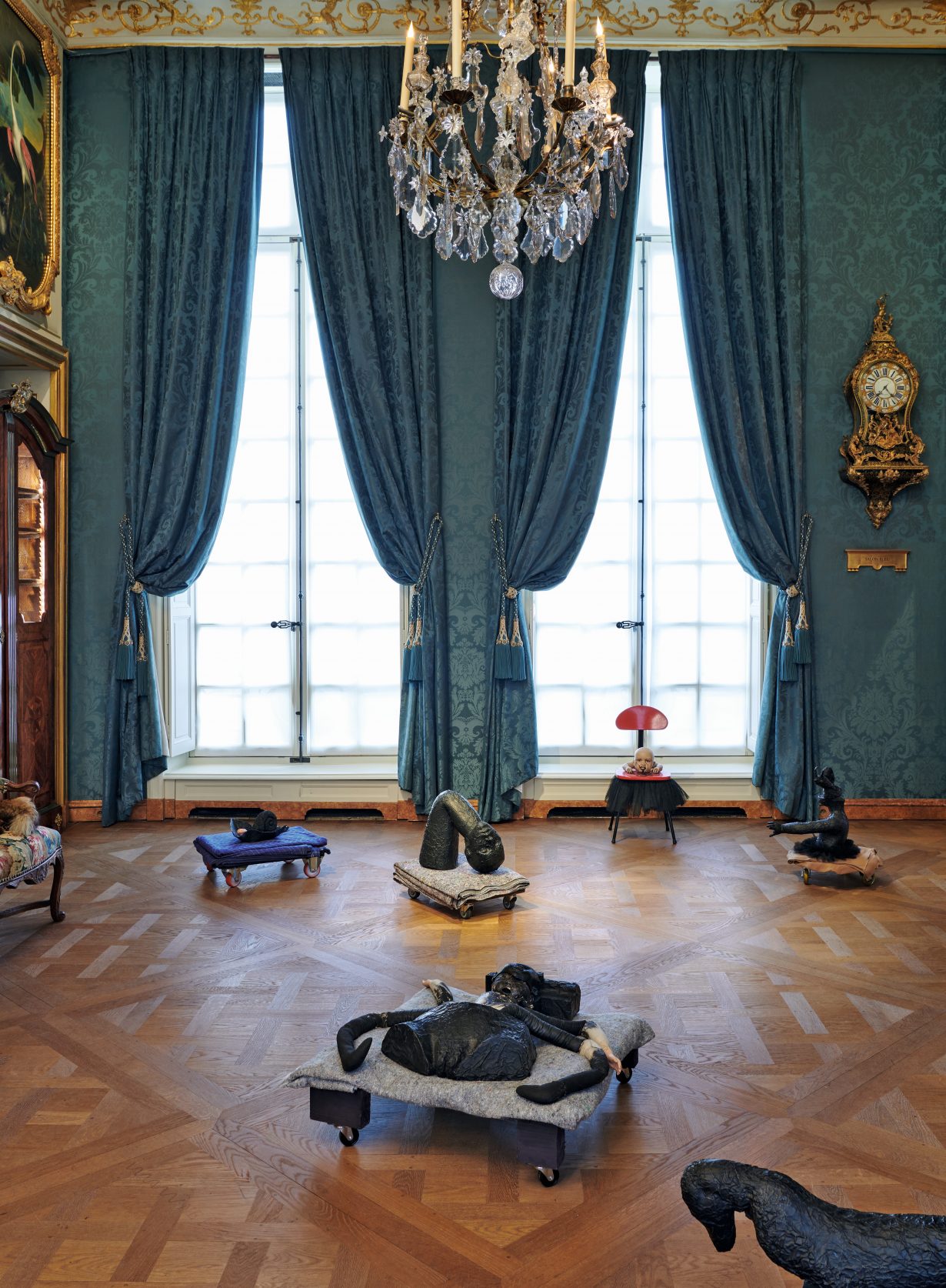
Elsewhere, Messager turns our attention to the extent to which animals inhabit the French language (please, er, bear with me as I attempt to translate some expressions), and what this reveals about the ways we imagine them. Her decklike collection of paper cards Les Qualificatifs donnés aux femmes (1972), here featuring literal pet-names used to describe women (think ‘ducky’, ‘vixen’ or ‘bunny’, though English examples are fewer), while a new series of Japanese-paper panels, Vingt-deux Expressions (2025), reproduces familiar proverbs or expressions. One of them – ‘Don’t sell the bear’s skin before you’ve killed the beast’, the French equivalent to ‘Don’t count your chickens before they hatch’ – has been slipped into the hands of the giant stuffed polar bear on the first floor. The most striking installation, however, is probably the archipelago of sculptures from Mes Transports (2012–13), scattered across the lavishly decorated salons of the first floor. There’s something pleasingly macabre in seeing these assemblages – piles of sculpted human body parts, wrapped in black aluminium sheeting and mounted on small trolleys – against the many slightly obscene seventeenth-century paintings of dead animals lining the walls, putting a darker spin on the nature morte (still life in French, which literally translates as ‘dead nature’). It’s these moments, where darkness balances the one-liners and more gimmicky installations, that really anchor Messager’s show. For all their humour, her animals are never simply comic props, nor are they the butt of the joke. Like the cutup bunny of L’Opération, they are closer to evidence – evidence that has been staged, dressed up, occasionally made to pose – in an investigation that keeps circling back to us.
Annette Messager: Une hirondelle ne fait pas le printemps is on view at Musée de la Chasse et de la Nature, Paris, through 20 September
From the September 2026 issue of ArtReview – get your copy.