“Early encounters – with vast, raw territories, petrified forests and geological time – still shape how I think and work”
ArtReview sent a questionnaire to artists and curators exhibiting in and curating the various national pavilions of the 2026 Venice Biennale, the responses to which will be published daily in the leadup to and during the Venice Biennale, which runs from 9 May through 22 November.
Matías Duville is representing Argentina; the pavilion is in the Arsenal.
Celebrating Visions. Versace partners with ArtReview to share stories from the 2026 Venice Biennale.
ArtReview Tell ArtReview what you plan to exhibit in Venice. What has influenced or inspired you?
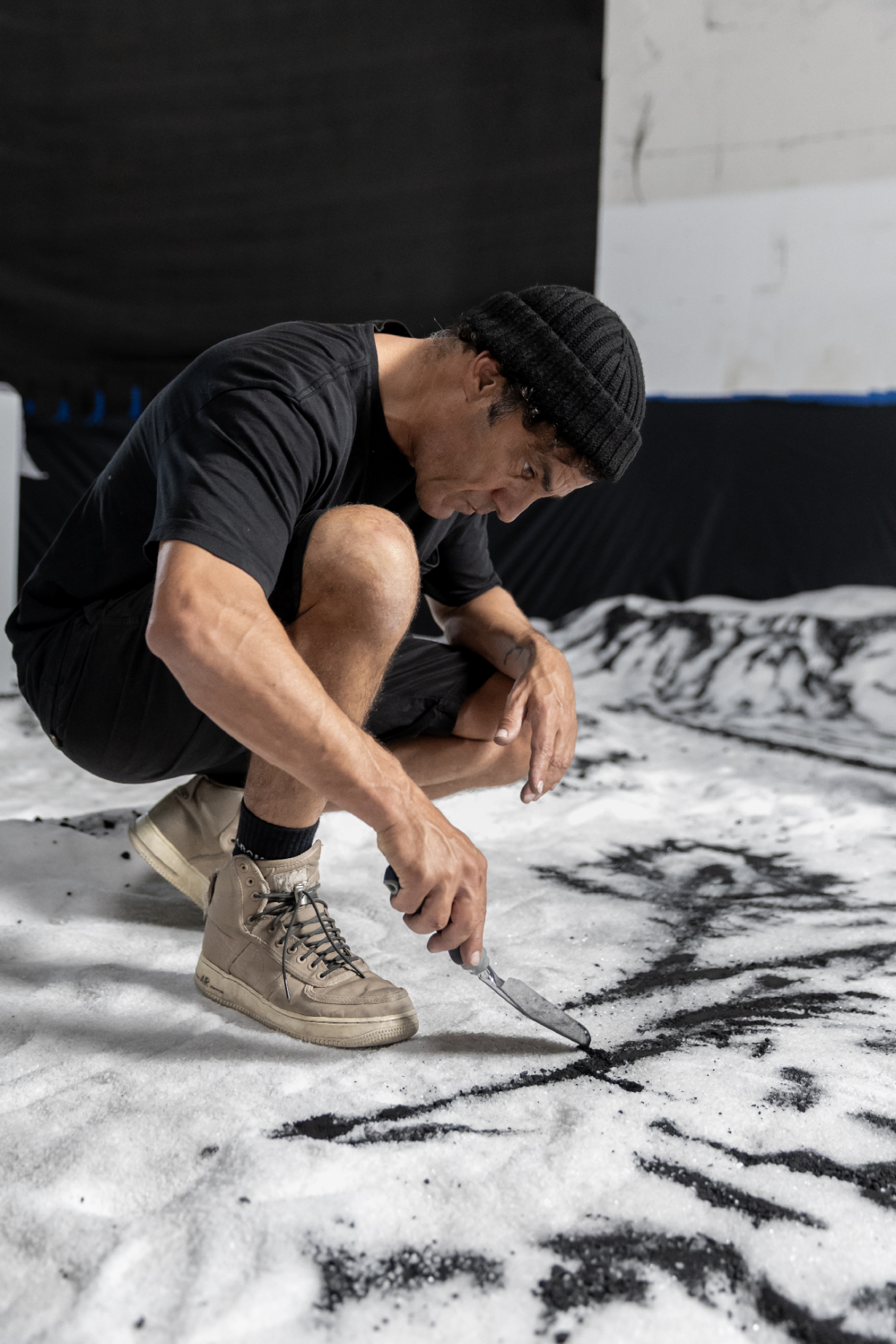
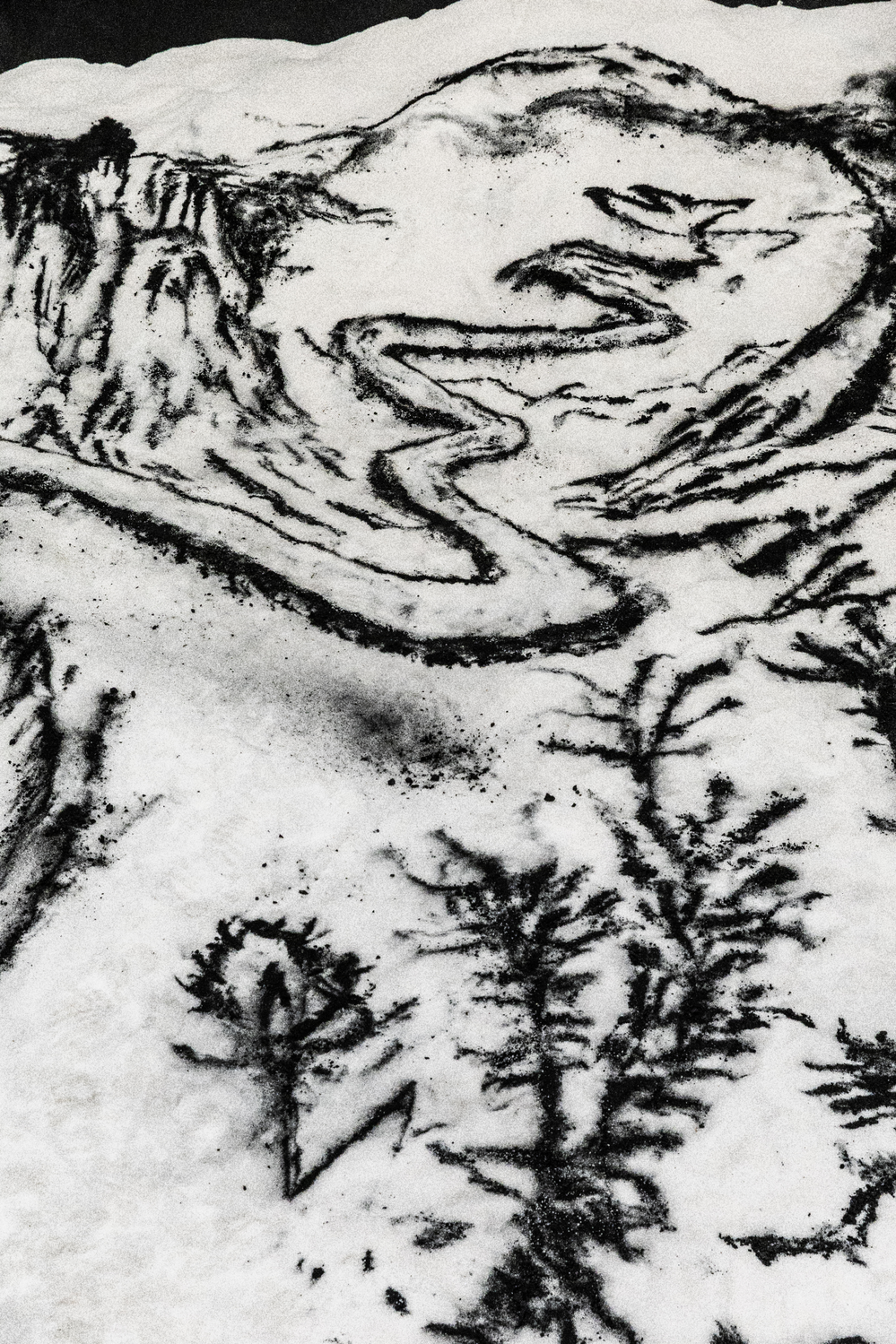
Matías Duville I will present Monitor Yin Yang, a site-specific installation that transforms the Argentina Pavilion into a walkable landscape made of salt and charcoal. The project expands drawing into a spatial, sonic and time-based experience. It comes from my long-term desire to push drawing beyond the wall.
My work has always been affected by the natural environments I experienced growing up, such as the forests of Mar del Plata and the landscapes of Patagonia. Those early encounters – with vast, raw territories, petrified forests and geological time – still shape how I think and work.
I’m also interested in chaos, in the idea that a work can remain open and continue to evolve. Even when there is a structure, I try to leave space for something unexpected to emerge.
AR In what ways (if at all) does your work relate to the theme of the Biennale exhibition, In Minor Keys?
MD For me, In Minor Keys suggests slowing down and focusing on subtle intensities. The project operates in that register. It’s not about a dominant image but about small shifts: sound, light, the movement of materials, the presence of visitors.
There is also a strong connection to a musical way of thinking. The drawing behaves almost like an open score, where each movement introduces variations that can transform the perception of the whole. The project works with very simple elements – salt, charcoal, a line – from which a complex field of tensions and temporalities emerges.
AR Why is the Venice Biennale still important, if at all?
MD It’s still important as a space where very different practices and contexts come into contact. There’s something about that coexistence that feels meaningful. It offers a unique level of international visibility and an opportunity to situate your work within a global conversation. It also allows you to experience your own work at a different scale, where you become, in a way, a stranger to it. That distance can be very productive.
AR What role does a national pavilion play at a time of increasing confrontational nationalisms? Is it about expressing difference or commonality?
MD A national pavilion always carries a tension. I don’t think of it as representing a fixed identity, but rather as starting from a specific place.
In my case, there is a connection to Argentine landscapes, especially from the south, but I’m not trying to depict them. I’m more interested in how they can open into something broader. I think of the project as a view from a southern territory, one that is shaped by distance, scale and displacement, that is situated but not confined to a single identity. In that sense, the work holds both difference and commonality without resolving them.
AR Who, for you, is the most important artist (in any discipline) that your country has produced?
MD It’s difficult to reduce that to one name. I’m interested in artists who have opened new ways of thinking. I would highlight artists such as Cándido López, for his painting and his way of constructing a national image; Lucio Fontana, for the gesture and the line as a radical act; Guillermo Kuitca not only for his work, but for his generosity within the Argentine art scene, shaping and supporting several generations through his fellowship program; and Adrián Villar Rojas as a contemporary, for the way he conceives and develops large-scale, monumental projects. All Argentine artists from different generations, very different from one another, but deeply relevant both locally and internationally.
AR What is something you want people to know about your nation that they might not know already?
MD Argentina is not only defined by the vastness of its territory, but also by the richness of its natural resources, many of which are part of global commons that are increasingly central to the future of the planet. It’s a place where landscape is deeply tied to matters of energy, extraction and preservation.
AR Given that you are exhibiting in a national pavilion, is there something (a quality or an issue or an attitude) that distinguishes the art of that nation from that of others? That makes it particular? Are there specific contexts that it responds to? Or do you think that art is a universal language that goes beyond social, political or geographic boundaries?
MD I think art always comes from a specific context, but it doesn’t need to stay there. In my case, there is something about coming from the south, from a peripheral context, and from a territory defined by vastness and distance. That condition shapes a way of looking. One that is perhaps more open, less centered, more aware of scale, displacement and instability.
At the same time, there is also a social dimension that influences how art is produced. Working from a context that is often economically and institutionally unstable creates a certain ability to adapt, to work with limited resources and to collaborate. That can generate a more experimental attitude, where uncertainty becomes part of the process rather than something to avoid.
In my work, these conditions are present, but they are transformed into something more ambiguous, a space where different images, times and geographies can coexist, what I sometimes think of as a mental landscape.
AR What, other than art, are you looking forward to seeing – or doing – while you are in Venice?
MD I’m looking forward to walking through the city. Walking is a fundamental part of my work. Venice has a very particular relationship with water, light and time. I’m interested in experiencing it slowly, almost like another landscape to navigate. I also like the idea of navigation, moving between walking and drifting, following the flow of the water.
AR Could you give us a brief overview of your average working day while creating your presentation in Venice?
MD The process is very physical, when working directly with materials on the floor, and deeply collaborative. It involves coordinating with a large multidisciplinary team led by curator Josefina Barcia and supported by my gallery in Buenos Aires, Barro, alongside sound artists, lighting designers, engineers and technicians, each contributing a specific layer to the work. It’s a constant dialogue between different forms of knowledge, where decisions emerge collectively while responding to the space. Even if there is a structure, the work evolves through small adjustments, accidents and interactions. So each day becomes a balance between planning and improvisation.
AR Can art really change the world?
MD Art may not change the world in a direct or immediate way, but it has a strong anticipatory power. It can register emerging tensions and sensibilities before they become fully visible in political or scientific discourse. Especially in relation to ecology and our relationship with matter, it can make certain conditions perceptible by creating experiences rather than statements. In that sense, art can open awareness and shape how we understand what is coming, which is already a form of transformation.
The 61st Venice Biennale runs 9 May through 22 November 2026