“Art in Ukraine is being produced despite the war, during the war, in the conditions of war and often in relation to it, but not only. What is important is that we still have the possibility to work and that we have things to say”
ArtReview sent a questionnaire to artists and curators exhibiting in and curating the various national pavilions of the 2026 Venice Biennale, the responses to which will be published daily in the leadup to and during the Venice Biennale, which runs from 9 May through 22 November.
Zhanna Kadyrova is representing Ukraine; the pavilion is in the Arsenale.
Celebrating Visions. Versace partners with ArtReview to share stories from the 2026 Venice Biennale.
ArtReview Tell ArtReview what you plan to exhibit in Venice. What has influenced or inspired you?
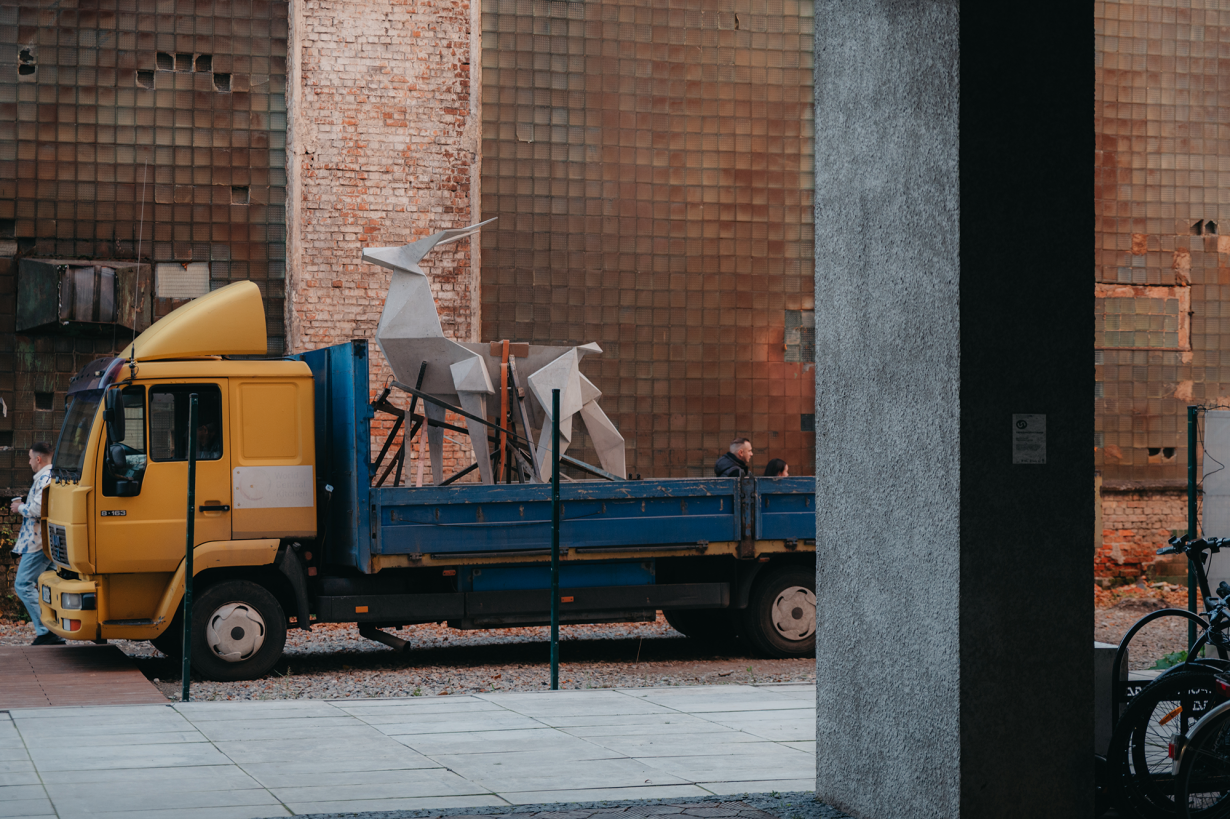
Zhanna Kadyrova The starting point for this project is a sculpture I made alongside Denys Ruban in 2019 for a public park in Pokrovsk, in the Donetsk region. It was created specifically for that place, during the renovation of the Yuvileynyi park, and installed on the former site of a Soviet nuclear-capable aircraft.
In 2024, when the frontline approached the city and a forced evacuation of the population began, the sculpture was also evacuated. It was not conceived as a movable work, so this change of condition is important.
It will be presented in Venice as the central piece of Security Guarantees, the project of the Ukrainian Pavilion. One part of the exhibition will be displayed in public space, at the entrance to the Giardini, while the other will be on view in the Arsenale. There, we will bring in historical materials, including relating to the Budapest Memorandum and the story of Ukraine’s nuclear disarmament.
For me, this is not only about one object. It is also about the path Ukraine has taken by choosing a certain direction of development that is not military but cultural, and about how this choice is reflected through very real situations.
AR In what ways (if at all) does your work relate to the theme of the Biennale exhibition, In Minor Keys?
ZK We didn’t try to adapt the project to the curatorial theme. For us, it was important that the Ukrainian Pavilion reflects subjects that are directly relevant and meaningful to us as a community.
At the same time, this is not a neutral context. A national pavilion is an official form of representation, supported by the state, so the idea that art can exist outside politics here is not really possible.
Because Ukraine has been living in a state of war for years, we inevitably speak about war, about security and about the broader political situation. These are the conditions in which the work exists.
So while the project was not deliberately built around the Biennale’s theme, certain connections may still appear.
AR Why is the Venice Biennale still important, if at all?
ZK It remains important because it is one of the largest platforms for contemporary art where national presentations, including that of Ukraine, take place.
This is not only about war. It is about the official representation of a country.
Ukraine does not have such a long or widely visible history of representation in this context, so having the opportunity and the resources to speak is very important. It allows us to be present in a cultural field where we are still not sufficiently seen.
AR What role does a national pavilion play at a time of increasing confrontational nationalisms? Is it about expressing difference or commonality?
ZK A national pavilion is first of all a way to present the culture of a country.
For me, this is not about nationalism but about cultural representation and art. I don’t think it is really about expressing difference or commonality. It more about showing what is relevant or not at a given moment.
Each country chooses its own way of presenting itself, its own approach to what and how it wants to communicate.
AR Who, for you, is the most important artist (in any discipline) that your country has produced?
Kadyrova did not answer.
AR What is something you want people to know about your nation that they might not know already?
ZK I think our task is quite simple: to show that Ukrainian culture exists and that it continues to function. Art in Ukraine is being produced despite the war, during the war, in the conditions of war and often in relation to it, but not only. What is important is that we still have the possibility to work and that we have things to say. There are historical materials in our project, but it is also shaped by our present experience of living in the country. It reflects the reality that surrounds us now.
I hope the project will help audiences, especially those who know little about Ukraine, to understand more, not only about the war itself but about the broader context in which it unfolds.
AR Given that you are exhibiting in a national pavilion, is there something that distinguishes the art of that nation? Or is art a universal language?
ZK In my case, art cannot exist outside politics. When you present a country that is at war, it is not possible to separate artistic work from political reality, especially in a format like a national pavilion. For me, this presentation is deeply political and closely connected to social, political and geographical conditions. So while art can be understood beyond borders, it is always shaped by the context in which it is produced.
AR What, other than art, are you looking forward to seeing – or doing – while you are in Venice?
ZK To be honest, I won’t have much time to see a lot of art. My main focus is to realise our project as well as possible.
At the same time, the Biennale is a place for meetings. I hope to see friends and colleagues from the professional community, as well as Ukrainians who have relocated in recent years. It is also an opportunity to meet curators and media professionals who support Ukraine and are interested in what we do.
Most likely, I will only be able to properly see the exhibitions later, once everything is finished and I return to see Venice at a slower pace.
AR Could you give us a brief overview of your average working day while creating your presentation in Venice?
ZK There is no typical working day. The preparation for the Biennale has taken almost a year and the process unfolded in different stages. It began with developing the concept with the curators, deciding what is important to us and how to present it. Then there was another phase, when the sculpture started its journey to Venice. This involved a larger team. Filmmakers documented the process, musicians contributed to the project and we travelled from city to city, first within Ukraine and then across Europe. At the same time, the team worked on the public programme, including discussions and film screenings. Later came postproduction and the technical organisation needed to realise the exhibition. There is also constant communication with institutions, partners and sponsors. And of course, interviews take a lot of time. Sometimes it is several calls or recordings in one day. So there is no single routine. Each stage has its own rhythm and its own kind of work.
AR Can art really change the world?
ZK From my personal experience, my attitude to art has changed. At the beginning of the war, I felt a strong disappointment in artistic practice. It was a moment of stress, of leaving my home, of feeling almost completely cut off from my previous life.
Later, through working, exhibiting and speaking about the situation in Ukraine, I began to reconsider this. Through projects, through communication, through telling both a shared and a personal story, I saw that art can function in different ways. It can also generate support, including material support.
I don’t think art can literally save the world. But it has weight. It is seen, it is perceived, even at a time when the language of war dominates everything.
I still believe that through thoughtful artistic projects it is possible to say a lot, and to change something, both in people’s perception and in some cases in real conditions.
The artist’s answers have been translated from Ukrainian
The 61st Venice Biennale runs 9 May through 22 November 2026