“The scale of tourism impresses me greatly”
ArtReview sent a questionnaire to artists and curators exhibiting in and curating the various national pavilions of the 2026 Venice Biennale, the responses to which will be published daily in the leadup to and during the Venice Biennale, which runs from 9 May through 22 November.
Norton Maza represents Chile; the pavilion is located in the Arsenale.
Celebrating Visions. Versace partners with ArtReview to share stories from the 2026 Venice Biennale.
ArtReview Tell ArtReview what you plan to exhibit in Venice. What has influenced or inspired you?
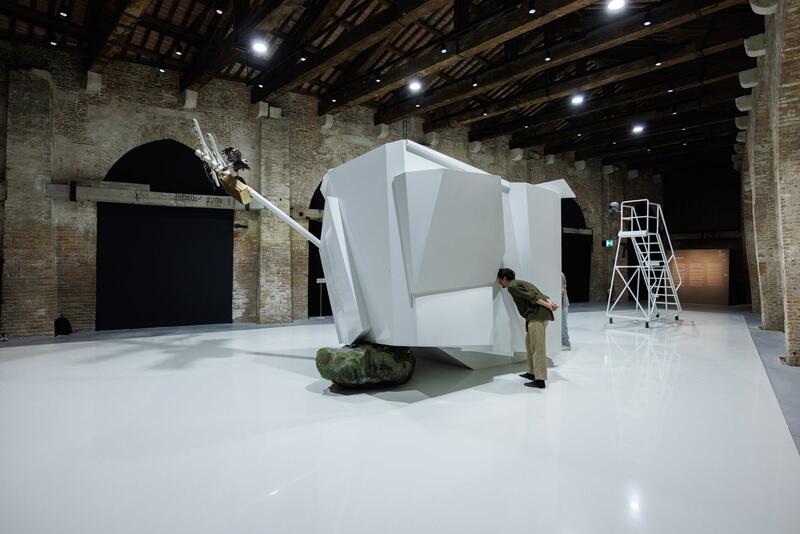
Norton Maza I will present Inter-Reality, an immersive and multisensory installation that offers the viewer a direct experience of the fragmentation of contemporary reality. It is a work built through multiple layers – visual, sonic, and spatial – where the real and the fictitious coexist and merge.
My practice has always been influenced by classical and Baroque painting, but also by very concrete personal experiences: having lived in contexts of both scarcity and abundance, let’s say – that tension between those two worlds. To this is added the present moment, shaped by overinformation, misinformation and a growing difficulty in distinguishing what is true from what is false.
AR In what ways (if at all) does your work relate to the theme of the Biennale exhibition, In Minor Keys?
NM I wouldn’t say there is a direct relationship, but rather an affinity that emerges from the fragmented and the non-evident. Inter-Reality avoids a univocal reading and instead proposes a shift toward ambiguous zones, where the viewer constructs their own narrative through the experience. The work embraces the noise of the contemporary – in its various forms – as a constitutive material.
AR Why is the Venice Biennale still important, if at all?
NM It remains a relevant space because, beyond its history, it allows for a dialogue between different cultural realities. It is one of the few places where perspectives from very diverse contexts intersect, opening up possibilities for reflection that go beyond the local. More than a site of validation, I am interested in it as a space for encounter and contrast.
AR What role does a national pavilion play at a time of increasing confrontational nationalisms? Is it about expressing difference or commonality?
NM It’s a complex question. I believe the national pavilion can be a space to precisely challenge that idea of a fixed identity. It is not a closed representation of a country, but rather a platform from which shared concerns can be brought into circulation. In my case, I am also working with two non-Chilean curators, the Argentine Marisa Caichiolo and the Cuban Dermis León. The work is grounded in a Latin American context, but the issues I address – misinformation, the ecological crisis, migration – are global. More than asserting a difference, I am interested in generating points of connection.
AR Who, for you, is the most important artist (in any discipline) that your country has produced?
NM It’s difficult for me to choose just one name, as there are many significant trajectories. However, I deeply admire Violeta Parra. Through her music, I’m able to visualise and feel many of the aspects that move me internally.
AR What is something you want people to know about your nation that they might not know already?
NM That it is a country full of contrasts, not only geographic, but also social and cultural. This condition generates frictions, but also an enormous capacity for invention. In many cases, creating from precarious conditions implies developing unexpected solutions, a sense of recycling and a flexible sense of humour. All of this is part of a sensibility that runs through different practices in Chile and across Latin America.
AR Given that you are exhibiting in a national pavilion, is there something (a quality or an issue or attitude) that distinguishes the art of that nation from that of others? That makes it particular? Are there specific contexts that it responds to? Or do you think that art is a universal language that goes beyond social, political or geographic boundaries?
NM I think that rather than a single defining characteristic, what exists is a very particular relationship with context. In Latin America, art often develops in direct dialogue with very concrete social, political and economic tensions.
In my case, this relationship emerges through a combination of the poetic, the symbolic and the critical. I am not interested in literally representing a situation, but in generating an experience that allows the viewer to reflect from a different place.
At the same time, I believe that art has a universal dimension that transcends borders, while always being shaped by a history and a place from which it is conceived.
AR What, other than art, are you looking forward to seeing – or doing – while you are in Venice?
NM I am very interested in the city itself: its history, its architecture, but above all its relationship with water. As a child, I always lived in cities close to water, and that brings back beautiful memories. I see it as a place that already contains a certain sense of unreality, which in some way resonates with the Inter-Reality project.
I am also interested in observing how people inhabit that space, beyond the art circuit. The scale of tourism impresses me greatly. I also hope to get lost in its narrow streets and encounter unknown realities.
AR Could you give us a brief overview of your average working day while creating your presentation in Venice?
NM It has been a very intense and collective process. Since winning the competition, we have been working extensively. It’s also true that each stage brings different challenges: from conceptual decisions to very specific technical solutions.
Italy is very far from Chile, so the logistics of transporting the work have been particularly intense: by sea, by air, by land, and through digital means. Much of the work involves coordinating teams, managing communication, reviewing details, and at the same time maintaining coherence with the initial idea. It is a process that requires focus, but also a great deal of flexibility.
AR Can art really change the world?
NM Art does not change the world directly, but it can generate a different way of perceiving it. And that shift in perception can open up new questions, create discomfort, or provoke reflection. In that sense, art has the capacity to activate something in the viewer, and that in itself is a form of transformation.
The 61st Venice Biennale runs 9 May through 22 November 2026