The artist Lina Lapelytė’s commission for this year’s Performa Biennial certainly has emancipatory intentions. But is freedom ever a realistic aim of performance?
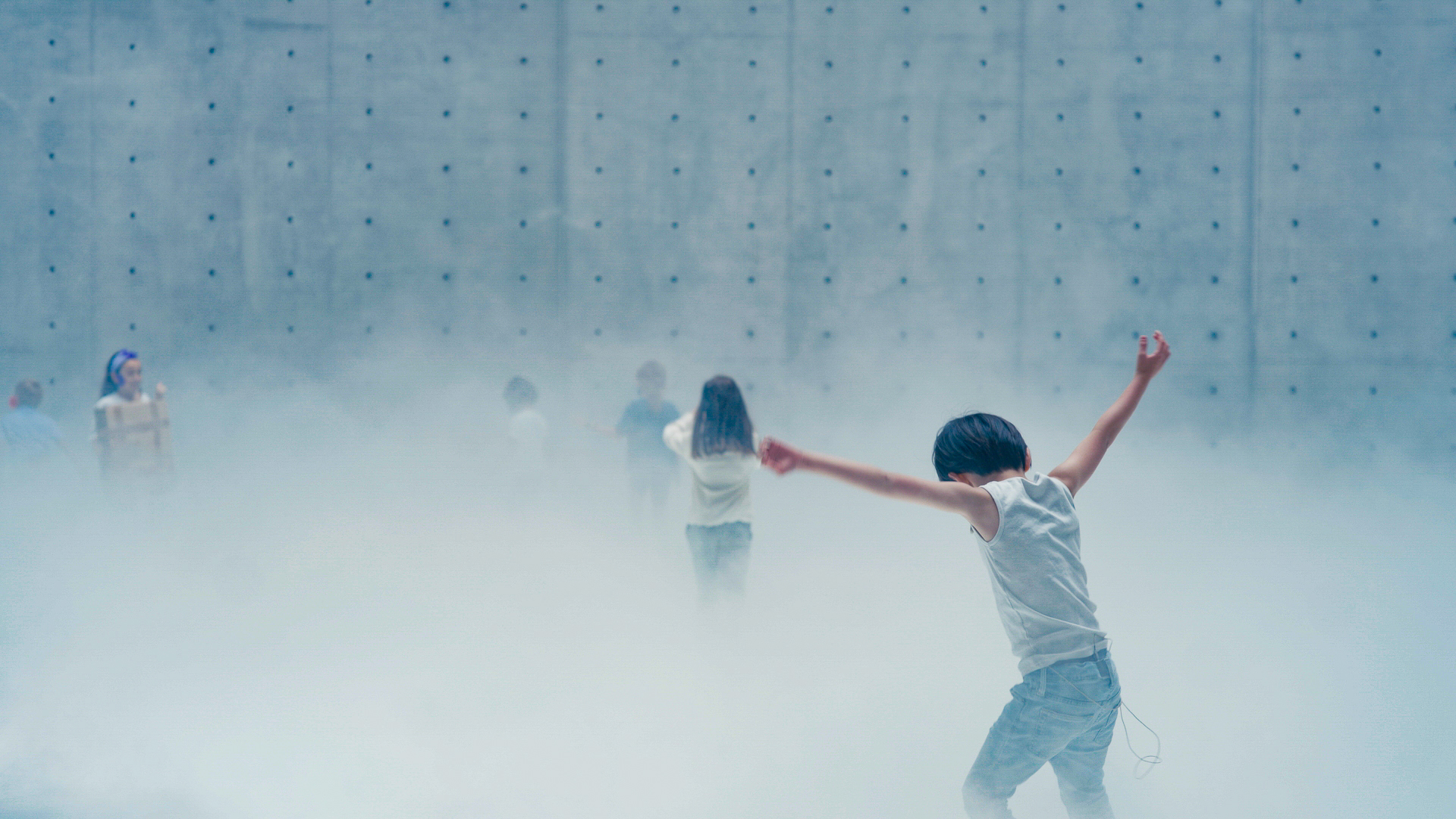
In a dim, fog-filled neo-Gothic sanctuary, beneath vaulted ceilings and German stained glass, the elongated shadows of the child performers in Lina Lapelytė’s 2025 Performa Biennial commission, The Speech (NYC), brushed the grey stone walls as they scuttled on all fours across the mezzanine before descending to stand wide-eyed, dressed in long-sleeve tees, blue jeans, mesh joggers and hoodies, in a circular arena surrounded by adult spectators.
In Walter Benjamin’s posthumously published essay ‘Program for a Proletarian Children’s Theater’ (1928/9), the philosopher and critic advocated for a kind of radical play that would act as a framework for the class-conscious education of minors. ‘In the view of the bourgeoisie, nothing presents a greater danger to children than the theater’, Benjamin wrote, because theatre threatens to ‘unleash in children the most powerful energies of the future’. In his view, which was heavily influenced by the work of the Latvian Bolshevik Asja Lācis, who was known for directing theatre troupes with Russian war orphans during the 1920s, performance served as a site of reverse-pedagogy, where, through improvisation, children come to surprise and inspire adults in the process of their becoming ‘free’.
There is reason to believe that The Speech (NYC), conceptualised by the Vilnius- and London-based artist (who won the Golden Lion at the 58th Venice Biennale for her opera Sun & Sea (Marina); 2019), was shaped by similarly emancipatory intentions. The premise of the work, which Lapelytė developed for the 2024 Festival d’Automne, Paris, and has since shown as a video installation in the Shanghai Biennale and revised for this subsequent presentation at Harlem Parish, New York, was simple: a group of children – in this case around 100 private-school students from Brooklyn – would gather in a minimalist setting and mimic animal sounds for the duration of the happening. Performa’s curatorial text states that ‘Lapelytė lets [children’s] instincts – once disciplined, now amplified – speak on their own terms’ and that the piece’s choreography ‘preserves disorder and improvisation, privileging the rhythms of children’s attention over any imposed structure’. As Lapelytė told The New York Times ahead of the premiere of the new iteration, ‘It’s freedom we’re interested in.’
But over the course of its opening-night execution, the artist’s simple premise unravelled, revealing the impossibility of the kind of ‘freedom’ the performance was meant to evoke. After the children’s dramatic entrance, the performance devolved into an almost arbitrary routine: laying carpets on the floor and squirming around on them as if preparing for naptime; running laps as if in gym class; squeezing shoulder-to-shoulder in a choirlike mass. All the while, the children emitted high-pitched growls, roars, whines and howls, interspersed with birdsong, bleating and buzzing. I felt sorry for them, spotlit as they were – less like wild beasts than their befuddled counterparts in the zoo – and oddly relieved whenever they broke character, such as when one waved to a familiar face in the audience, when a few stared at the floor for minutes on end or when a group of middle-school-aged girls retired upstairs, leaned against the mezzanine railing and watched from above. Maybe that, for them, was freedom.
Why use children? They certainly added an affective texture to Lapelytė’s concept by producing onstage what sociologist Maja Brzozowska-Brywczyńska identifies as the ambivalent otherness and monstrosity of cuteness. But what is it about children that makes them better suited to enact what the press release calls ‘the earliest forms of human address’ than, say, the untrained adult performers Lapelytė has previously employed, such as the tone-deaf singers she staged in a musical performance in 2022? ‘Children’s theater productions inevitably strike adults as having authentic moral authority’, wrote Benjamin. The idea of children forming a microcosmic, self-sufficient, prelinguistic utopia did indeed carry a moral – moralising – weight, though I left Harlem Parish thinking less about the future than about the clichéd image of children being children – or rather, children performing surface-level representations of themselves – in a situation that could have passed for a school play. Without the cold backdrop of the Bourse de Commerce’s Tadao Ando-designed rotunda, which accompanied The Speech’s Paris production, the cloying kitsch underlying the performance’s concept was exposed.
So too was the false assumption that if one lets language simply ‘fall away’, what remains is authentic, unrepressed, uncensored expression. Relying on animal noises, the performance was made more predictable and controllable. If the children had been allowed to use words, who knows what they might have said? Had they been free to draw on the full range of human vocalisation, we might have witnessed a spectacle akin to when the eleven-year-old girl in Bill Viola’s video Anthem (1983), standing beneath the vaulted ceiling of LA’s Union Station, amid a relentless montage of industry, technology and extraction, opens her mouth as wide as a lion’s and screams.
Lapelytė’s pageant of prelinguistic freedom – as a hypothetical conceived by an artist prior to meeting the students with whom she’d be collaborating, and as an experiment ultimately administered by their schoolteachers, who delivered the instructions and oversaw the rehearsals in the artist’s stead – imposed if not strict choreography then a set of behavioural expectations that foreclosed the possibility of genuine emancipation.
The production had to relocate to Harlem Parish from the Federal Hall National Memorial when the latter closed during the 2025 US government shutdown. At its intended venue, Lapelytė had planned for a happening that would carry more of a charge, one that alluded to ‘the political speech acts’ associated with the former capitol building and, by extension, American democracy. What The Speech (NYC) did instead was highlight an impasse in intergenerational communication, one with its own political implications. A century ago, Benjamin wrote about what he saw as a struggle to transmit class consciousness to youths: it is not enough, he observed, for children to please adults by ‘parroting’ slogans, and, besides, the desire to parrot won’t last ‘ten or twenty years’.
This impasse appears between adults of different generations just as often as it does between adults and children. Three days after I saw The Speech (NYC), I went to hear Susan Buck-Morss, philosopher and Benjamin scholar, speak at the P.I.T., a community bookstore in Williamsburg, about her notion of a ‘commonist ethics’ – global solidarity through which social action instigates events that reveal ‘the possibility of human freedom’. About an hour into the disjointed talk, which touched on everything from W.E.B. Du Bois to Kazimir Malevich to Zohran Mamdani’s mayoral win, it became evident that audience members were conflating the Benjaminian dialectical image undergirding much of Buck-Morss’s ardent theorising with the literal pictures on their social media feeds. The conversation hit a wall when a thirty-something interlocutor asked Buck-Morss how to fend off brainrot, and the philosopher suggested they get off social media. “Meaning […] is sort of determined now for us,” her interlocutor insisted. “It’s incredibly difficult to have a thought in your head because of that.” “Why bother thinking today at all?” mumbled a twenty-something who’d earlier asked about the ‘relevance’ of intellectual conversations at a time when media is so totalising. Buck-Morss beheld her audience with a wan smile. After a while, she said, “I’m getting pissed because here you are, miserable about your dystopic life. […] No one’s got your eye open like in A Clockwork Orange.”
Their bickering went on interminably, but in hindsight, I was relieved that those who spoke in that cramped bookstore refused to let each other off the hook. The elder thinker offered no carte blanche, no hint of moral or intellectual permissiveness; her younger readers likewise would not let her theories go unchallenged as ahistorical truth. For a few hours, in a tiny, temporary arena of discourse, no one got away with mere chirps and croaks.