These four large paintings are an exercise in holding together fragility and resilience on canvas
Part of the Sainsbury Centre’s Can We Stop Killing Each Other? season of exhibitions exploring conflict and resolution, Roots of Resilience is the culmination of Ethiopian painter Tesfaye Urgessa’s residency there in March 2025. The centre’s collection – a mix of artworks and objects from Europe, Africa, Oceania and the Americas – has inspired four large paintings and several midsize works mostly made during the residency. Here Urgessa presents his paintings alongside several such works, ranging from Francis Bacon’s Head of a Woman (1960) to Henry Moore’s 1932 sculpture Mother and Child, and from Ivorian figures to Picasso’s Woman Combing Her Hair (1906).
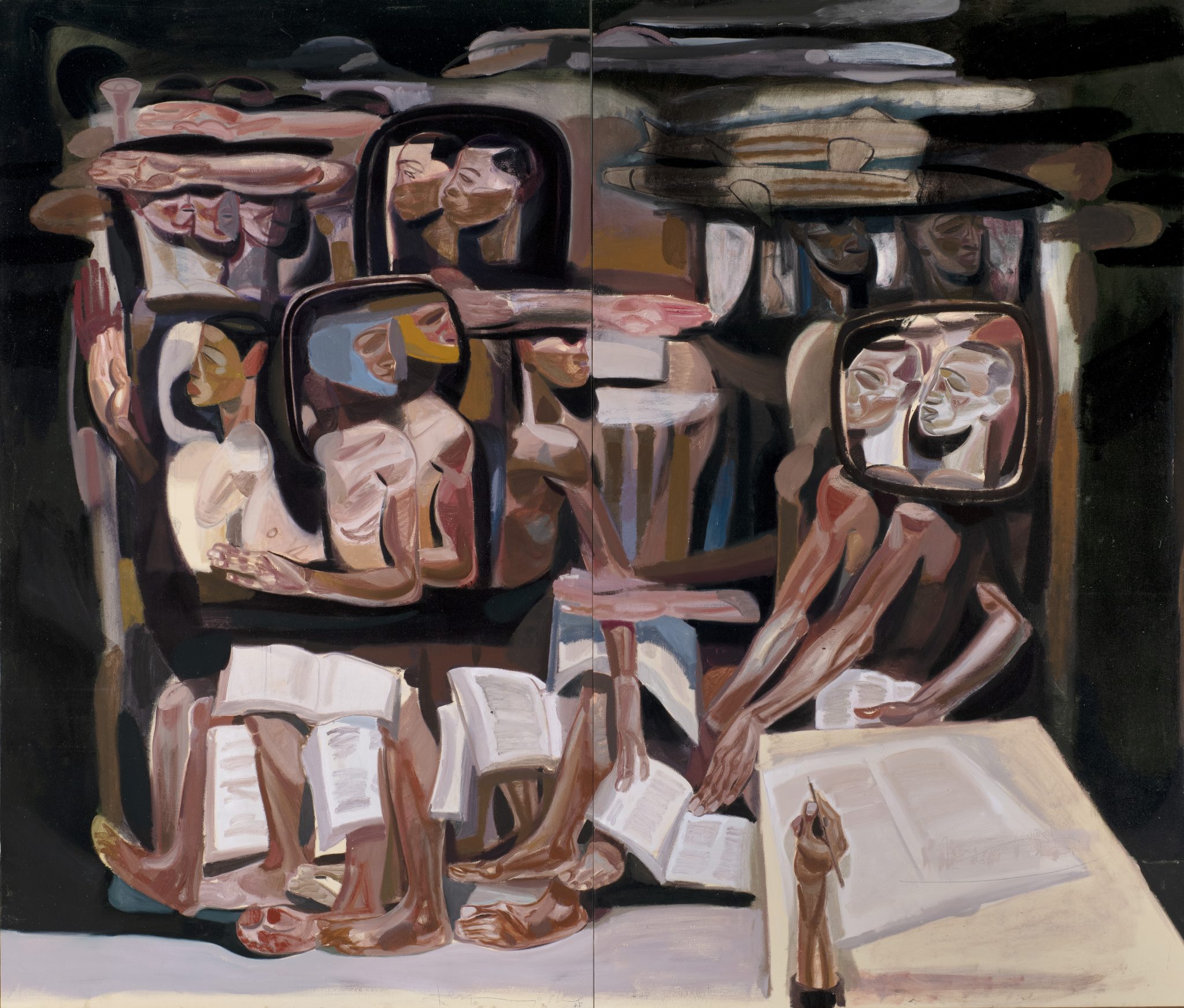
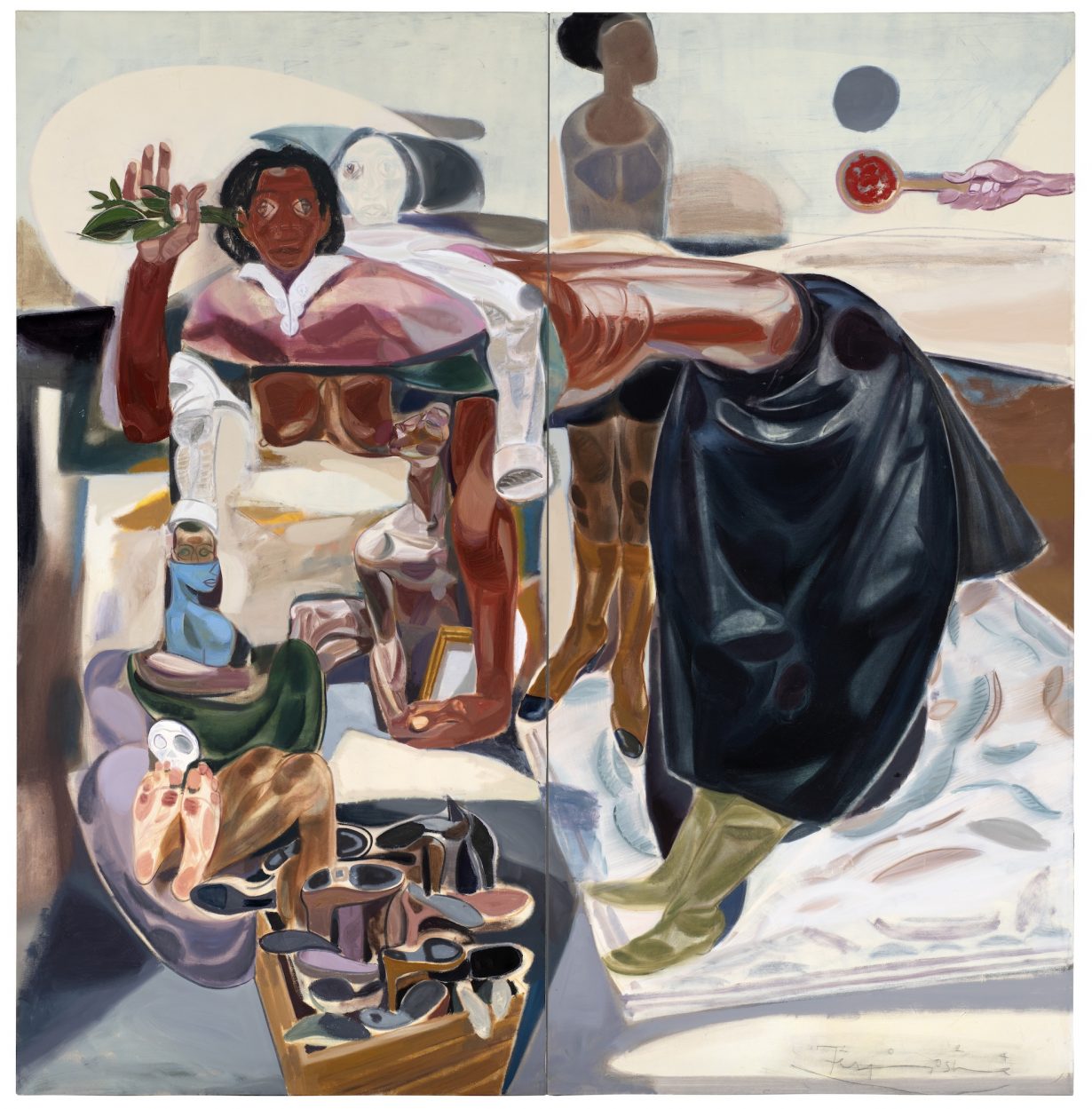
No Country for Young Men, 31 (2024; first shown as part of Urgessa’s Ethiopia Pavilion presentation at the 2024 Venice Biennale) sets out the artist’s exploration of the psychology of displacement through a surrealist logic. Brown male figures, emaciated yet springy, are ram-packed and sequenced in divergent directions, beset by splayed books and a single hand holding a pen over an opened book in the bottom right corner. First Flame (2025) develops the same grammar: the left panel of the diptych is cluttered – nested figures, a suckling toddler, human legs and a crate of upturned shoes – yet the pictorial weight is carried in the right panel by a navyblue skirt seen from the waist to the feet, forming a solid, columnar base.
The deceptive imbalance invites a corrective response; the viewer’s attempts to right the image become part of the work’s intrigue. Scale is intuited by the pairing and proximity of a distant hill, an even more distant grey sun and a small handheld fan or mirror. Urgessa works within a narrow spectrum of earth tones, a palette that has deepened, he has said in an interview, since his return to Addis Ababa (after 13 years in Germany) in 2022.
Bacon’s Head of a Woman is restaged in Luminous Life (2025) as a cross-generational grouping of men in deep ochre against a pale green and white background. Picasso’s Woman Combing Her Hair is shown alongside Urgessa’s expressive version of it, which privileges colour over shading and strength over mass. The contorted anatomy of Urgessa’s subjects allows the body to speak emotionally, an exploration of fragility and resilience. The Ethiopian artist’s visual strategies are rooted in a lineage stretching from European surrealism to African modernism, in particular the work of Sudanese modernist Ibrahim El-Salahi. Beyond its formal mastery, this curious blend of bodies and objects is both homage and confrontation, simultaneously reverent and disruptive, relinquishing authority and aura while pointing to the resilience of the self amid displacement.
In Roots of Resilience Urgessa masters an approach modelled on Giorgio de Chirico’s and Philip Guston’s illogical combinations of items and anatomies – including recurring statuelike heads, sometimes in stark white – which underwrite the surrealism evident in First Flame (2024–25). The ‘resilience’ he depicts is both human and artistic: a psyche reassembled from fragments, building an enduring self against displacement. Across most of his multifigure paintings, simple compositional anchors appear: a crate to the left, a mat to the right; in No Country for Young Men it is the books, in Luminous Life, a square table. These motifs give the eyes a resting place, stabilising otherwise kinetic or incongruous compositions. The tension becomes less a contest of influences than the evolving logic of an artist working out how to hold together fragility and resilience on the canvas.
Roots of Resilience: Tesfaye Urgessa at the Sainsbury Centre for Visual Arts, through 15 February
From the November 2025 issue of ArtReview – get your copy.
Read next Charwei Tsai: Touching the Earth