This is a novel about grief and friendship; about memory and women. It’s about the relationship between individuals and communities and about how both those identities are formed. It’s about class and gender, about social conventions, and about how the latter define what and who becomes visible and what and who does not. Mainly, it’s about love. Or, more specifically, a ‘love, that always remains incomplete, un- spoken, unlived’, as it is described about two-thirds of the way through the third of Geetanjali Shree’s five novels (all originally written in Hindi), now published in translation for the first time outside of her native India.
What makes Shree – a Booker Prize-winner for the translated version of Tomb of Sand (2022) – one of the world’s most daring and innovative novelists is the way in which form and meaning in her works are intricately linked. And so here, like the love it describes, her book’s narrative itself is at times incomplete, unspoken and unlived. ‘Maybe this is how it always is,’ Shree writes. ‘Things don’t really happen when they’re happening. They happen later. When a storm within links them up into a sequence of events.’
Which can, at first, seem difficult and frustrating, but, as you move on, becomes ever more powerfully honest, direct and emotive. Shree’s tale describes the relationship between two women, Chachcho and Lalna, following the death of the former, as seen through the eyes of Bitva, then Lalna. Bitva identifies Chachcho as his mother, but as the novel progresses it becomes more uncertain as to which of the two women occupies that role biologically.
As for Lalna, she has just returned to the housing complex in which all three of them (plus Chachcho’s now long-dead husband) once lived, having left abruptly sometime earlier. In each of their narratives, past and present experiences merge to the extent that Chachcho appears as a ghostlike figure, dead, but ever-present. As they hop around in time, each also exists as a patchwork, with the result that you, the reader, are never really clear as to whether it’s you who is stitching the story together or Shree. Your reading becomes as performative as the actions of any of the main characters. But, as the novel progresses, it does become increasingly probable that Chachcho and Lalna were lovers.
In part, those uncertainties come about because both narrators are hugely conscious of what they don’t want to say and don’t want to know (and so don’t say or pretend not to know things that might be vital to any conclusive ‘plot’). The force of convention is the more suocating, more silent ghost that haunts Shree’s text. Its characters are surrounded by disapproving gossip and by people (notably Chachcho’s husband) who don’t know how to deal with whatever it is they suspect is going on. In the face of this social claustrophobia, Chachcho and Lalna find sanctuary and freedom on the complex’s roof – ‘when the roof is beneath your feet, there’s the whole sky above’ – while peeking through the skylights below their feet at the surreptitious goings-on of their (hypocritical) neighbours. In this book even the building performs. Below the roof you live according to society’s architecture – its structures and rules. Shree’s is an exceptional tale of how little it takes to gain a certain freedom, and how difficult it can be to gain even that much: ‘belonging to no home or hearth, just to the roof’.
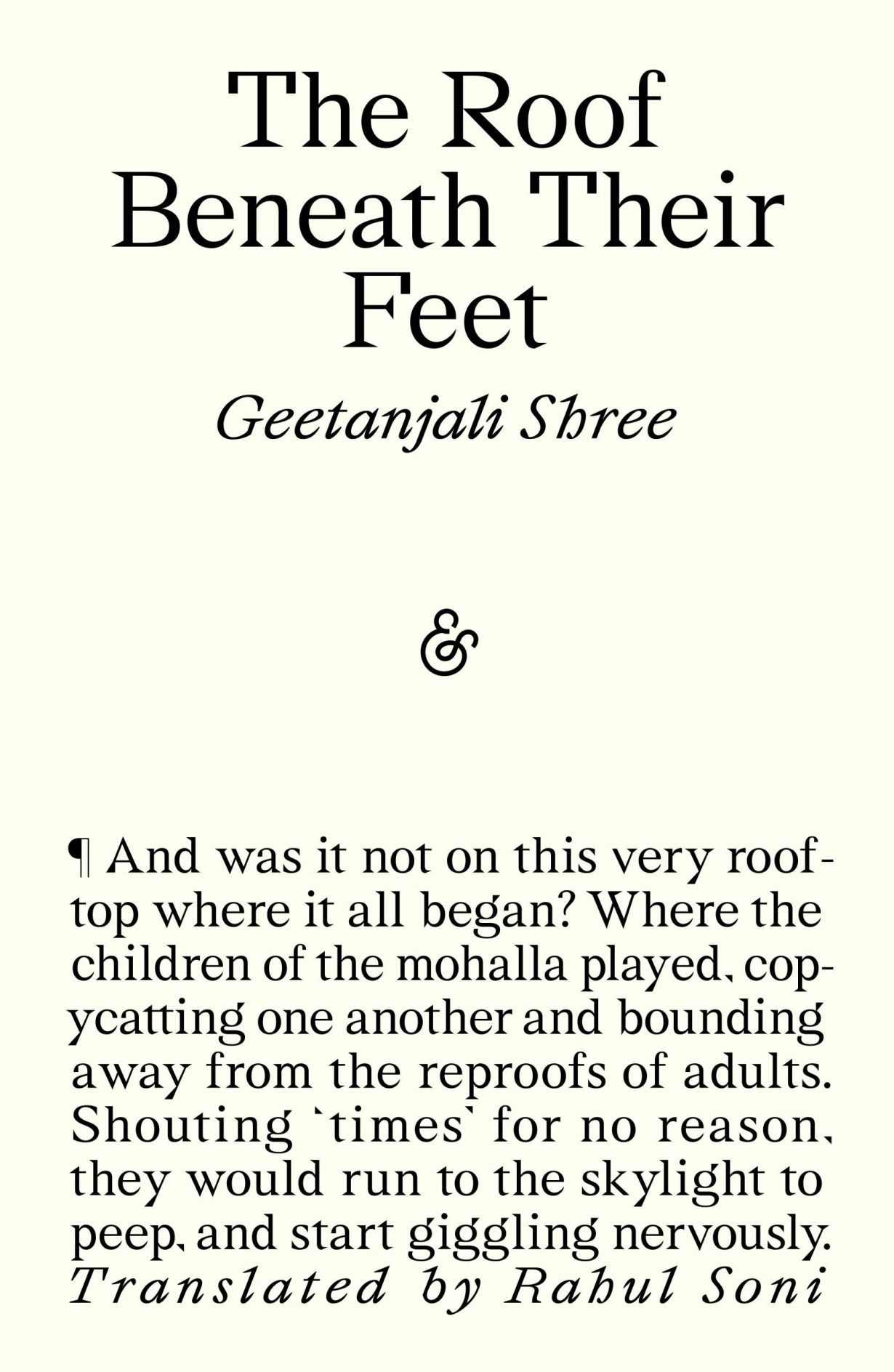
The Roof Beneath Their Feet by Geetanjali Shree; translated by Rahul Soni. And Other Stories, £14.99 (softcover)