Threading Inwards explores forms of spirituality in textiles
Threading Inwards takes the action of its title to connect the work of 14 artists from across Asia. In doing so it finds a path that unites spirituality, memory and rites of passage in a tactile depiction of the many ways in which fabric, thread and yarn are part of our daily existence, our otherworldly longings and imagination. Not that textile as a medium for these things is an unusual association; just an often neglected one.
The 14 positions on show here offer a wide range of possibilities for a consideration of the connections between fabric and spirituality: we start the journey by stepping through a soft threshold, created by Han Sang A, a Korean artist who works primarily with meok (Korean black ink) and cotton, and who shapes these into works that recall Korean ink paintings but take the form of eerie soft toys. Many of these forms carry religious significance – stupas, lamps and decorative shapes that would sit comfortably inside a Buddhist temple. They offer a sombre yet playful transcendence.
Something similar is at work in Hu Yinping’s collaborative project Soul Bottles (2026), which comprises a series of bottles that have been knitted or crocheted by Chinese women who were asked by Hu to reproduce, in yarn, some of the most common objects in their lives. Vacuum flasks, kitchen jars and mugs are recreated in thick and colourful woollen thread: unusable in relation to their original intended purpose but becoming what the artist has baptised ‘Soul Bottles’ or ‘Soul Jars’, in reference to vessels traditionally believed to shelter the souls that have left their bodies. In the words of the artist these vessels come to represent their makers’ ‘own personal heaven’ while adding a subtext about gendered roles in domestic space.
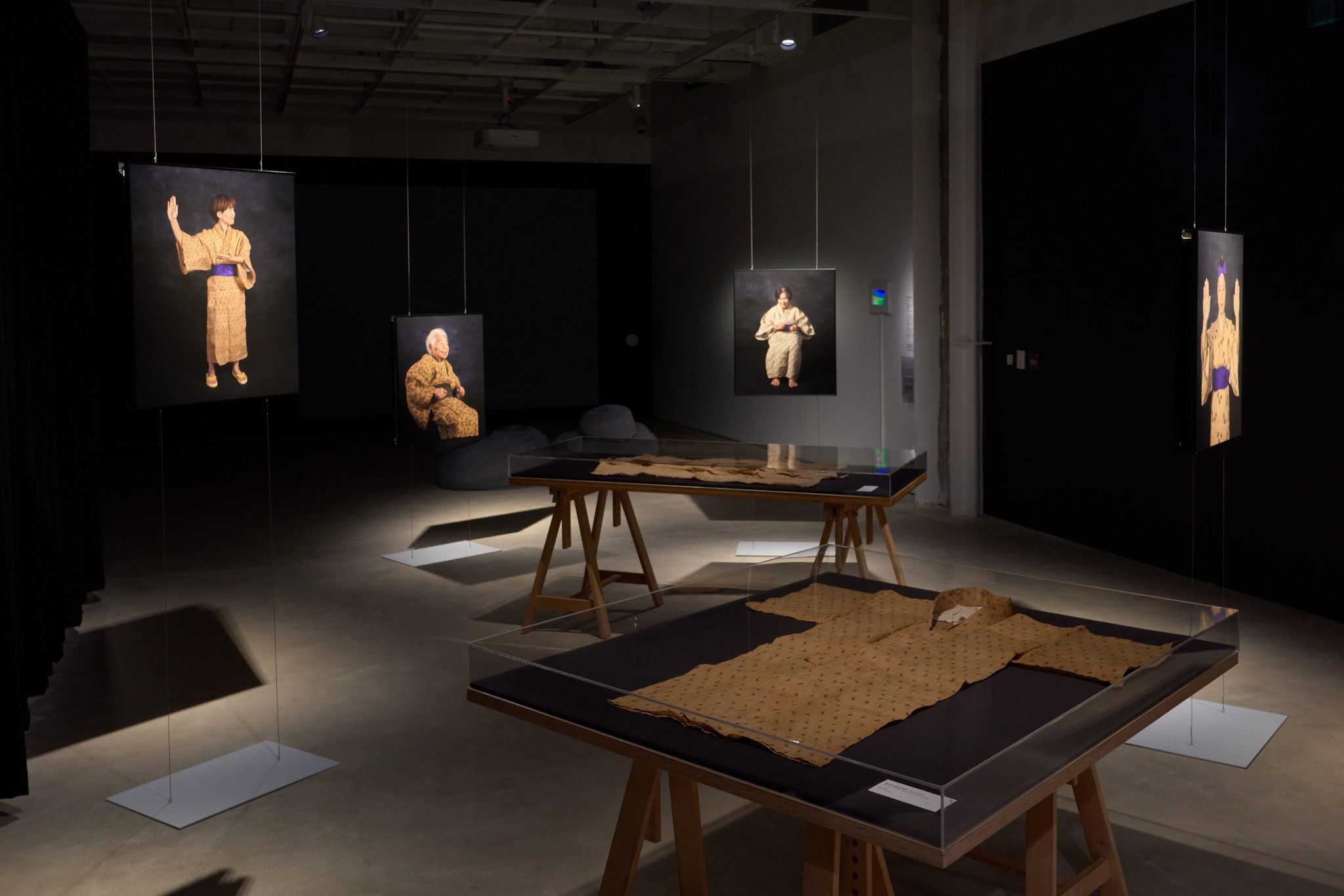
Kim Sajik, an artist of Korean descent living in Japan, travelled to the village of Kijoka, in Okinawa, to photograph rare bashofu kimonos, made of banana plant fibres. This is a type of fabric, once common to the area, that is now close to disappearing: very few weavers know how to produce it. Kim photographed a number of the latter, portrayed as if floating against a black background, their hand gestures and gazes expressing their attachment to bashofu in a manner similar to that one might experience when dredging up a long-lost family portrait and experiencing the emotions it triggers. Taiwanese Puyuma artist Milay Mavaliw, on the other hand, in Totems of the 16 Indigenous Peoples (Imprints), (2013–19), plays with the geometrical patterns of the sacred symbols used by the 16 Taiwanese Indigenous groups still present on the island, and turns them into a single square grid. The Puyuma people’s tradition of welcoming guests with flowers is turned into a free-hanging piece, called The Scent of Flowers (2013–19), that translates that joyous welcome into a curtain, with colourful flowers set against a black background that creates a much more imposing threshold than would the flowers alone.
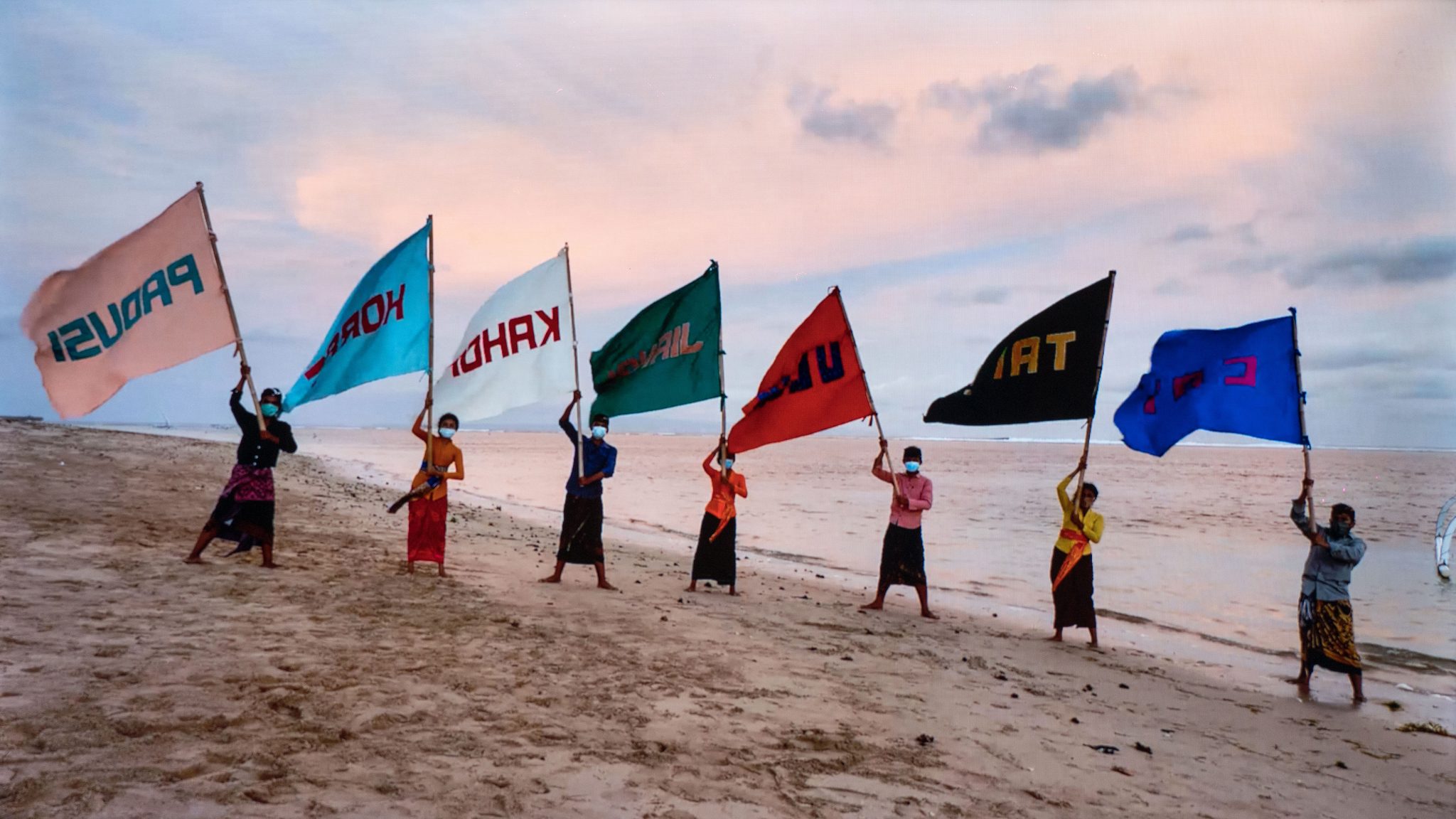
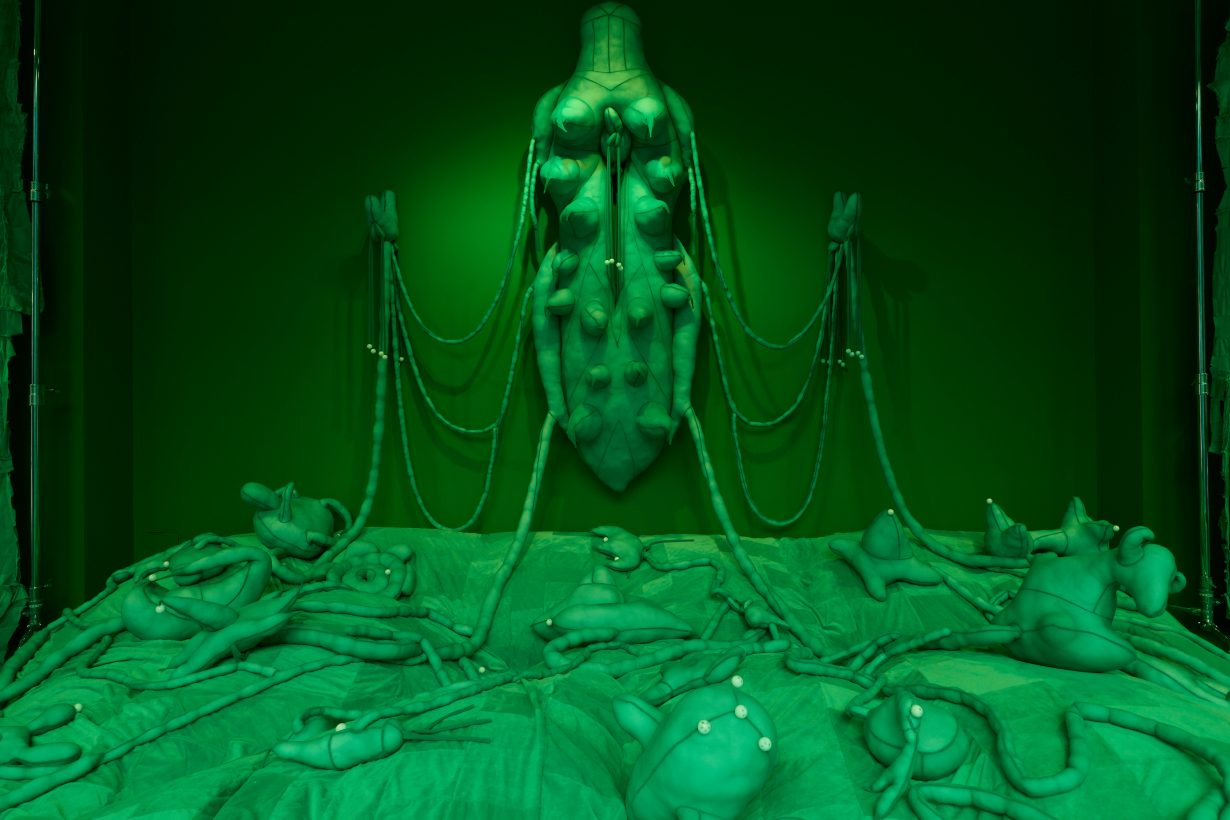
The wide variety of ways in which the 14 artists have interpreted the duality of cloth and spirituality underlines the versatility of textiles in our lives. The references can be direct, as in the embroidery and appliqué work of Balinese artist Citra Sasmita, Sky River in Fountain of Amygdala (2026), which reimagines funerary rites as part of a cycle of life, adding an image of two women giving birth, in a tightly woven cycle inspired by the Balinese myth of the giant turtle Bedawang Nala. But however much they dialogue with tradition, many of the works are also defiantly modern. IV Chan’s Chloronest (2026) merges the idea of an immersive performer’s ‘green room’ with notions of CGI green screens and themes of fertility and protection into a large textile sculpture in which visitors can rest or interact. While Aziza Kadyri uses AI to generate traditional Uzbek dances linked to silk production on screen in a homage to her grandmother.
Threading Inwards at Centre for Heritage, Arts and Textile, Hong Kong, 21 March – 28 June
From the Summer 2026 issue of ArtReview Asia – get your copy.