Four exhibitions, unfolding alongside the 25th Biennale of Sydney, look to material inventiveness and embodied experience to reimagine a broken world
It’s an important month for Sydney’s art scene, with the opening of the 25th Biennale of Sydney. Titled Rememory and curated by Hoor Al Qasimi, the Biennale sets out to explore histories that exist without physical trace. Stories that are carried, not in galleries or buildings – the sandstone monuments that define this harbourside city – but, rather, in what can be sensed and felt in the body. Away from the Biennale, however, four exhibitions across the city, each on view now, are similarly intent on exposing the faultlines of this moment, challenging and remaking legacies and histories from different vantages.
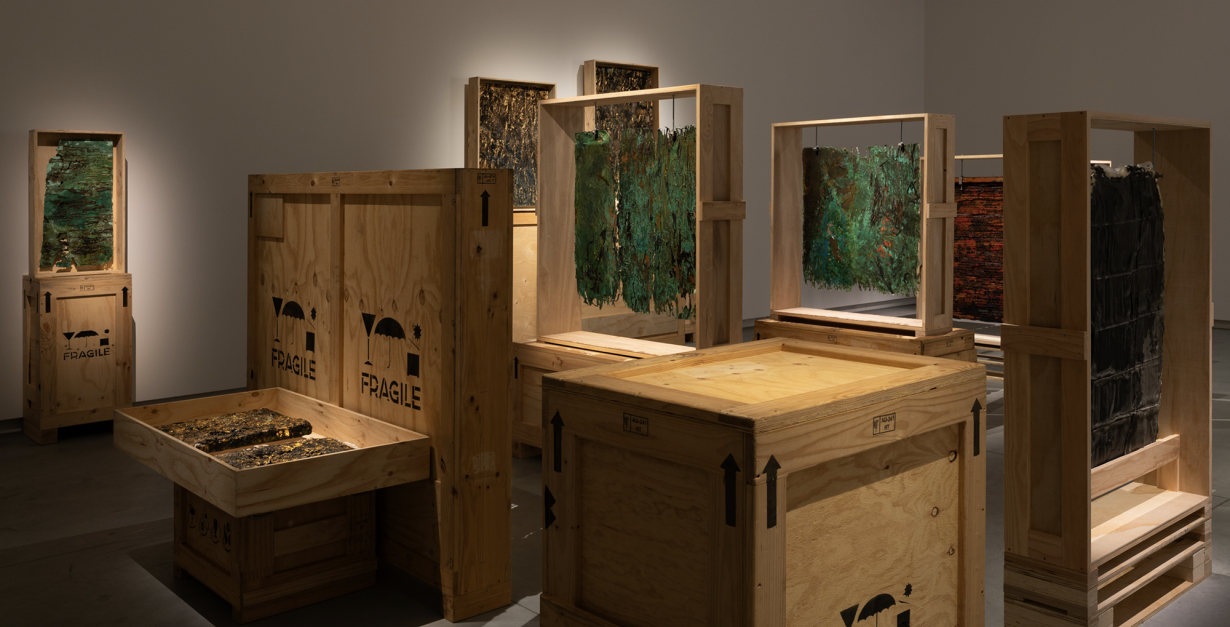
Kirtika Kain: Unkept at Chau Chak Wing Museum
Drawing from anti-caste traditions, Kirtika Kain charts the absences and silences that shape her Dalit lineage. Spending time with Kain’s new exhibition Unkept – the result of a residency at the V&A East Storehouse in London – I’m struck, not just by the way that the show challenges the politics of collection and display, but by how it rethinks the public record itself. It has become common, now, for exhibitions to grapple with colonial legacy. Less common is to conceive of what could exist in its place, but in Unkept, Kain’s shimmering works – made of charcoal and rope, sindoor and hessian – point to stories of labour and ritual, the ancient hierarchies that value some bodies over others, creating a fictional archive that invites new modes of seeing and being. I’m mesmerised by i (2025), a sheet of etched copper, cotton and tar broken in two, with swathes of turquoise and olive suddenly crumbling away and splayed over empty space, like the outline of an uncharted zone on a map. It is framed, like the other works in the room, by the nondescript wood of packing crates. Nearby, a silkscreen splattered with black. In this work I study swirling hemispheres of darkness that gather force and intensity. Not so much a portrait of absence but an attempt to imagine a way into it, give it form. Kain’s works transfigure the language of negation that shapes so much conversation in the artworld by suggesting that a gap in the record doesn’t constitute a void, but an opening. A way to access registers of feeling and experience.
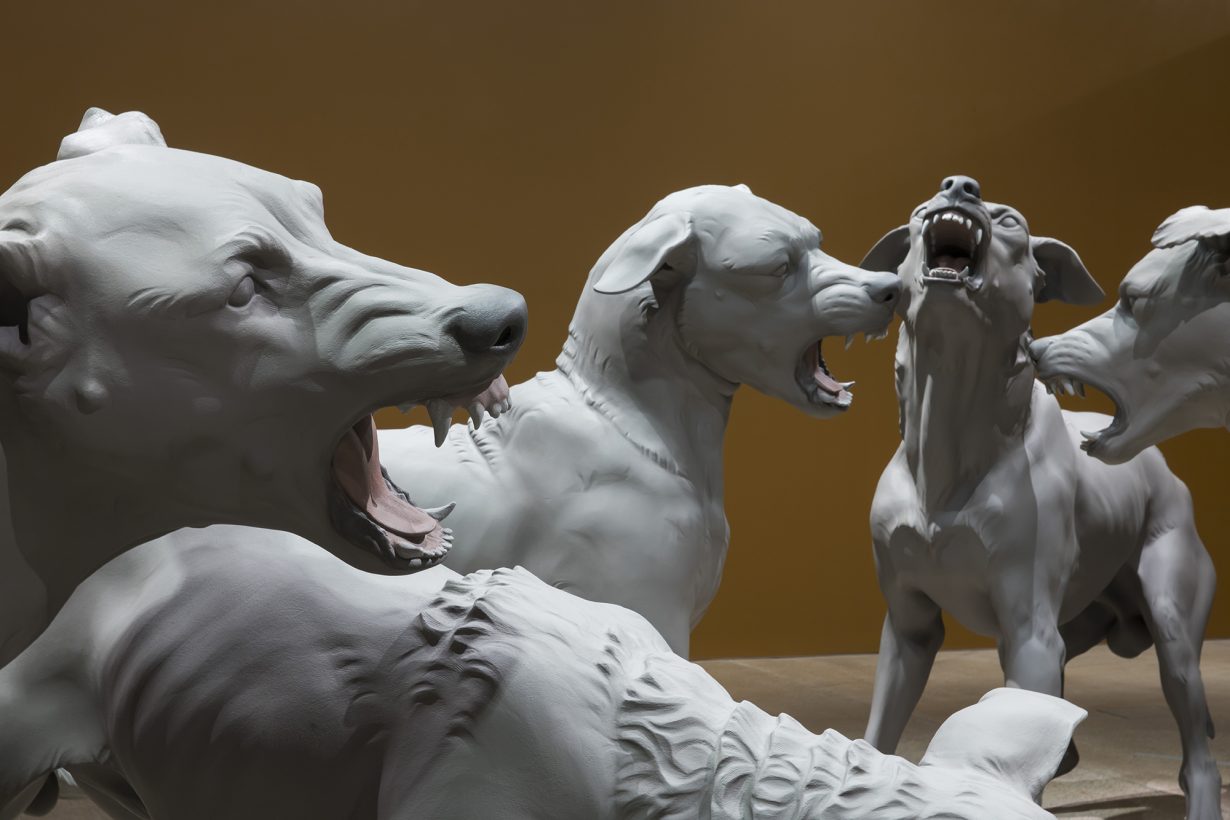
Ron Mueck: Encounter at Art Gallery of New South Wales
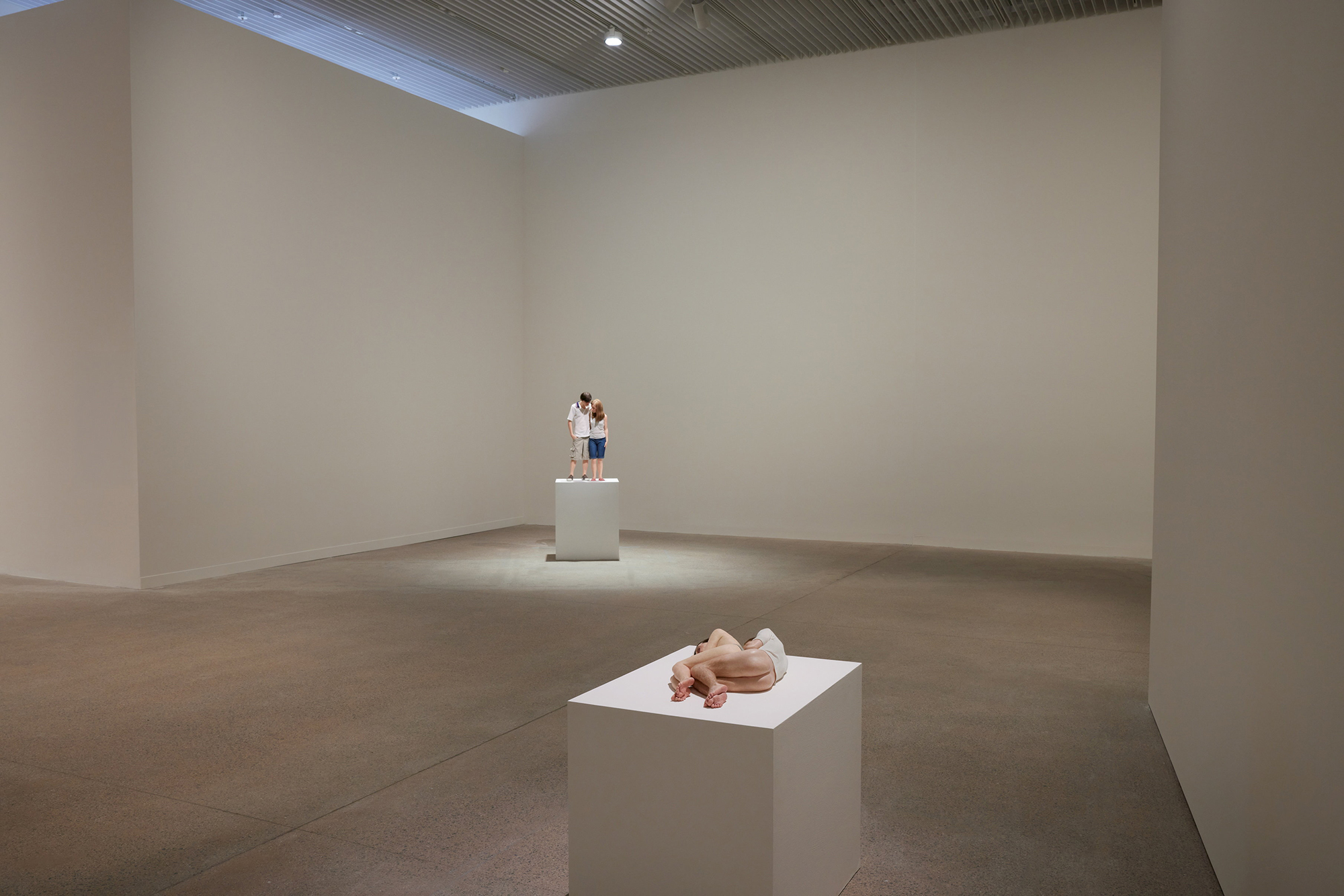
At Art Gallery of New South Wales, I am startled by Havoc, a 2025 work by Ron Mueck at the centre of his show Encounter, a sculpture of hounds that lunge and snarl, baring their teeth. I notice the muscles of their haunches, the pink of their tongues, and feel both discomfited by their violence and somehow relieved by their ugliness. It’s as if Mueck has mustered a vision in resin and clay to meet the brutality of this moment. If this vision isn’t subtle, his pack of dogs, braced for attack, their bodies gleaming and dark, recalling the hounds of hell, it’s because the structures of this world – the seemingly inevitable trajectory of power in society toward acts of possession and destruction – warrant it.
Mueck’s sculptures – their pale, marbled flesh, their flashes of cellulite-like silicone and sprigs of (real) hair – assume a strange poignancy. In Ghost (1998/2014), an awkward teenage girl leans against a wall, as if struggling to balance on her spindly legs, her exaggerated height ironically highlighting her vulnerability. In Spooning Couple (2005), a man and woman in bed, nestled into each other, in a state of (perhaps post-coital) undress. But look again, at the space between their bodies, their faces suffused with tension, locked inside their private worlds, and you might recognise yourself. Moving up close to the sculpture, smaller than human scale, tiny details pile up – the curve of a belly, the crescent of a toenail – and despite the precision with which these figures are rendered, it’s difficult not to be struck by all the ways they are trapped in bodies.
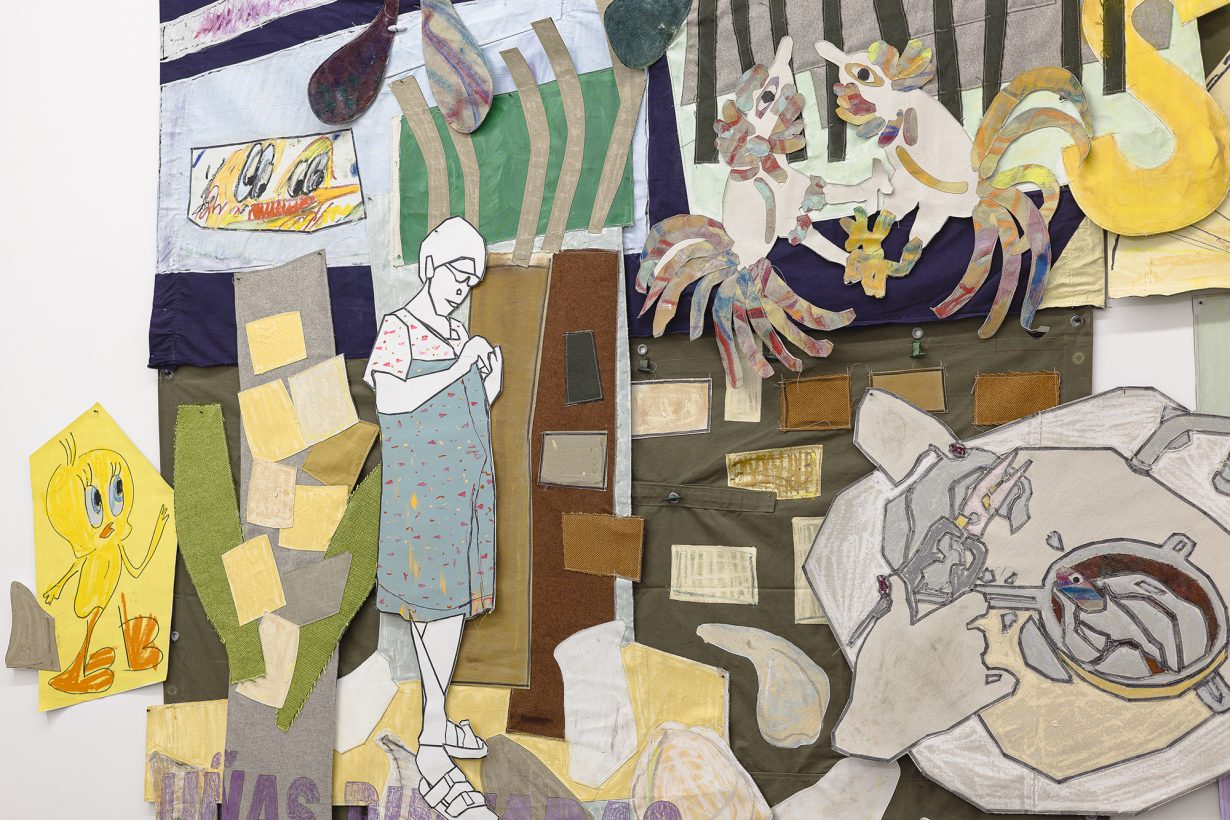
Nadia Hernández: Por la orilla de la quebrada (Along the creek’s edge) at STATION
I cross Hyde Park to visit Por la orilla de la quebrada (Along the creek’s edge), a solo show by Nadia Hernández, a Venezuelan-born artist, whose work explores cotidianidad, a practice that centres the way connections to family history and memory are enacted in the everyday. On one wall hangs Remezcla 24/10/6 (Remix 24/10/6) (2026), a mixed media work of floating colours and shapes: a woman in a daydream, a saucepan in a sink, letters that spell out ‘Lo Siento’ drift in and out of my sight, a tangle of associations. The work’s materials – cotton, felt and linen, military tarpaulin – hint at the ongoing battles of Venezuelan people against human rights violations under Nicolás Maduro, an autocrat who was captured by US forces in January, the end of his regime sparking a new wave of uncertainty. But Hernández – who is also currently exhibiting at the Art Gallery of New South Wales – deploys these allusions to Venezuelan history playfully, connecting them with the daily rhythms of living, the past and present sharing the same visual plane. Precarity is part of the modern condition, we’re reminded almost everywhere we look. But in front of Hernández’s work I feel hopeful. In Hitos matutinos (‘Morning milestones’) (2026), words like ‘café con leche’ and ‘pastelitos’ – a type of Venezuelan pastry – are scrawled across military tarpaulin: small moments of pleasure cut against the grand narratives of a conflict-rife nation. Instability, Hernández suggests, is both portal and aesthetic register. The source of new ways to do and be.
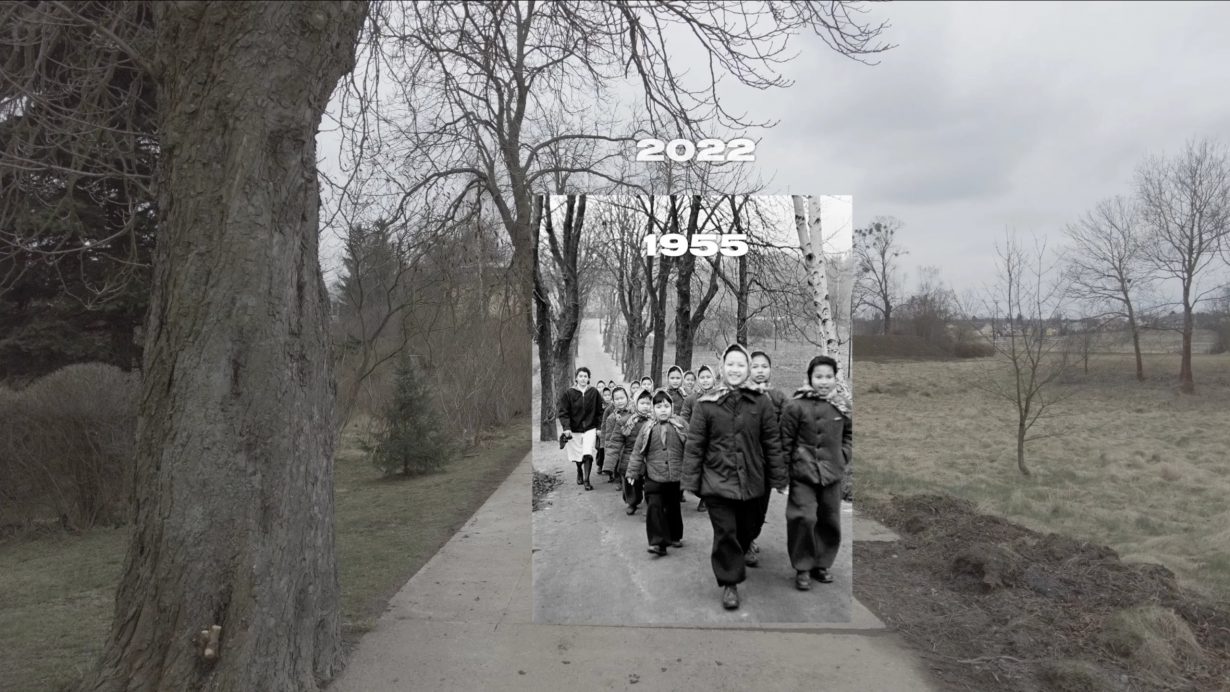
An Offering, A Burning, A Prayer at 4A Centre for Contemporary Asian Art
An Offering, A Burning, A Prayer brings together six artists to explore fire as a means of renewal. The show, which marks the Year of the Fire Horse, doesn’t revisit the past so much as it insists on lineage as a shapeshifting thing, how ancestral rituals can conceive new forms of expression. Walking upstairs, past bricks affixed to the wall – remnants from the gallery’s recent renovation, redeployed by the artist WeiZen Ho as a sign of rebirth – I pause in front of Dance Inside Me, a 2022 video work by the Berlin-based Singapore artist Choy Ka Fai. In it, he traces the practice of a shamanic dance that travelled with women from Vietnam as they scattered around the world. I watch a dancer moving across the frame, in thrall to some secret rhythm, not speaking back to the archive, but embodying another kind of knowledge altogether.