***Subscribe now or get your copy from our online shop***
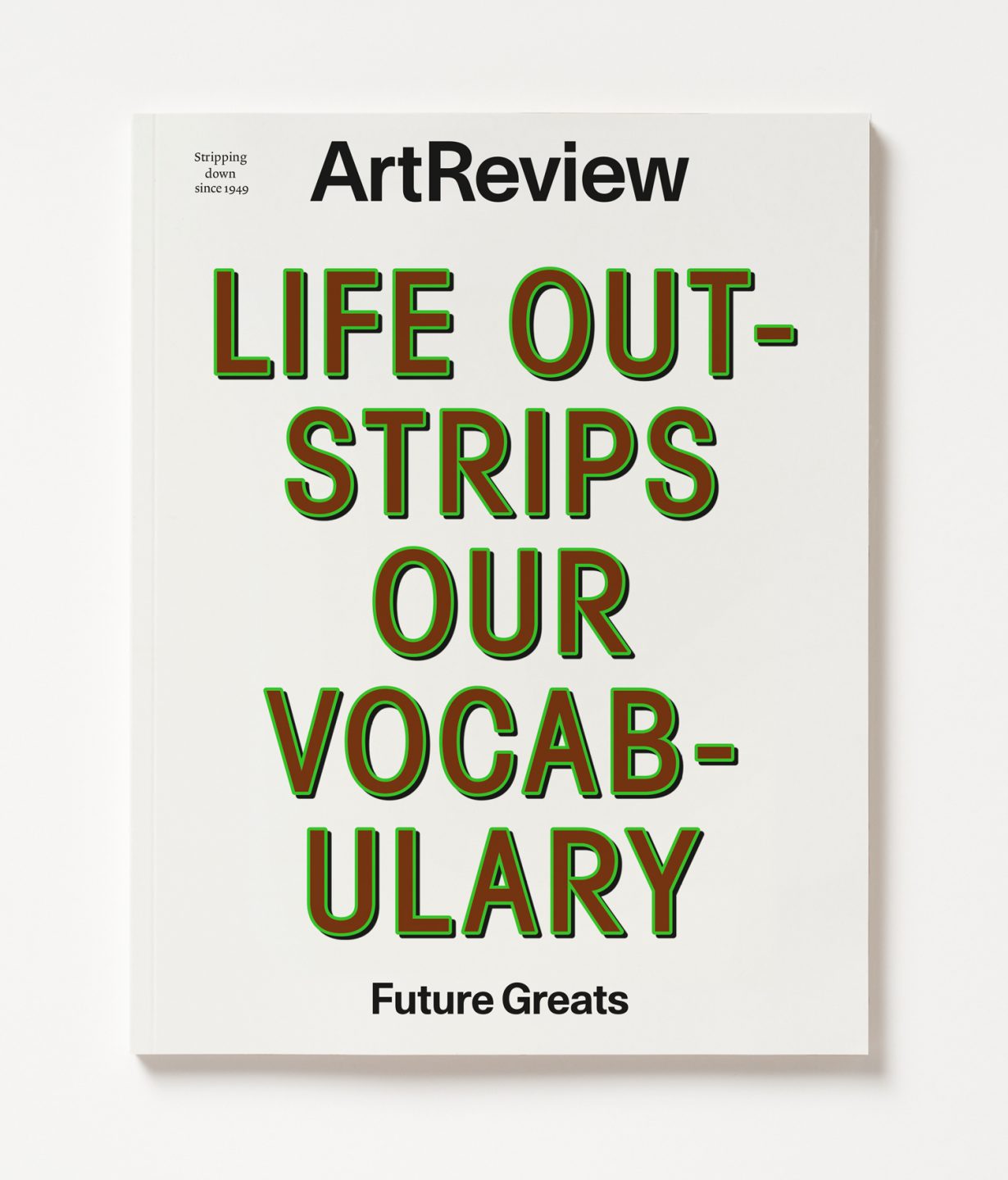
ArtReview’s January & February issue presents the magazine’s annual Future Greats feature: portfolios of work by artists who are setting out in new directions, often with new preoccupations, to destinations not yet known but likely to be of great interest. This, at least, is the view of the artists and critics who have made these selections, tasked by ArtReview with thinking about what art can or should be in the years to come, particularly as artists work more laterally – more infrastructurally, socially and across media and disciplines.
This year’s cohort includes filmmaker Svetlana Romanova, selected by New Red Order, who foregrounds Indigenous visual language, particularly in the Arctic region; painter Leah Ke Yi Zheng, selected by Martin Herbert, who merges techniques of Chinese painting with histories of the Western avant-garde; the cooperative Kopiisme, selected by Cercle d’Art des Travailleurs de Plantation Congolaise, which specialises in coffee cultivation and collective forest management; artist Kulpreet Singh, selected by Emily Jacir, whose work is grounded in the local environmental history of Punjab; artist Collin Sekajugo, selected by blaxTARLINES, whose work centres on sustainability and features locally sourced and recycled materials; and the collective Cocina Colaboratorio, selected by Campo Adentro / Inland, which takes action towards sustainable food futures.
Elsewhere, Stephanie Bailey evaluates the work of Emilija Škarnulytė, whose multimedia practice ‘swirls with posthuman mythologies, in which Earth is the ultimate gauge of a multiscalar hydrological space-time composed of natural atomic matter’. In films featuring mermaids, drone and underwater shots of rivers, bioluminescent organisms and decommissioned military and energy sites, ‘micro and macro scales are woven into a tapestry by bodies that become living instruments’.
Meanwhile, Kat Benedict observes that ‘the prosthetic and the posthuman have become staple terms in contemporary art concerned with the body’s interaction with technology’, but ‘many artistic interventions centred on the prosthetic unconsciously mobilise disability as nothing more than a metaphor’. Benedict considers how the work of artists Mari Katayama, Jesse Darling and Park McArthur recognises the metaphorical potential of prosthetics while also moving from a reductive abstraction to a representation of the day-to-day realities of disabled experience.
Berenice Olmedo creates works that take disability and biopolitics as their subject, ‘utilising medical equipment as both a recurring motif and a symbol for technology in general’, writes Oliver Basciano. The artist doesn’t think of orthoses and prostheses as medical aids, but as integral parts of the human body, without hierarchy. ‘Each individual’s body is an orthosis to another, [Olmedo] points out: our bodies are socialised and used as tools by others to reach a greater potential than we could achieve individually.’
Also in this issue, Clive Chijioke Nwonka asks what is gained and what is lost in the attempts by contemporary art institutions to create Black cultural value; Richard Phoenix questions what might emerge from supported studios; Jenny Wu explores the relation between collector and collected in Édouard Glissant’s art collection; Alistair Hudson suggests that new technology in museums be seen not as a threat but as an opportunity for new thinking; and Chris Fite-Wassilak and Mark Rappolt annotate Edwin A. Abbott’s Flatland: A Romance of Many Dimensions.
Plus reviews of exhibitions across the globe, including the Kochi-Muziris Biennale, My Barbarian in New York, Hito Steyerl in Milan, Iván Navarro in Santiago and Lygia Pape in Paris; and reviews of books by Geentanjali Shree, Tyler Coburn and Ai Weiwei.
***Subscribe now or get your copy from our online shop***