Tandem projects at Chicago’s Watershed Art & Ecology draw inspiration from visits to fishing villages along China’s Huangqi Peninsula
Light-lure fishing, widely adopted across the global fishing industry for its efficiency, is also deeply contested for ecological disruption, excessive bycatch and its invasive light pollution. Its inherently engineered interplay of light and darkness forms the central axis of Rhett Tsai and Chang-Ching Su’s tandem projects at Watershed Art & Ecology. Separately commissioned, the artists, together with art historian Jessica Zi Chen, decided to conduct a joint research-trip to fishing villages along the Huangqi Peninsula in Fujian Province, China.
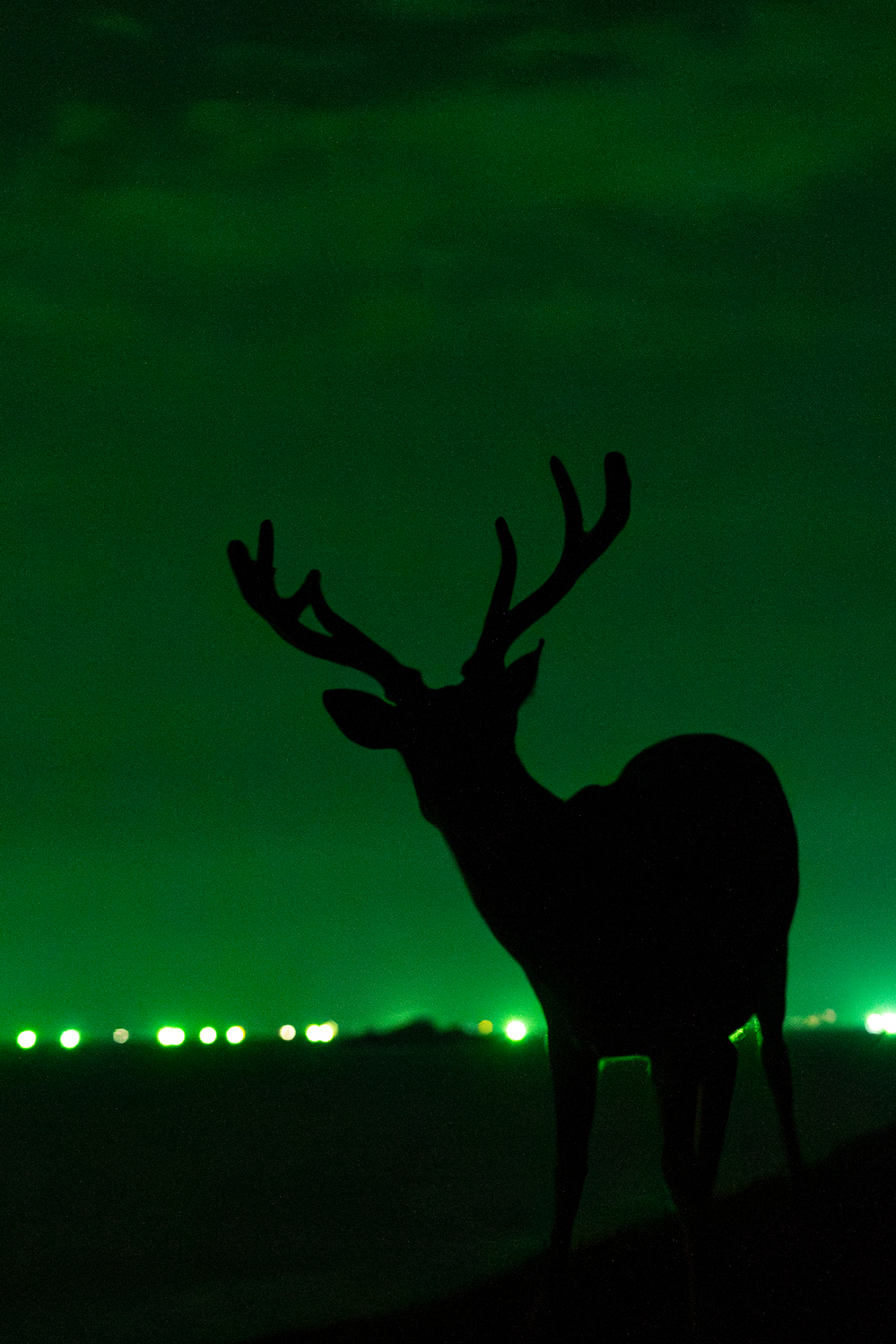
In Greenlessness #1–7 (2023–25), Su directly exposes colour sheet film to the green LED lights used on Chinese squid-fishing vessels. As these boats return from Taiwan’s Matsu Islands to Fujian, the film registers varying saturated shades of green. Mounted onto polystyrene boxes and loosely scattered along a wooden wall, these glowing expanses of colour envelop the viewer, evoking a submerged viewpoint. Light-lure fishing links global seafood supply chains, coastal tourism and competing geopolitical narratives, particularly when read through the cross-Strait relations of Taiwan and mainland China. Su documents a boat quietly crossing this maritime boundary on his phone in the vertically oriented widescreen video 10:47 PM, August 23, 2023, Daqiu Island, 8 miles off the coast of China (2024); saturating coarse green noise almost spills over the frame, suggesting the lens is pushed to the max of its focal length. The artist’s surreptitious effort to document this ‘trespass’ is evident. Empirically, even if a vessel does not overstep the borders, its luring light often does. Similarly, when Su photographs a deer beneath Matsu’s green-lit sky (In the Limelight, 2025), the image hovers between a sense of reunion and confrontation.
Extending this inquiry, Su translates Global Fishing Watch satellite data into retroreflective points, printed onto 150 solar-powered keychains. In Pocket Constellations (2025), these objects are suspended across the dimly lit gallery wall to represent the jagged contours of the Min (Fujian) –Tai (闽台) coastlines, transforming systemic environmental trespass into a tactile and portable commodity. Ironically, the work (again) demands a gesture of complicity: only when visitors shine a flashlight onto this constellation does the scale and persistence of this pollution become completely visible.
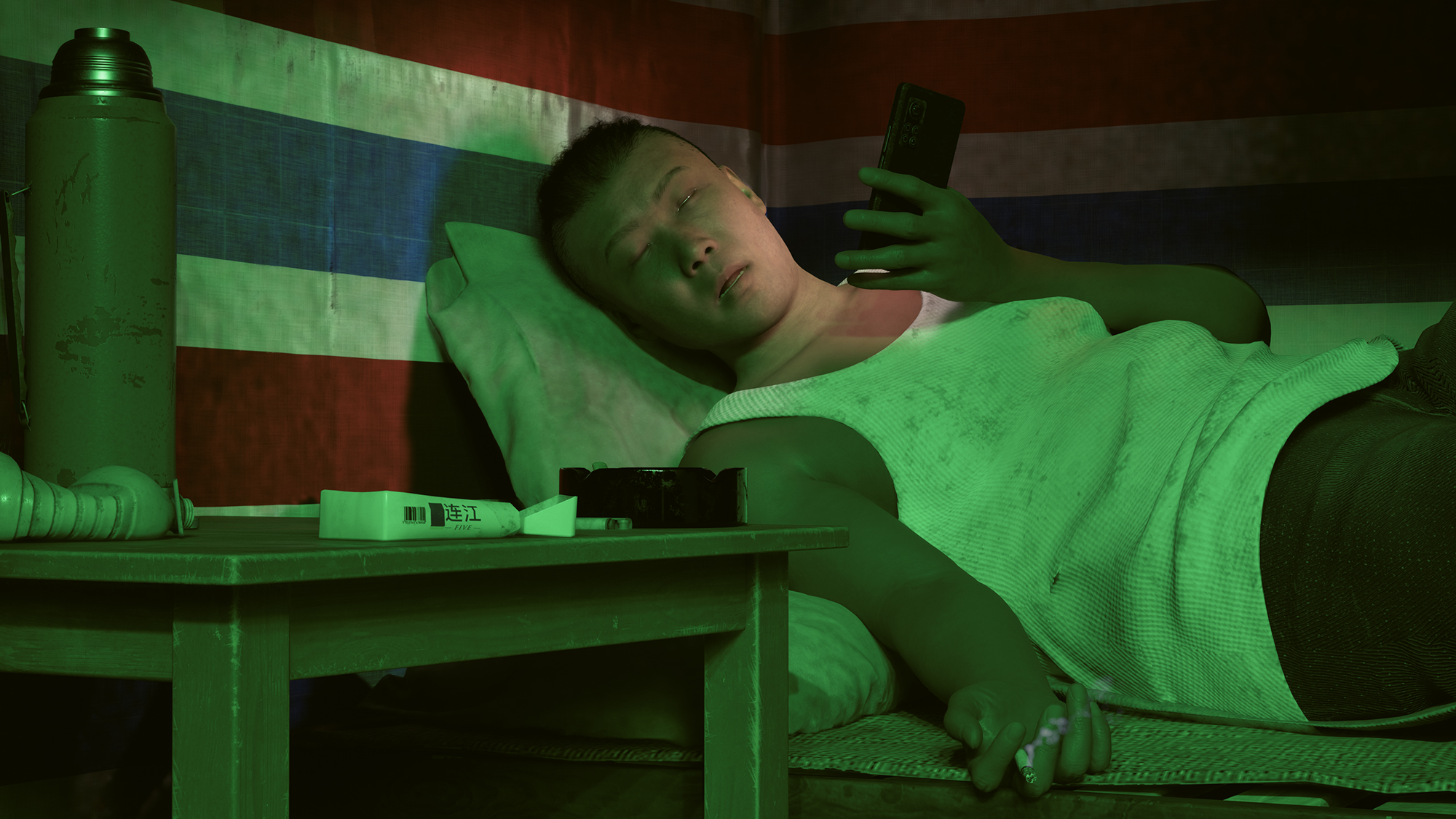
While Su channels nostalgia for an unlit landscape and a less mediated coexistence between human and nonhuman life, Rhett Tsai translates this silent, mournful sensibility into more corporeal rhythms. Tsai’s two CGI films, Green Light Ties the River (2026) and Dozing Overpass (2025), bathed in a thick, inescapable green light, depict plotless scenes drawn from daily life in Lianjiang, Fujian: a man scrolling his phone drifts in and out of sleep (a rhythm that aligns with the typical fisherman’s workday running from 6pm to 4am); a woman seemingly waiting for an unspecified ritual to conclude quietly squats on a deck. Details of lure lights flash intermittently, with voiceovers repeating vocabularies of fishing: ‘green light’, ‘soft net’, ‘jigging machine’. The project’s melancholic style carries a veiled narrative of social anomie, subtly tracing the descent of the individual into a standardised cog.
In the VR-equipped video Be Sampan (2021), Tsai stages a fictitious sea-to-land voyage of ‘Xin’, a fictional Tanka character, to probe the history of this boat-dwelling community along China’s southeastern coast. Years of crouching and labouring within cramped boat cabins resulted in a distinct curvature of the Tanka people’s leg bones, with land-dwellers stigmatising this physiological trait and derisively labelling them Kuóh-dà (‘curved hooves’). During the 1950s, the Tanka were incorporated into a ‘coming ashore’ campaign through which the PRC transformed the formerly errant sea-dwellers into a legible populace under the centralised demographic registration system. From a swaying onboard perspective, the video drifts through scenes where memory and imagination intertwine. Shaky seascapes, distant urban billboards and the submerged wreckage of fishing boats retrace Xin’s journey ashore in a quest for belonging. Occasionally, different images are presented to each eye in the VR glasses, conveying the Tanka’s profound vertigo and psychological residue during this transition.
Yet Tsai disrupts any historical arc through a series of supplementary prints alongside the video, presented as if they were Xin’s logbook. With drawings, Xin identifies the new ‘curved hooves’ of contemporary society, such as the ‘mouse hand’ of computer users and indented pinkies shaped by smartphones, framing these physiological distortions as the consequence of a sociocultural bycatch, the shadow side of a broader ‘bad’ luring embedded in the prospective dividends of meticulously designed efficiency. The fisherman’s loss of agency thus appears less as a maritime exception than a ubiquitous contemporary condition. As light circulates without restraint across ecological and political boundaries, we have to ask what forms of submission are being lured into the net today.
Jigging Green / Luring Bad at Watershed Art & Ecology, Chicago, from 10–31 January
From the Spring 2026 issue of ArtReview Asia – get your copy.