The Filipino artist’s embroidered works find new new ways to articulate territory
Cheng-Lan’s Corner is a modest, street-level project-space tucked into Hong Kong’s midlevels. But look at the hand-drafted exhibition plan crafted by Filipino artist Cian Dayrit that you pick up on entry and you’ll find cartographic-type symbols for a volcano and a graveyard sitting at its heart. You don’t need to look again at the two-room space to realise that the map is not depicting the immediate territory. It’s more a frame of reference.
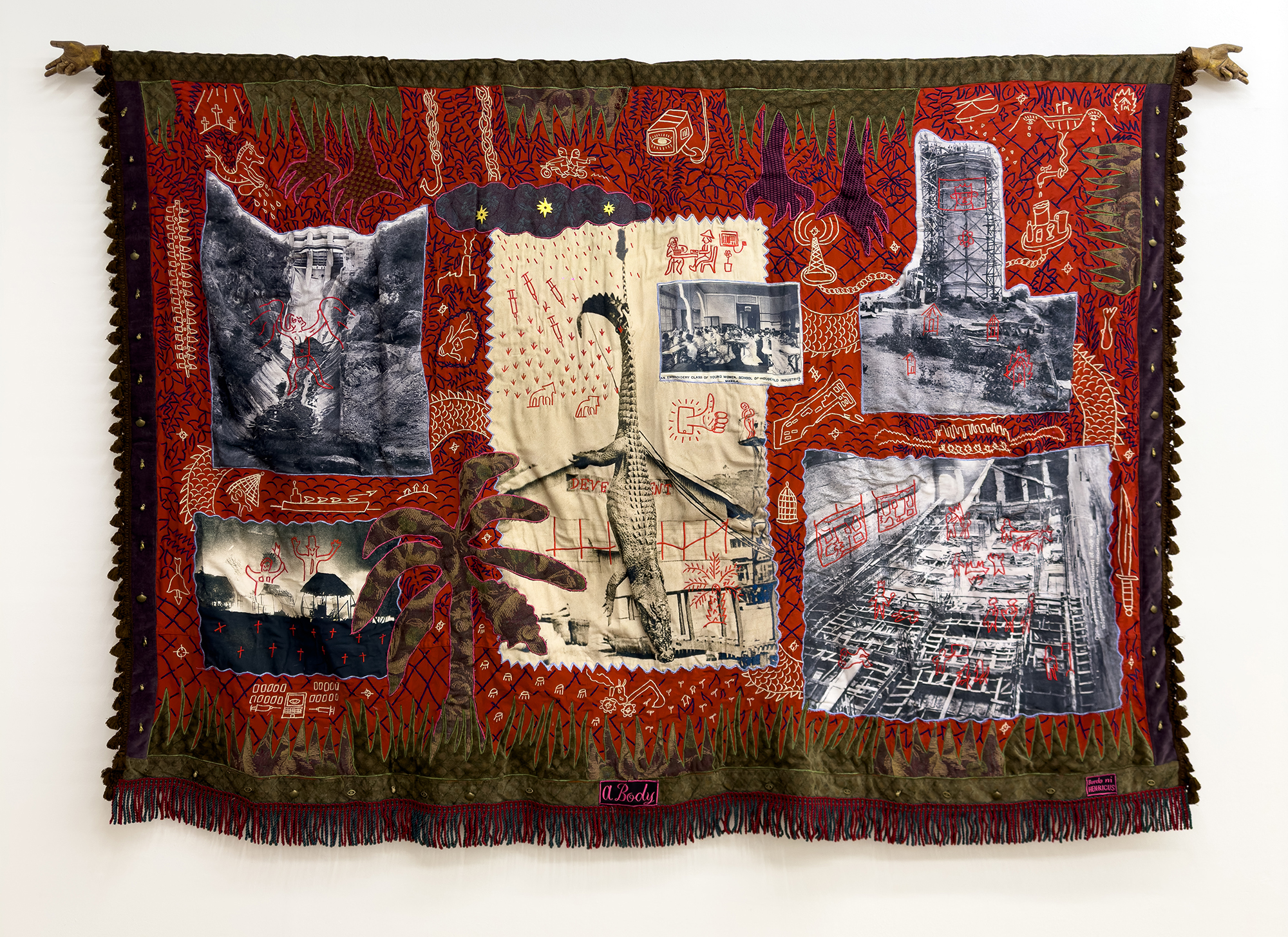
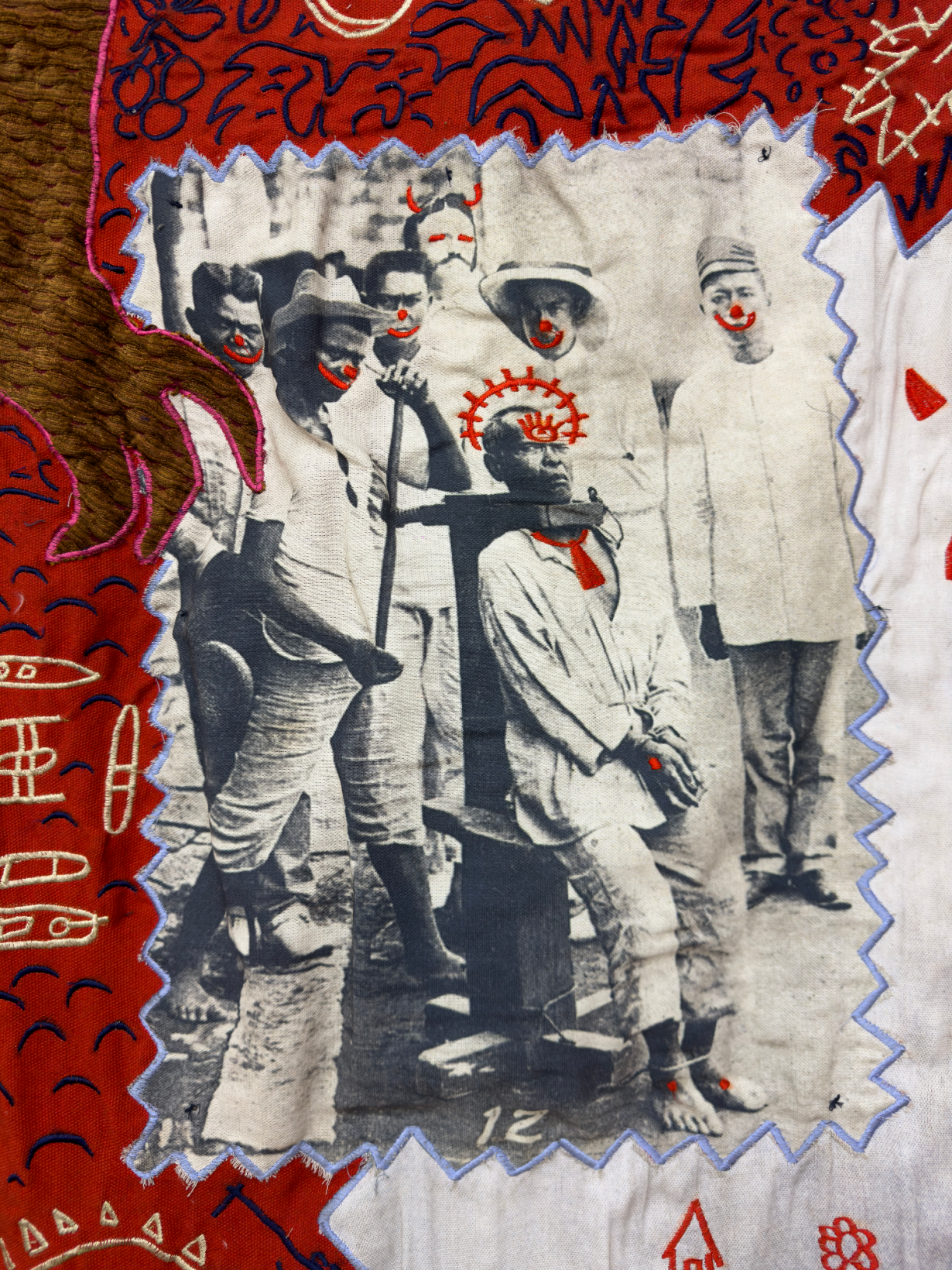
The title of the show derives from the two largescale embroidered collages – collaborations with Henry Caceres and Rj Fernandez, giving off heavy trade union banner vibes – that hang from the ceiling, dominating the main space. A Country (2024) features photographs of dams and other infrastructure under construction. There are images of workers demonstrating the use of a garotte, which, we learn from the handout was ‘an execution method used by the Spanish’ during the colonial era in the Philippines, but which we can gather from the context of the artwork is just another one of the instruments for taking control of a people and a place. We learn from the same that one of the other historical photographs shows the monument to Filipino nationalist Jos. Rizal under construction in the very early twentieth century. Embroidered over the whole are cartoon serpents or dragon figures, barbed wire, shovels, high-rise buildings, bombs, satellites and surveillance cameras, as if to update the instruments of ‘nation-building’ and control to the present day, while also alluding to the legends of a precolonial past. The story is literally layered. A Body (2024) centres on a photograph of a crocodile corpse suspended from a crane – a victim or trophy of the progress described in A Country and in some of the other photographs in this work – and of an industrialised embroidery class. The embroidered annotations and graffiti include broadcast towers, thumbs-up symbols and a flock of syringes descending like carpet bombs.
Back on the handout-map the words ‘LAND’ and ‘LABOR’ intersect across the ‘A’s such that they form a kind of crucifix at its centre. Other crosses indicate the graveyard. Both are surrounded by a ring of keywords: ‘Institution/Nation Building, Infrastructure, Resource, Flows, Migration, Agrarian Struggle, Resistance, Neoliberal Policies, Development’, which might suggest the battleground to which the artist is directing our attention. And you need only leaf through an index card file labelled Counter-Maps From Workshops (2017–24), which documents things like land reclamation and dredging, and industrial agriculture and how they change the land, inscribed in maps not unlike the handout you picked up on entry to find that confirmed.
On a wall behind the embroideries are eight drawers that look like they were salvaged from a sideboard storing cutlery (Shrines for the Battle Dance (I–VIII), 2024). Mounted on the wall so their contents face the viewer they house a strange mix of objects – plaster digits strung alongside chandelier crystals, military insignias, sports trophies, perfume bottles, totems, floppy disks, nitrous oxide cannisters, moulds of teeth, toy soldiers, ID photos, empty Pili & Pino-brand health food jars, and wooden fish, wooden dolls, wooden guns, wooden buffalo, wooden hands. All of which might represent the knickknackery accumulated over a lifetime, or offloaded at a fleamarket: the material effluent of progress. Or, another articulation of the territory; another way of describing the way in which an individual life, as much as a nation, can so easily become little more than a representation rather than a reality: tribalism becomes commercialism. A collection of signs completely gutted of significance. Like the crocodile dangling from that crane. You’re left wondering too about how the type of development and ‘progress’ Dayrit chronicles in the Philippines is reflected in the urban jungle of Hong Kong’s mid-levels, where the only crocodiles are found in parks and zoos, and any in the wild are likely escapee pets; and how his shrines resonate in a place in which Filipinos are the largest ethnic minority, a large portion of them foreign domestic workers, labouring to support families back home through a more global kind of infrastructure that has similarly destructive effects.
Cian Dayrit A Country, A Body, Cheng-Lan’s Corner, Hong Kong, 18 March – 17 May
From the Summer 2026 issue of ArtReview Asia – get your copy.