In films featuring mermaids, bioluminescent organisms and decommissioned military and energy sites, the artist’s work swirls with posthuman mythologies
Emilija Škarnulytė’s nine-minute film Æqualia (2023) documents an impressive feat of endurance. Although that is not always clear, given the striking bird’s-eye moving image the artist created of a mermaid swimming the blurry six-kilometre line where, near Manaus, Brazil, the waters of the Rio Solimões and Rio Negro meet but don’t yet merge. “People sometimes think it’s a render, and don’t realise it’s me,” says the artist, who donned a flesh-toned suit and cap for the task. Wanting a clean shot, Škarnulytė worked with a local drone operator stationed on a nearby island, a boat on standby, and took to the water alone. “I was just there, looking down, oriented by the differences in temperature,” she explains, describing the cool clays and silts feeding the Solimões from the High Andes and the hot, lowland waters of the Rio Negro. Crocodiles, piranhas, black caimans and cargo boats were a constant risk.
Presented with the sounds of being submerged in water, in a reflective black box that amplifies the physical expanse through which Škarnulytė moved, the resulting film’s beauty sublimates the dangers the artist faced, as her body transformed into a measure of awe-inspiring extremes. Not only between two strikingly different rivers rendered visibly molecular in Æqualia’s audiovisual study, but between what the artist describes as “the visible world and the quantum world beneath the water”, referring to the processes that define life as an atomic enmeshment of living ecosystems. Throughout, pink Amazon River dolphins swim alongside the artist, their mottled skin blending the chalk and charcoal tones of the waters they so easily cross. At points, the camera goes underwater and zooms in so close that it becomes unclear if we are looking at human or animal skin: a truly posthuman sublime in the face of Earth’s monumental materiality.

“For me, it’s not about wearing a mermaid costume, it’s about embodying the form of a shapeshifter,” Škarnulytė emphasises. “The characters are inhabiting the form – it’s more like a ritual.” Sirenomelia (2018), which existed in a previous iteration as No Place Rising (2015), was the artist’s first chimeric incarnation. Described by the artist as “a mutant mermaid’s odyssey through Cold War labyrinths in Arctic water”, Škarnulytė swims around a decommissioned underwater NATO submarine base in Olavsvern and the Geodetic Observatory at Ny-Ålesund, Spitsbergen, both located in Norway, above the Arctic Circle. “In that moment, embodying the mermaid in the Arctic Ocean, I’m thinking about hidden structures of scale, and the sounds of dying quasars that have been used to measure Earth’s rotation and plate tectonics,” Škarnulytė explains, referring to the technology that operates at the observatory. Here, the mermaid functions as an ancient echo, much like the siren, the snake and the other worldly creatures that Škarnulytė manifests; as an organic form locating itself amid civilisational relics, which sees the world and all its material manifestations – including the manmade – as a living entity to commune with rather than an inert material from which endlessly to extract.

Škarnulytė’s multimedia practice swirls with posthuman mythologies, in which Earth is the ultimate gauge of a multiscalar hydrological space-time composed of natural atomic matter. Take the film Aphotic Zone (2022), named after the area in the oceans where light can’t reach. Bioluminescent life forms float in the depths – apparently the Gulf of Mexico, where scientists are seeking coral capable of flourishing amid ocean warming and acidification – to a soundtrack of ocean sounds mixed with recordings of celebrations marking the 500th anniversary of Spain’s conquest of the Aztec capital Tenochtitlan, in Mexico City: an uncanny entanglement of nature, history, science and industry. Or Eternal Return (2021), presented as a four-channel video installation at Tate Modern, London, to mark that year’s cop26, combining deep-sea images and footage of a python snaking over an industrial switchboard – a scene that reappears in Burial (2022), a film exploring the decommissioning of the Ignalina Nuclear Power Plant in Lithuania – to depict the future in 10,000 years. In each case, micro and macro scales are woven into a tapestry by bodies that become living instruments.

“I think of measurement and scale a lot – measuring the world, measuring history, measuring time – through different reference points and orders of magnitude, whether the human body or something else,” Škarnulytė says. In the case of the video Sunken Cities (2021), the artist swims in full-black mer-skin through the submerged ancient Roman city of Baiae: another boundary revealed to be profoundly osmotic, like two rivers meeting, as algae and coral encrust ancient architectures sunken into the seabed. Works like these highlight a fluid border that is more blur than divide, recalling Škarnulytė’s personal and intellectual connection with visionary Lithuanian-American artist and architect Aleksandra Kasuba, who saw the world without edges – a consistent reference in the artist’s practice.
Škarnulytė has long explored freediving as a method to explore that edgelessness. “I train myself to breathe, with expanding lungs, which connects to processes of evolution,” she says, referring to the mammalian diving reflex of slowed heart rate and other responses. “Maybe [the work is] a proposal to come back to where we came from.” That return to source points to another influence on Škarnulytė: twentieth-century Lithuanian archaeomythologist Marija Gimbutas, who believed that peaceful matriarchal societies existed in Neolithic Europe and worshipped serpentine, form-shifting goddesses. Intertitles introduce these ideas in Xirasia (2023), a film examining ancient traces left around the Guadalquivir River mouth in southern Spain. The camera pans over circles, spirals and waves carved into a neolithic cave wall, before traversing lines carved into terrains that become increasingly developed by industrialised agriculture. Spinning over these images, at points, is a Neolithic figurine with bulbous hips, buttocks and breasts: expressions, per Gimbutas, of an androgynous divinity.

Xirasia is the third instalment of Škarnulytė’s riverine film trilogy (all 2023), starting with Æqualia, which positions the serpent and mermaid – the latter being among the oldest depictions of goddesses, the artist points out in conversation – as measures of planetary space-time, much like the rivers that carry memory as matter. The second film, Riparia, operates like a fulcrum between both compositions, with Æqualia’s two rivers imagined as a pair of entangled serpents – “embodied goddesses” as Škarnulytė puts it – personified by the artist and a collaborator in glittering snake-drag. At one point, the holographic sigil of two intertwined pythons hovers over the scene. That same image appeared at the entrance to Æqualia when it premiered at the 14th Gwangju Biennale in 2023, and again in The Code (2024), an animation showing the snakes transforming into a genetic sequence.
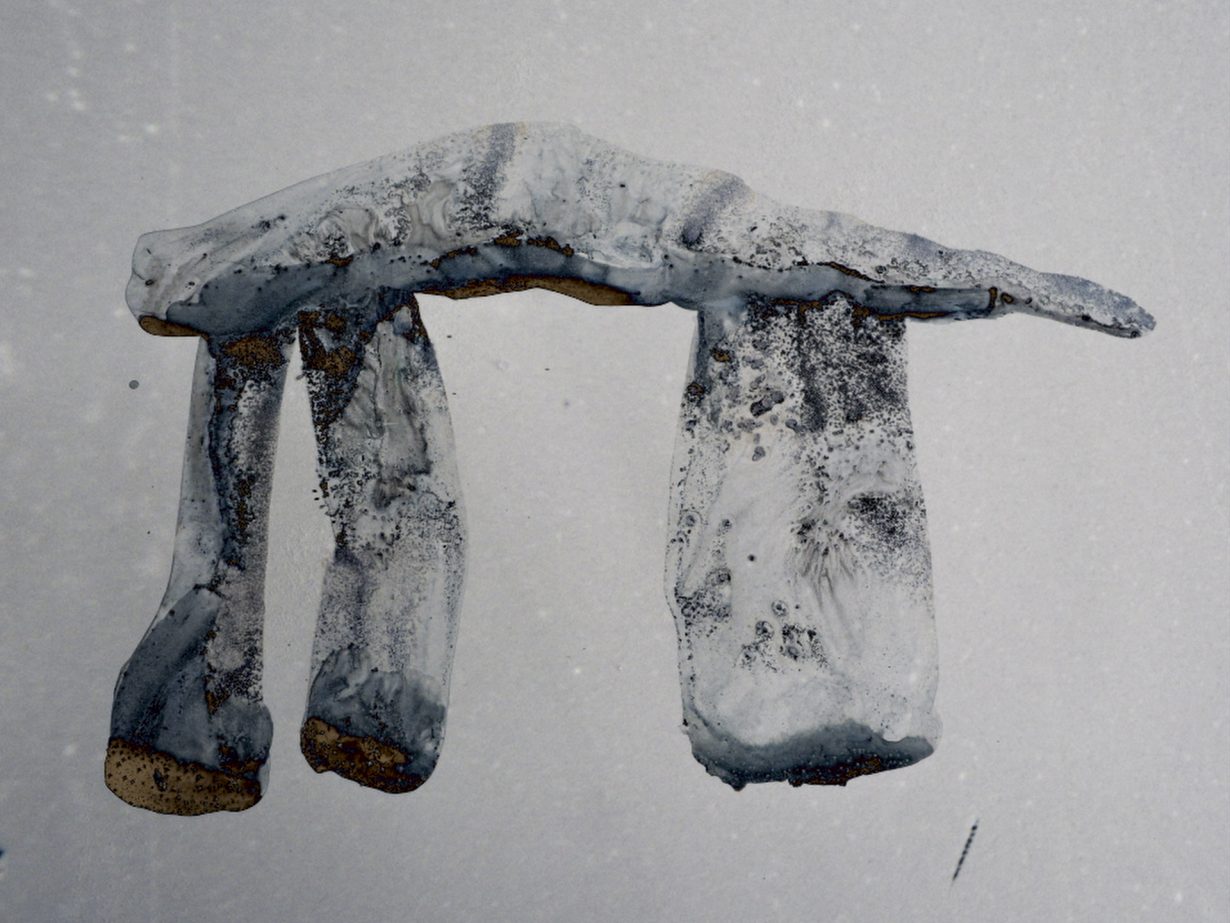
Škarnulytė sees the confluence of earthly bodies – whether a double helix, or an artist and her subject – as sacred portals. This is evident in Telstar (2025), created during Škarnulytė’s Tate St Ives residency in June 2025. Opening up an elastic expanse of cosmic time stretching from the Neolithic era to the present, the two-channel 16mm film examines stone formations around Cornwall – from the Bronze Age Dry Tree to the ancient dolmen Lanyon Quoit – alongside the Goonhilly Satellite Earth Station. With images emphasising their circularity, the artist considers each form as a threshold, whether a stone circle or satellite: a union of myth and technology, geology and storytelling, that taps into a world in which stillness is an illusion and each atom carries tales that contribute to ever-expanding narratives. All of which speaks to the communion Škarnulytė conceived for her immersive solo exhibition at Tate St Ives, with a super-edit of previous films revolving around Telstar, the central work, from Riparia to Hypoxia (2023), a film about the sea goddess Jūratė, who cries Baltic amber. Škarnulytė likens this gathering to a pantheon. “It’s like a system now,” she muses. “In a way it could all be one continuing work.”
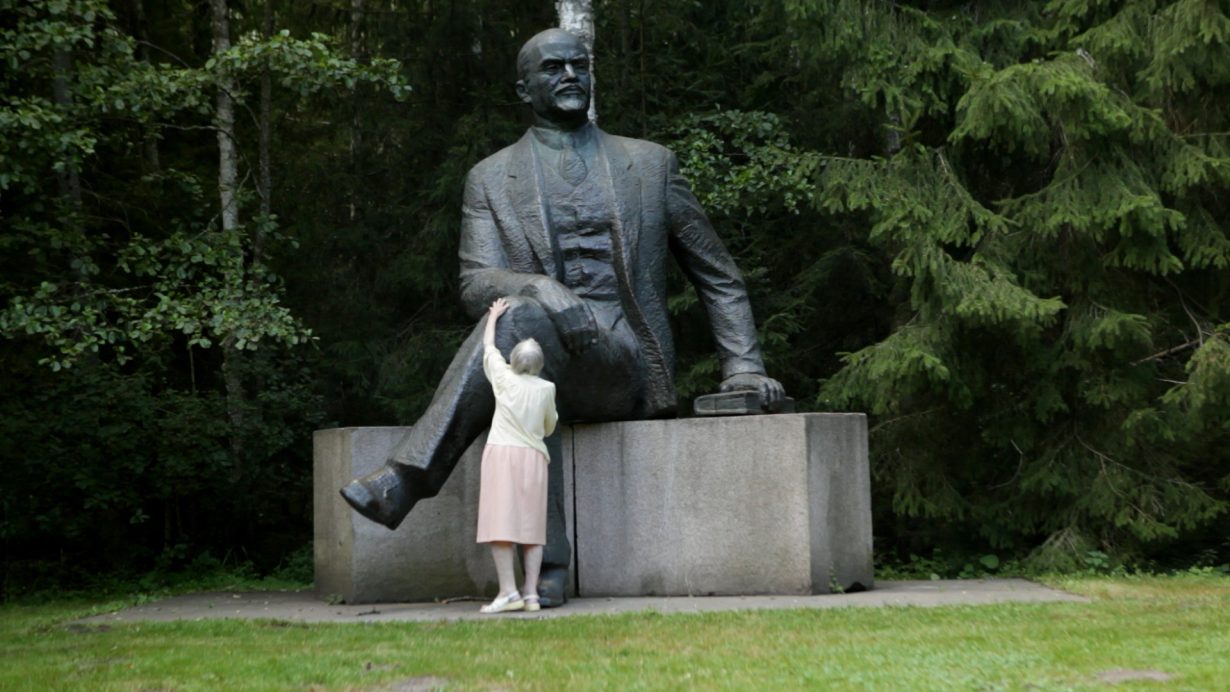
Also on view is Aldona (2013), an early film featuring Škarnulytė’s grandmother, who lost her sight in 1986 shortly after (and believed to be linked to) the Chernobyl Nuclear Power Plant explosion. The camera follows Aldona using her hands to trace the contours of Soviet-era statues of figures like Marx and Lenin in Grūtas Park, close to the border between Lithuania and Belarus: another matriarchal vision that Škarnulytė summons through her practice, of bodies so attuned to the material world that they cannot help but feel its pulse.
An exhibition of work by Emilija Škarnulytė is on view at Tate St Ives through 12 April
From the January & February 2026 issue of ArtReview – get your copy.