The grid in the artist’s hands becomes a paradoxical thing: highly regimented yet somehow entropic
A grid is a simple framework with radical implications. Its neat subdivisions offer a means of imposing order, yet its endlessly repeatable pattern conjures the very sense of boundlessness it seeks to contain. In her show Annunciation at Greene Naftali, Hanna Hur utilises this paradoxical quality of the grid to create a suite of hypnotic paintings whose power comes from her ability to instigate a feedback loop between several overlapping layers. Hur’s compositional elements are highly regimented. Ruler-straight orthogonal lines of coloured pencil appear in every work, and each layer is ruthlessly concise. Together these interlocking motifs reverberate with radiant detail.
Hur’s paintings are strongest when the clarity of their graphic structures accentuate the entropic qualities of liquid paint. In Suspension (all works 2026), a nearly-four-metre diptych, coin-size circles of white and pearlescent pigment are painted over each intersection of an underlying grid, punctuating these spatial intervals with a shimmering full stop. Over this matrix Hur has brushed a thin veil of lapis lazuli pigment in short vertical strokes. The mineral blue settles unevenly across its surface like a glowing azure sediment. Underneath these layers a blurred chequerboard pattern of watery black horizontal brush marks over gesso creates a churning sensation, giving the work a pulse.
I remain transfixed in front of Suspension for half an hour. Up close, the layers in Hur’s paintings seem to sit independently of one another – superimposed without fully interacting. From the right distance, however, these rhythmic elements cohere into a soothing visual puzzle. The orthogonal lines that fill the canvas come to feel like an array of tiny blades slicing into my gaze. Each half of the painting seems to be a complete cosmos quietly contradicting its counterpart. Over time, individual dots begin to distinguish themselves from the crowd.
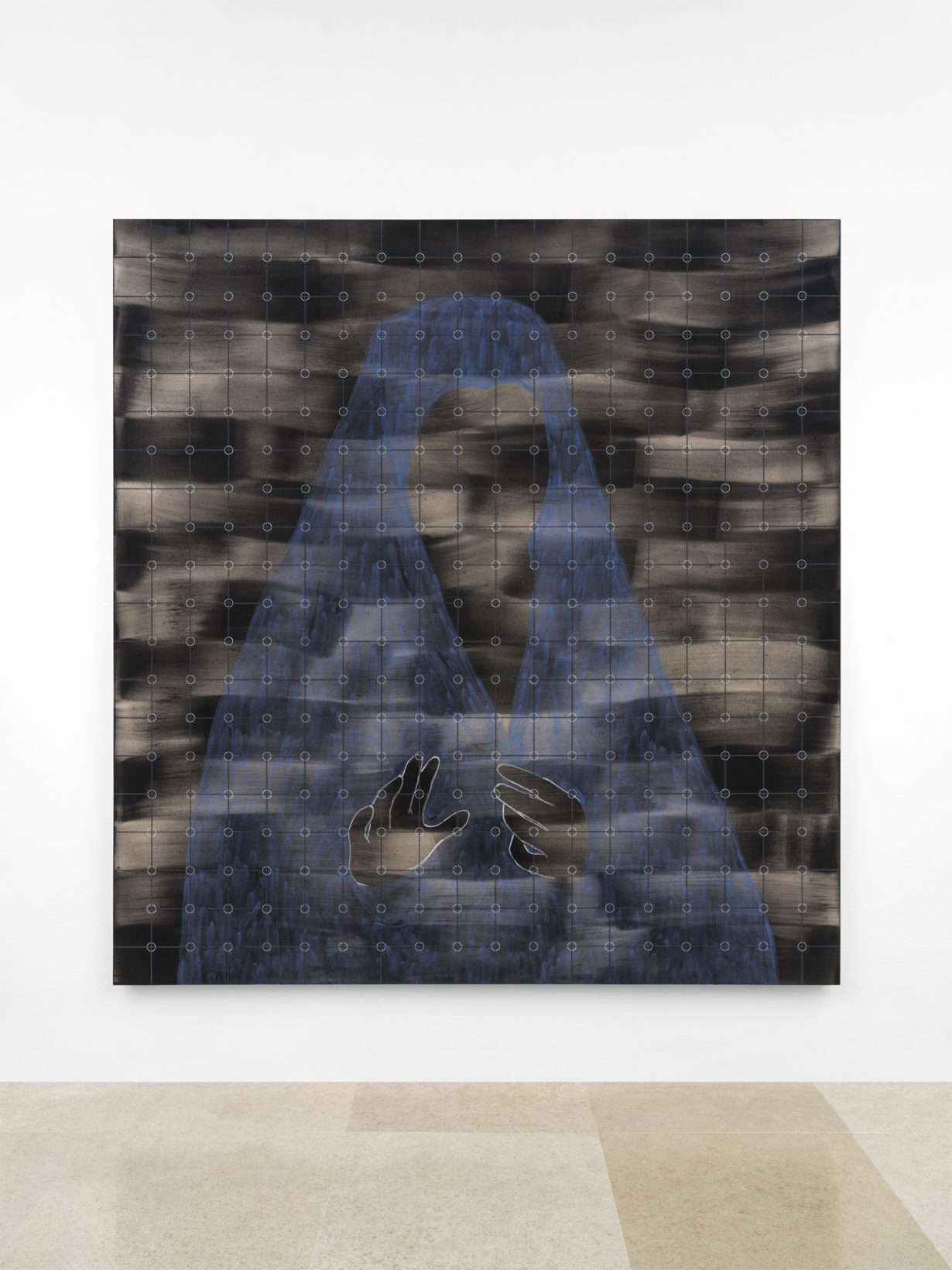
Hur’s concision offers a rare reprieve from a cultural landscape that is loud, performative and oversaturated. In her pulsating grids, this economy feels effortless; in her figurative works, however, it is less convincing. Two paintings in the show, both titled Auto Annunciate, feature the silhouette of a cloaked figure with open hands – based on, according to the exhibition text, Antonello da Messina’s Virgin Annunciate (c. 1475). The line that articulates Mary’s hands looks oversimplified and cartoonish, diminishing the impact of the implied protagonist whose outline occupies much of the canvas. Even the enchanting lapis lazuli haze underperforms in these works because its edges feel hesitant and imprecise as it attempts to capture the curve of the Madonna’s cloak. Here, the effort to signify undoes the impact of the symbolic figure, breaking the spell of the painting.
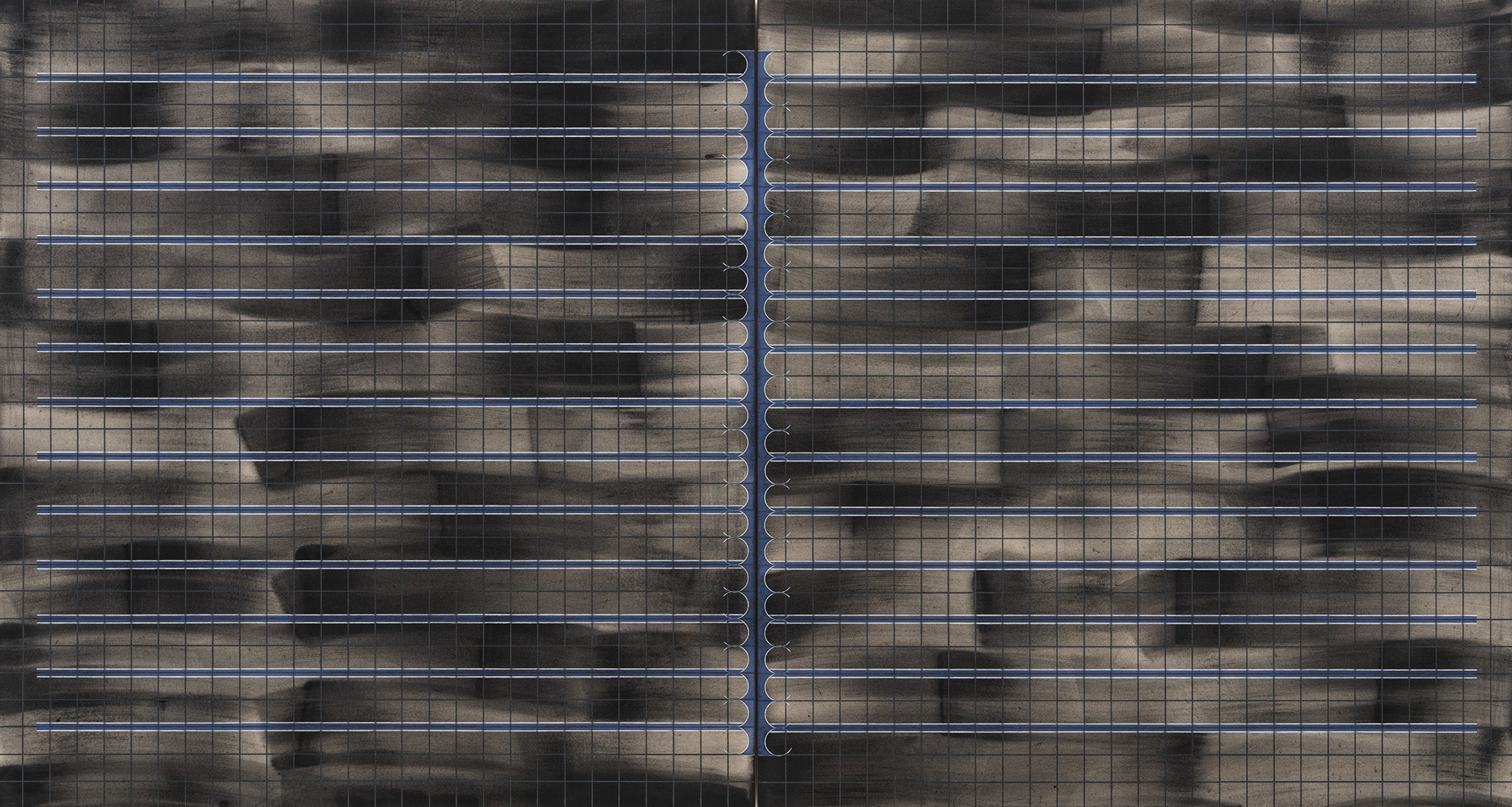
By contrast, the diptych Angel xvi features a spinelike pattern at the seam between its two panels. Composed of partial circles and horizontal bars, the pattern made me acutely aware of the vertebrae holding up my torso. Because Hur uses thinned paint, drawn lines and raw pigments without added binder, the paintings’ surfaces lack body in terms of obvious texture or lustre. This absence builds tension with the body of the viewer and the edges of the canvas. In the quasi-figurative works, this tension becomes the distinction between bodily sensation and the visual signs through which a body is represented. In a sense, between feeling and thinking – an impossible choice.
Hanna Hur: Annunciation is at Greene Naftali, New York, 10 September – 31 October
From the October 2026 issue of ArtReview – get your copy.