Bizarre Life asserts that an image can surrender its photographic identity while retaining an iconographic power
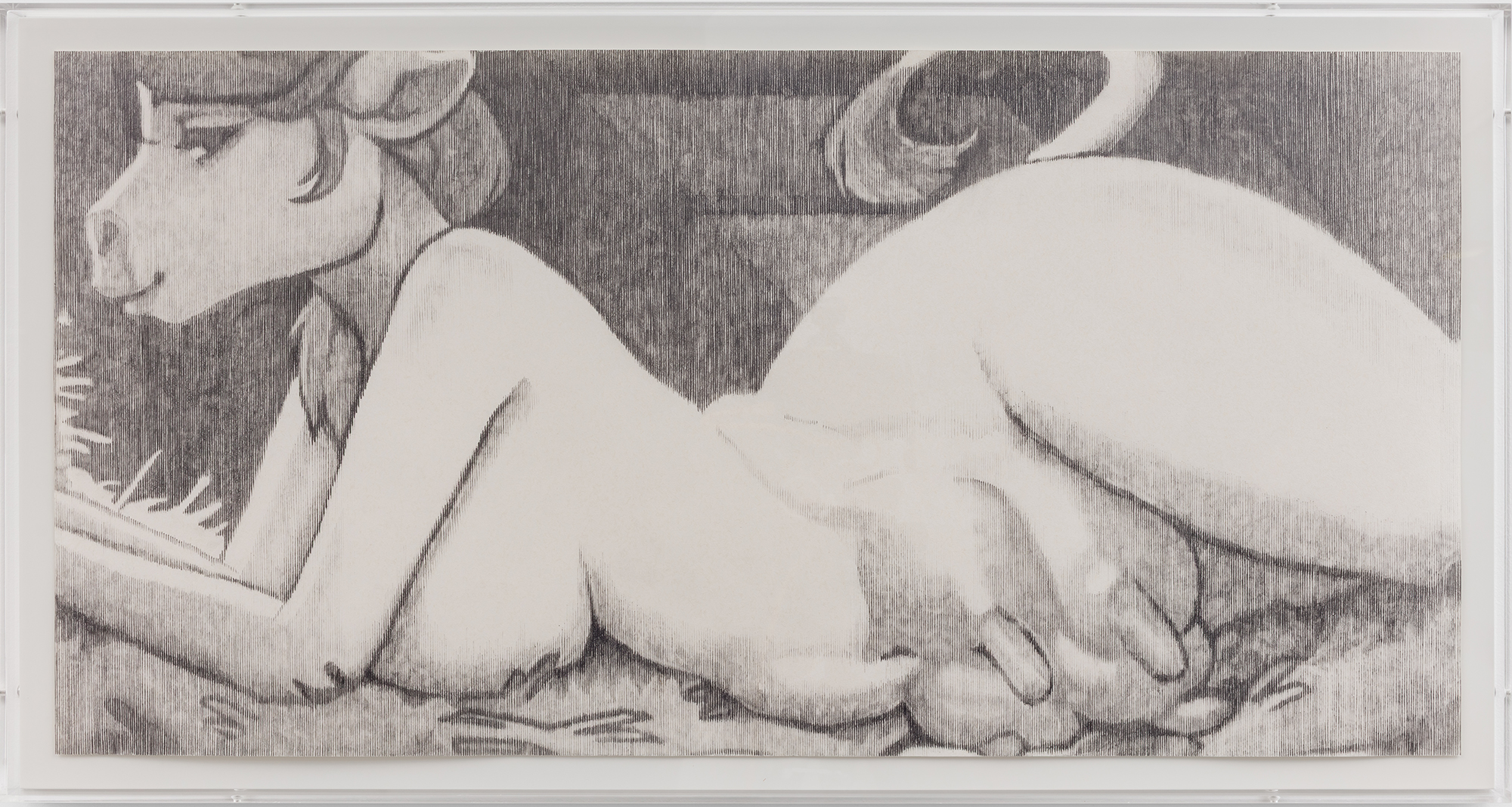
Throughout Bizarre Life, I’m reminded of Susan Sontag’s belief that photographs are direct stencils of the real, ‘like a footprint or a death mask’. Laila Majid and Louis Blue Newby’s drawings, collages and videoworks all circle the photographic, trading in the mutability of images; ripped concert footage, reproduced memes and vintage magazine cuttings, across the artist duo’s collaborative series, are all given a rough equivalence. Each work carries the trace of a moment, decontextualised in a way that unsettles what they might otherwise document, finding new and incongruous meanings. The wispy graphite traces that form the Contact drawings (all works 2026) have the feel of contemporary rubbings, as if these images have been archaeologically appraised and documented to form an idiosyncratic typology. Found images are manipulated through thermal-printing software, then redrawn by the artists, the process softening each line into a fuzzy static. Contact (Chorus) depicts three shop mannequins, their faces contorted into unsettling smiles that appear blurred by that textured grain. Contact (Together) shows a meme of an anime character, arm outstretched with bold glowing text overlaid, ‘LETS CLOCK A GAG TOGETHER’. Contact (Mother) and Contact (Mother II) sees the Drag Race TV presenter RuPaul in dialogue across the room with a full-breasted anthropomorphic horse. It’s tempting to unpack this pairing via its subjects, but the chosen images gesture less towards constructions of gender than the flattening logic of the ‘feed’, where such disparate images are exchanged with indifferent availability. They once signified something; now, intrinsically, they symbolise nothing at all.
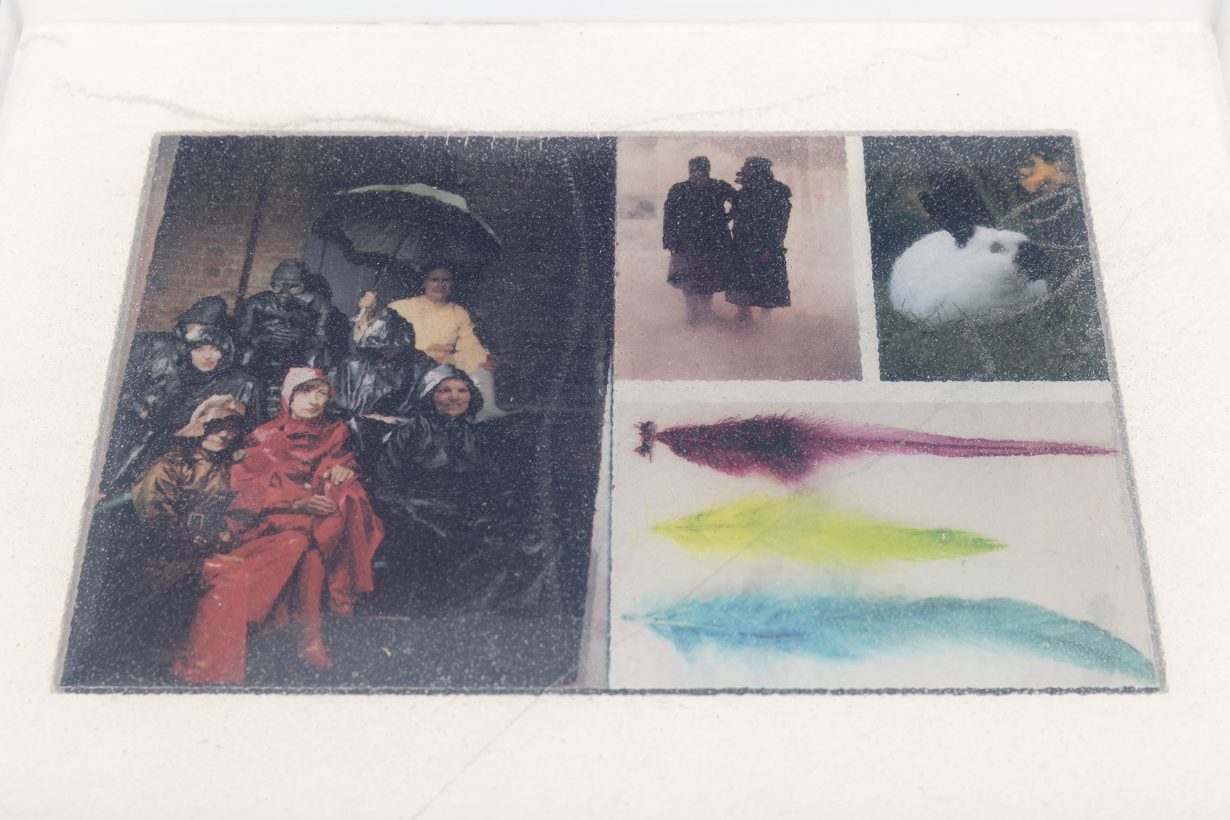
Spread (Pleasure in Plastic) is one of several wall-based assemblage works, installed at waist height, that punctuate the space, appearing to reference magazine layouts, each enclosed, like the drawings, within a neat Perspex frame. Here, various photographs are held together beneath a thick silicone skin etched with a leather texture: a juxtaposition of incommensurables, photos of a rabbit, fishing lures and a group in rubber rainwear (taken from a rubber-fetish magazine) forced into close proximity. The work’s offsetting of the ‘everyday’ against an idea of the ‘other’ is compelling, with the images’ diffuse proximity and the materiality of the silicone layer. Decontextualisation appears as a governing logic, yet where the singular drawings let that same estrangement emerge from the image itself, the display of the Spread works almost overstates this point.
The vertically presented videoworks, Inner Heat (Strobe) and Inner Heat (Taylor’s Version), push photographic instability into motion. The former shows a reversed low-res film of fireworks sucking back in on themselves, climaxing and retreating in pixelated splendour, while the latter documents a particularly uncanny moment: slowed content filmed at a Taylor Swift concert shows the singer as a glowing entity, strange in the slowness and total abstraction of her body, presumably the result of lighting, costume glitter and a struggling camera sensor, all battling through the variables of image processing. Between the subtle distortion of the drawings and Swift’s low-res splendour runs a common feeling, where images that share little more than their superficies can fluctuate in meaning. With these moments of dissonance, Bizarre Life asserts that an image can surrender its photographic identity while retaining an iconographic power. The exhibition never exactly settles on whether this is a connective force or an unsettling one. Perhaps it is both.
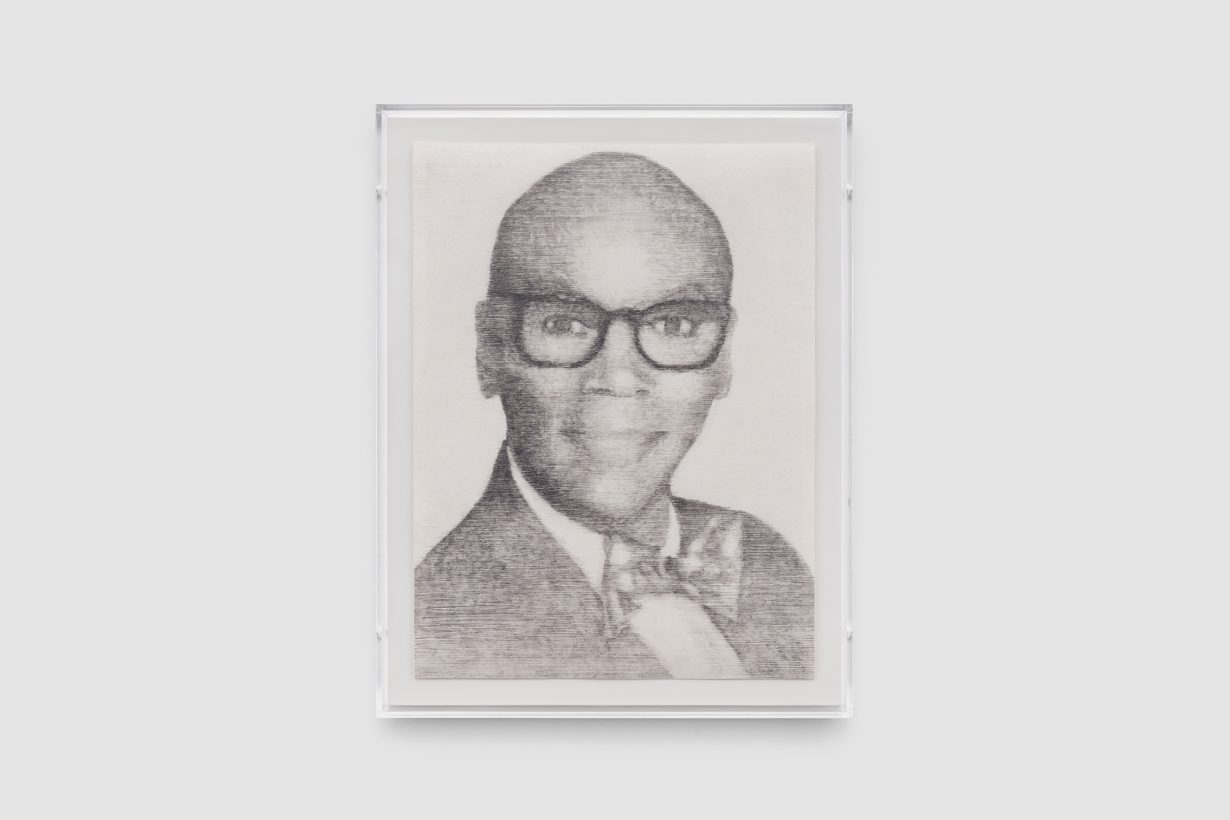
Laila Majid and Louis Blue Newby: Bizarre Life at Niru Ratnam, London, 2 September – 3 October