My Father’s Shadow has a lot to say about the productive deployment of the right to opacity, writes Clive Chijioke Nwonka
The Nigerian diasporan existence in Britain, as constituted in film, literature and moving image, is inherently an archival existence. One that is in turn defined by the search for communal access to history and memory, which are often found through forgotten narratives and images that, as a result, act to bring traditional Nigerian storytelling modes into the realms of popular and cross-generational cultures. The Nigerian oral tradition, the practice of the provision of indigenous knowledge by immediate and extended family through verbal storytelling as a means of cultural preservation and defence against the postcolonial condition, functioned as a sermon on the practices of cultural erasure by institutions of social and cultural power, on our own ability to narrate our own experiences, on heritage, spirituality, the passing down of cultural history and the position of Nigerian identity in this history’s documentation. As part of a generation of British Nigerians who experienced childhood during the 1990s, and whose own children, as a third generation, enjoy a less native experience of the homeland than we did, the abridging importance of the Nigerian oral tradition lies in how its modes of knowledge transmission allow us all recourse to a spiritual realm so central to Nigerian culture.
For me, access to this oral tradition was also achieved through the reading of Ben Okri’s 1991 Booker Prize-winning novel The Famished Road. For the Nigerian diasporic reader, the book is laden with a magical literary quality and texture that silently opens doors, and serves as the documentation of a lived existence and experience. In this way, it can illuminate the imagination; it can function as art.
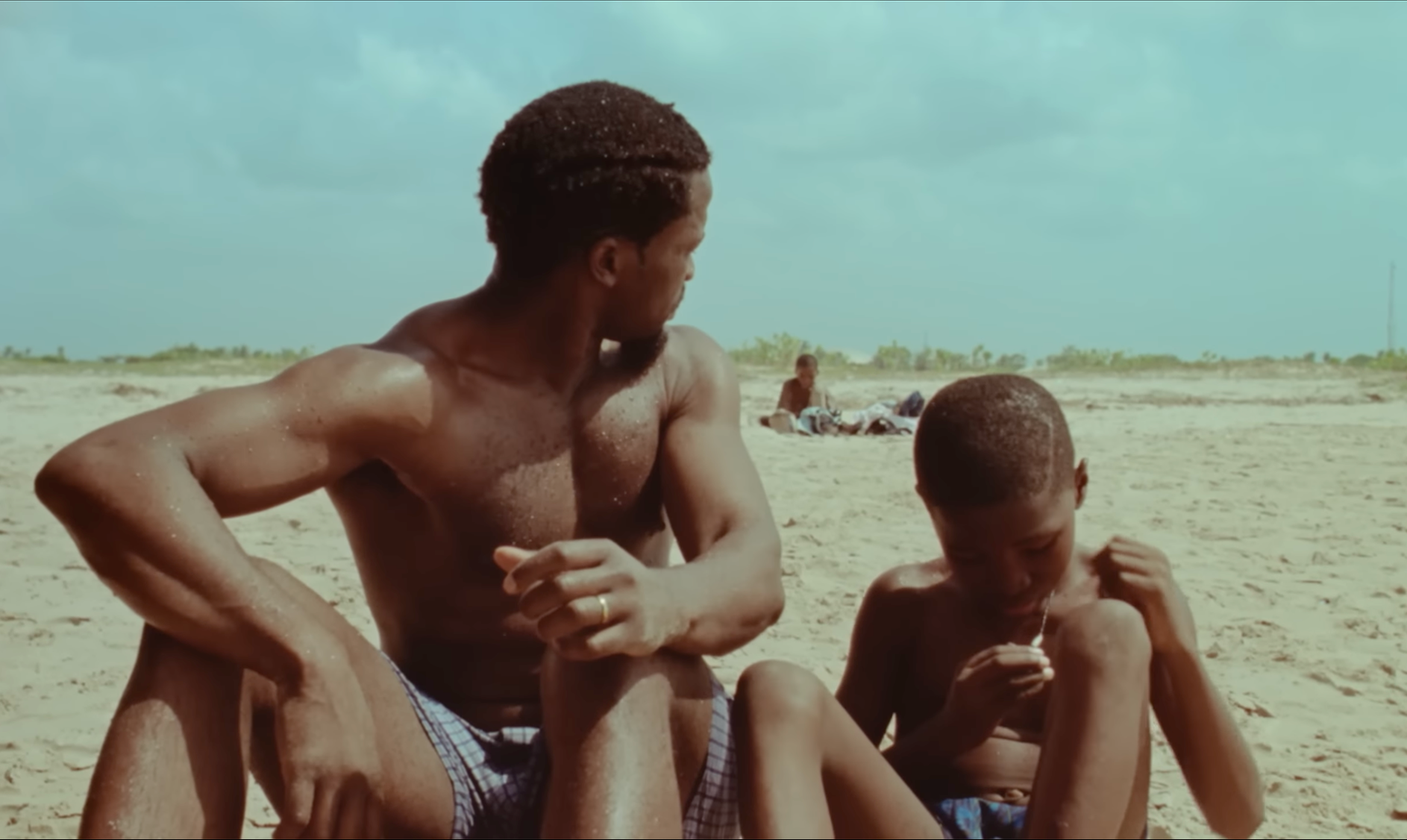
There is a similar approach in the newly released film My Father’s Shadow (2025), by the British-Nigerian filmmaker and artist Akinola Davies Jr. A semiautobiographical story of two adolescent brothers’ unexpected and eventful journey through Lagos with their estranged father, it is set against the immediate backdrop of the fractious 1993 Nigerian presidential elections, following which military dictator Ibrahim Badamasi Babangida annulled the unofficial result of the vote that indicated a victory for the pro-democratic Moshood Kashimawo Olawale Abiola. For a Nigerian film (Nigerian at the level of diasporic experience) widely acclaimed and chosen for the Cannes Official Selection, My Father’s Shadow offers a paradoxical texture: seemingly both available and imperceptible.
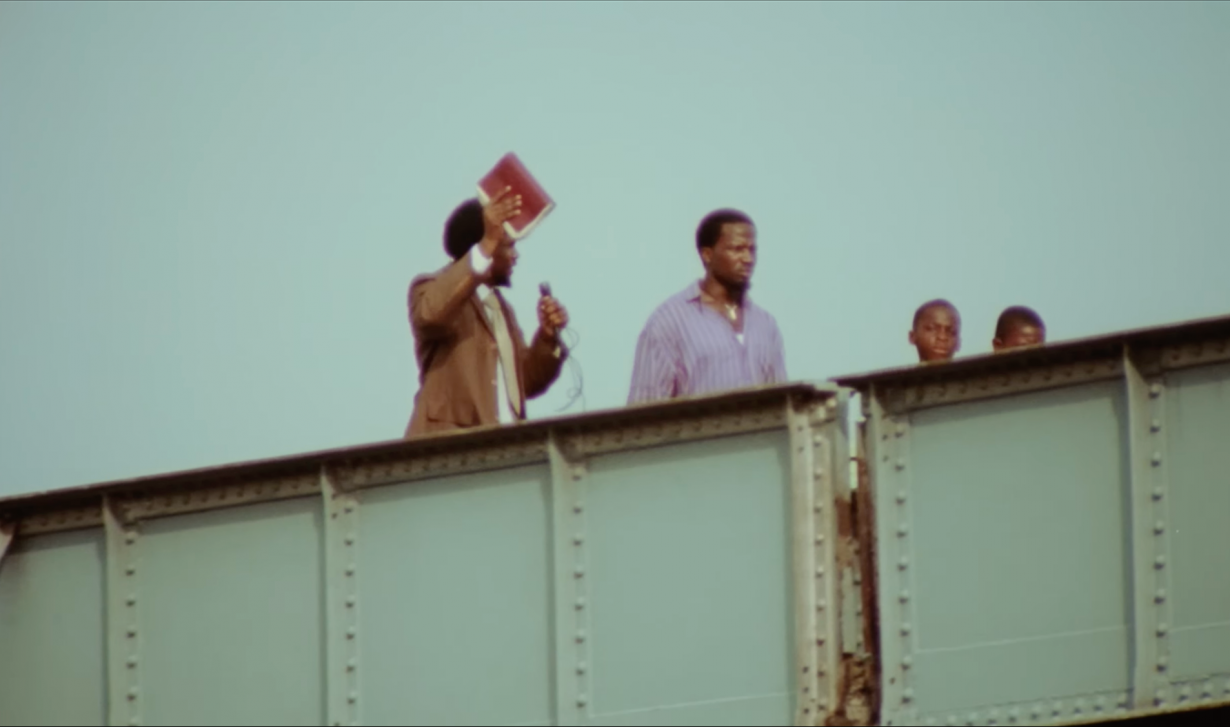
For a film seemingly rooted in the empirical – the presidential elections and the violent civil disturbances that continuously punctuate Nigeria’s narrative – My Father’s Shadow has a wholly metaphysical facture; one that feels tangible only to those who possess an intimate knowledge of the cultural specificity of its mode of storytelling, this being the oscillation between the literal and spiritual world. This asks audiences to accept their reading of the film as being conditioned by certain opacity, the ability to be obscure, unintelligible, untranslatable, even to an eager and celebratory public. This is particularly novel within a contemporary film industrial context in which the prerequisite for African films to achieve Western valorisation is that they provide easy definition and categorisation, and allow for an open-access, cross-cultural coalescence: that they be translatable. That it can do this is what prevents film as a medium from becoming ruinous to the oral tradition. To accept Black creative works as an essential and indissociable outcome of the Black lifeworld is to accept that they can carve out a space of unknowability within a space of ubiquity and amid the hollowness of the liberal applause that so often accompanies the hyper-enthusiasm for ‘Africanness’ as aesthetic culture.
My Father’s Shadow succeeds in provoking a different kind of speculative practice. It opens up the possibility that we can find in the film a visual language that speaks to the metaphysical, for it invites me to imagine Jorge Luis Borges’s metaphysical ‘The Circular Ruins’ or ‘Tlön, Uqbar, Orbis Tertius’ (both 1940) given cinematic treatment, or indeed what and how Okri’s The Famished Road would tell us of the abiku and its oscillation between the material and subliminal African world, were the book’s animist realism to be revisited in filmic form. However, the primary effects of the film are less astral, for my first response, upon watching My Father’s Shadow, was not to subject the film to otiose academic critique, but to call my parents to verify the film’s detail, to revive their own memoirs of 1993, an unexpected clarificatory desire spirited by the film that is both drawn from and furnishes a Black cultural memory, and one that is so versed in the oral traditions of family and identity so germane to the Nigerian diaspora. For how are we to approach the Black archives, literary, cinematic, oral or otherwise, that are not lost, incomplete or even damaged by colonial rupture, but have simply been devoid of a pictorial realisation, presence and communal recollection? This underpinned the questions posed to my parents, whose own existence was fragmented between Nigeria and London at the time. The 1993 elections became a point of reference within the Nigerian Pentecostal churches and informal gathering spaces that all served as a congenial locus for a disputatious Nigerian diaspora, where the political machinations of the homeland were dyed into the everyday contours of a postcolonial identity.
Upon the film’s release, Akinola Davies Jr stated, ‘As a community we don’t really talk about collective grief or collective trauma. This film presents a bridge for both generations to connect and for people to understand what their parents went through.’ My Father’s Shadow convenes that kind of communal experience of being of a diaspora, and seeing a history through the optic of the fantastical, the kind of source material for a collective memoria now made obscure by a diaspora increasingly fragmented by age, distance and generational passing. It seemed, at least to me, to open up to new thinking about the transtextual possibilities of what the oral tradition, via film, could be.
From the March 2026 issue of ArtReview – get your copy.