Backrooms, the directorial debut by Kane Parsons, is going gangbusters at the box office, but, Lewis Gordon wonders, is this just ‘prestige slop’?
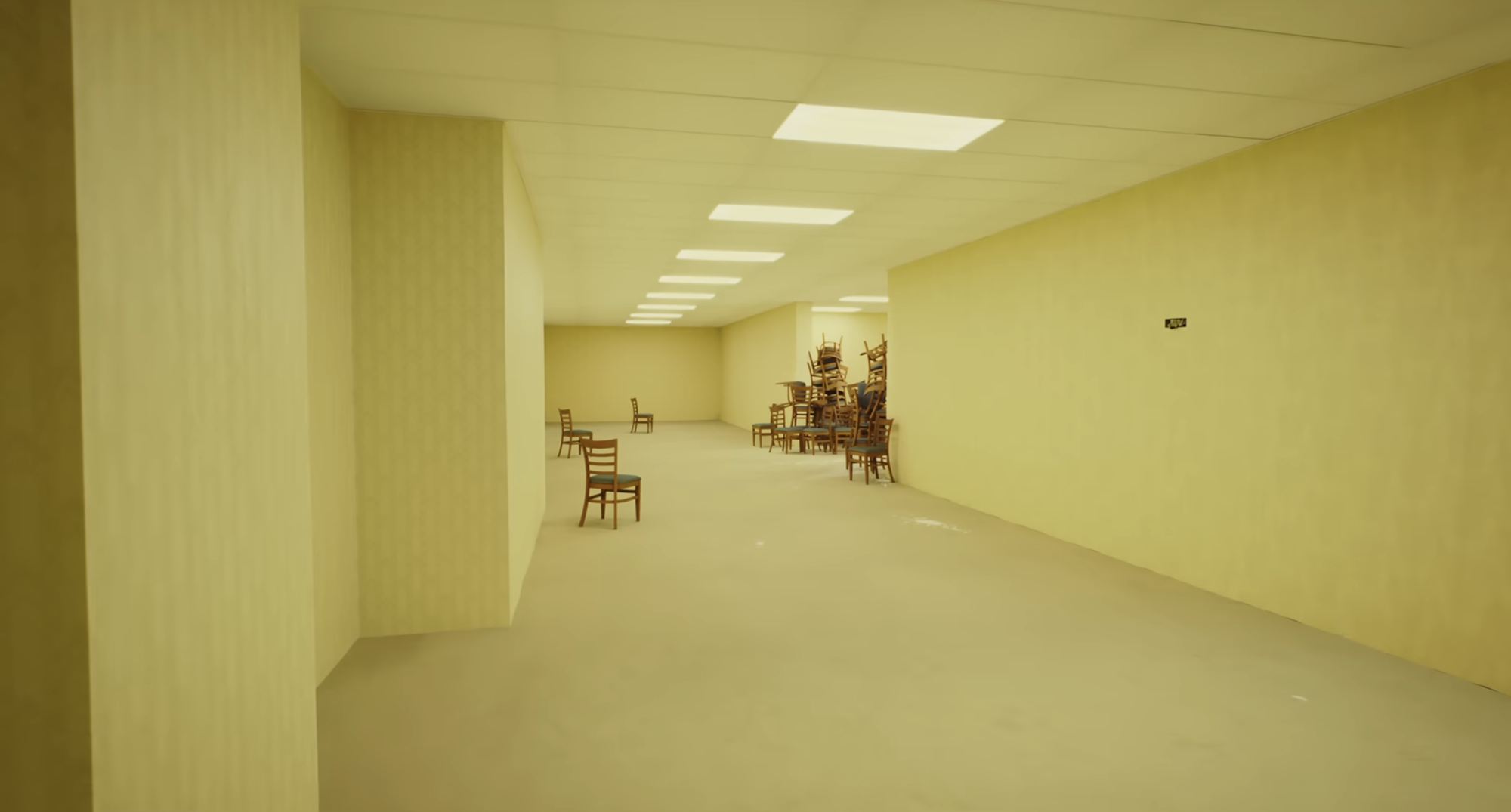
It started with an image that circulated on message boards in the 2010s: a shop interior lined with queasy yellow wallpaper, strip-lighting beaming down harshly on a miserable beige carpet. The angle of the photo is odd, a little askew: you peer through a wall into a large room. There are no doors, just lots of walls (which look fake rather than structural). Your eye is led by the gaps in the surfaces, which suggest that these large angular rooms might lead to yet more rooms, ad finitum.
In 2019 an anonymous user posted it on 4chan; somebody quickly commented with a little flavour text. ‘If you’re not careful,’ they wrote, it’s possible to ‘noclip out of reality’ and ‘end up in the Backrooms’. They described the ‘stink of old moist carpet’, the ‘madness of mono-yellow’ and the ‘endless background noise of fluorescent lights’.
Thus, the Backrooms was born, a ‘liminal’ space – and a monstrous mutation of an Augé-ian nonplace – that propagated on the internet as an urban myth of posts, memes and yet more similar images. The liminal space is of course in itself a contradiction: how can something be a threshold and a space onto itself? Now it is the source and subject of a $118 million-grossing Hollywood movie directed by a twenty-year-old wunderkind, Kane Parsons, who made his name on YouTube making a Backrooms web series. Parsons’s great trick lies in streamlining the collectively authored lore into a kind of auteurist single vision: with that earlier series, 24 chillingly effective found-footage-style short films that deftly capture the space-flattening and space-stretching perceptual quirks of the oppressively non-Euclidean spaces. Parsons wore his influences on his sleeve – notably the Half-Life (1998–present) videogame franchise and Stranger Things (2016–25) – yet his works possessed a startlingly original aesthetic: a kind of electric nightmare take on The Blair Witch Project (1999).
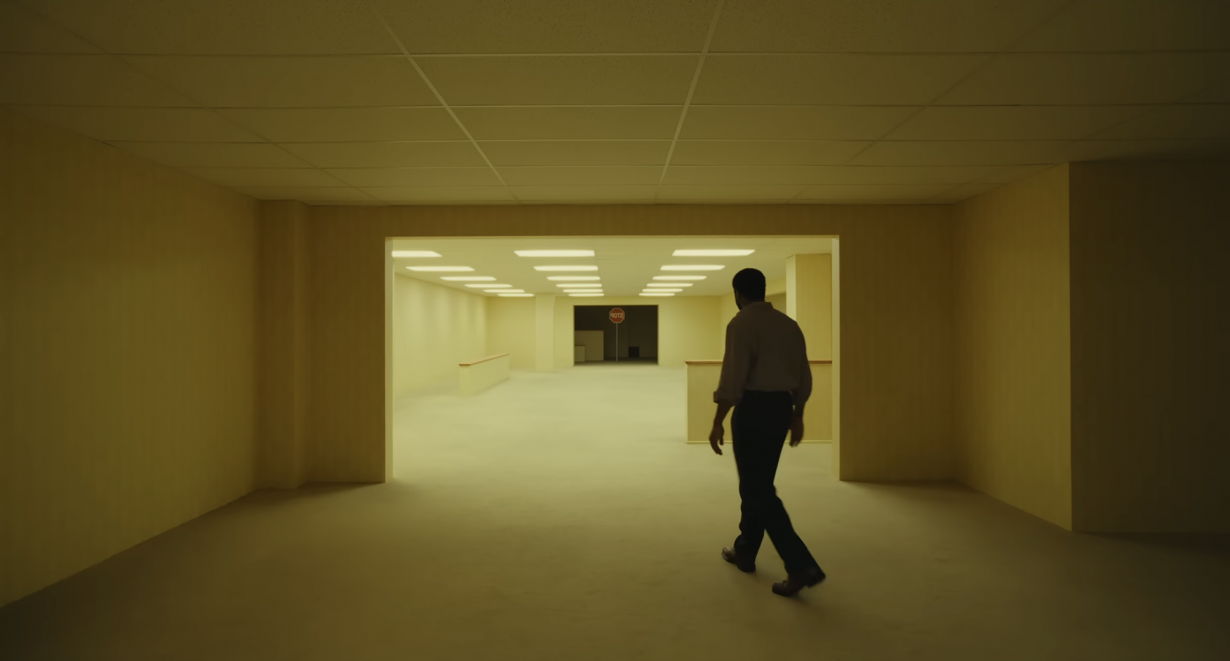
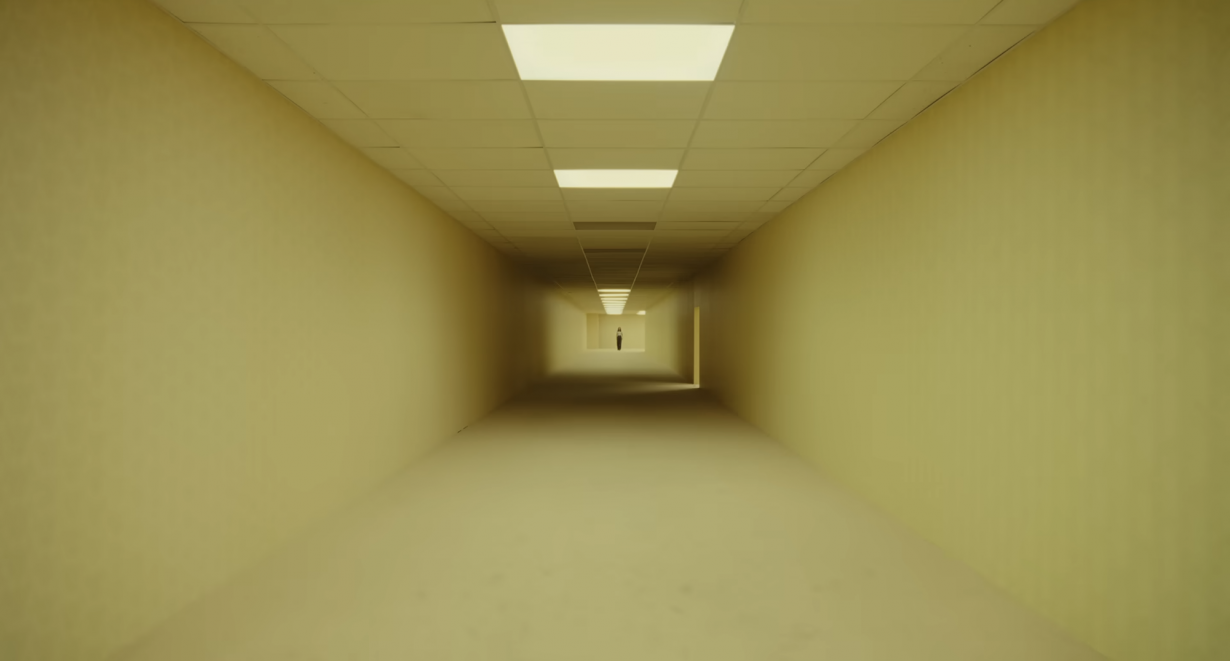
A lot is being made of Backrooms (2026): predictably, how it heralds the arrival of the Zoomer Hollywood era; also, how it is a fable in the mould of Slenderman (the breakout star of the internet horror creepypasta phenomenon) and SCP (a communal sci-fi compendium). The second point is more interesting, though underexplored: how could Backrooms flourish on the internet as a piece of collective worldbuilding and storytelling in the first place?
The genericness of the style, which can be easily achieved using modern digital tools, seems crucial to its adoption and dissemination. Parsons created his original Backrooms series using the 3D graphics software Blender, adding postproduction distortions and glitches in Adobe After Effects. Speaking to Esquire, Parsons recalls marvelling at how he was able to make ‘borderline photoreal stuff in an afternoon’. Other exponents too can easily snap their own Backroomy photos (tweaking basic effects to achieve that quintessential desaturated look) or reappropriate existing shots of other vague liminal spaces. Videogame makers have created their own Backrooms experiences in game engines like Unity and Unreal at a remarkable clip: see Day 7, later rereleased as The Backrooms (2019), Escape the Backrooms (2022), Pools (2024), Dreamcore (2025), Subliminal (2026) and many more.
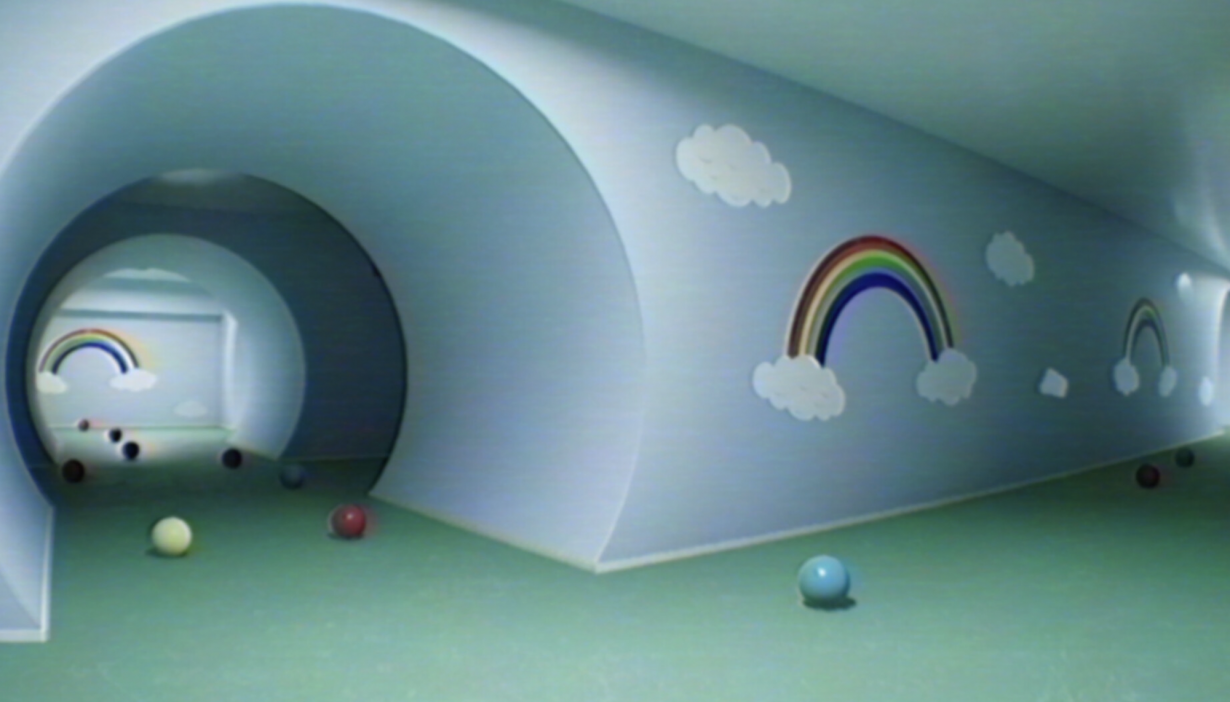
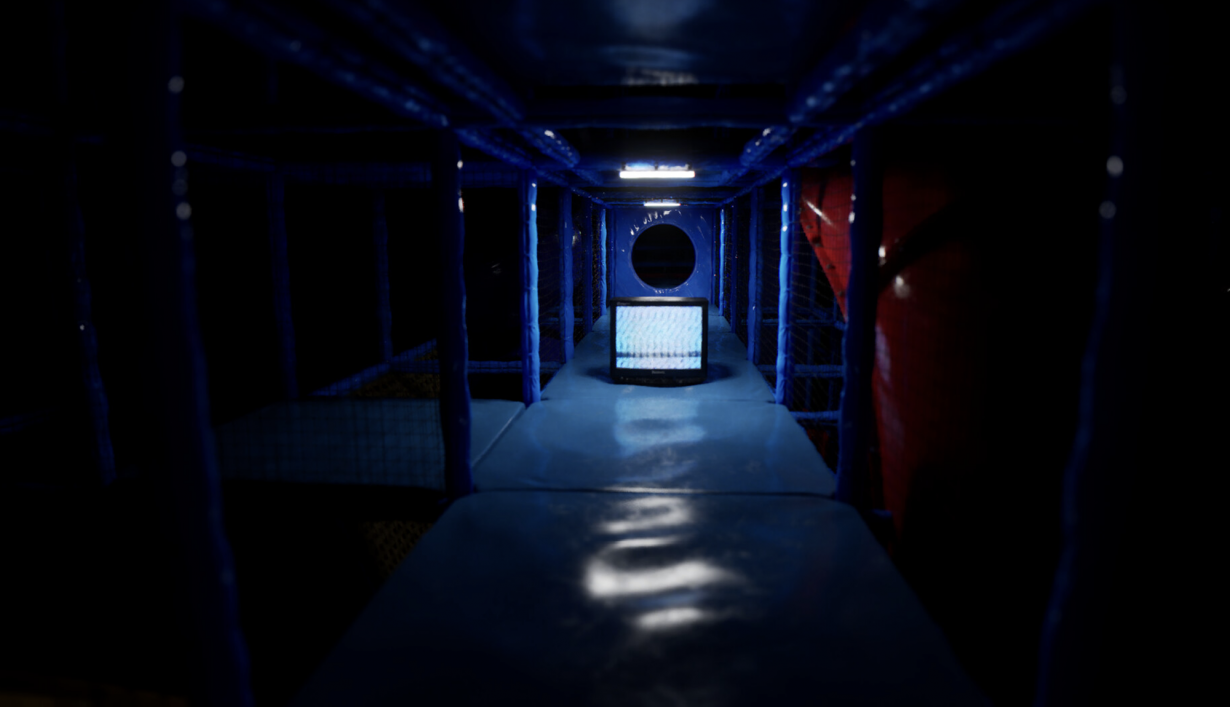
There is a sloppy quality to the visual style’s regurgitation across various mediums on the internet, collective lore becoming a hallucination. One might call it a kind of ‘prestige slop’, such is the intellectual pontificating that the intentionally nonspecific (yet pedantically rule-based) aesthetic has invited.
Parsons has said he sees the Backrooms as a reaction to the ‘fear of monoculture’ – the sameness of workplace architecture and the anxiety of spending the better part of your life in such a place. (As if we hadn’t seen enough of Severance, 2022–, in recent times.) His words echo those of Rosa A. Cruz, who wrote that the Backrooms has become a ‘metaphor’ for an economic system that has ‘colonised not only physical space but also time and subjectivity’, while highlighting the Freudian uncanniness latent in the imagery.
Yet Backrooms and its liminal-spaces brethren seems like a strangely neutered aesthetic for a time when work is scarily turbulent (layoffs, gig work, falling real wages, the threat of AI), and much less is said about the visual style’s relationship with the broader political chaos and genocidal violence of the mid-2020s. An anodyne quality seems to be part of the appeal: one may view the participant who enters these spaces, and becomes obsessed with them, as engaging in a kind of technologically mediated avoidance strategy, suspended in a state of either fascinated horror or perpetual amniotic bliss. (In fact, there is certainly something womblike about the 2,800 square metres of set that was meticulously built for the movie: it looks pleasantly plush; one imagines the temperature not a degree too hot or cold, just right; I can imagine falling asleep in a corner.) Where such an aesthetic found resonance in the early 2020s, for many suspended in time and space because of the COVID-19 pandemic, now the vibe just feels dated – like reading a Mark Fisher essay 15 years after it was published.
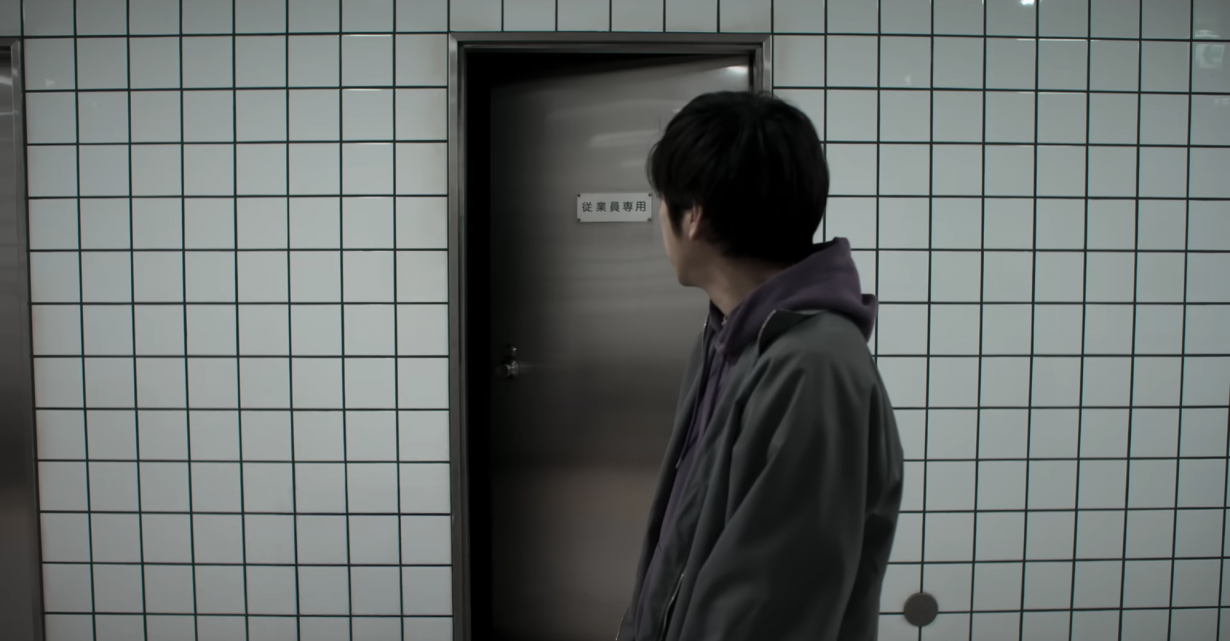
In some ways, Clark (Chiwetel Ejiofor), the protagonist of Backrooms, is a stand-in for our wider liminal-pilled culture. “I like it here,” he says, content with leaving his real-world problems (a failed marriage and an alcohol dependency) on the threshold of the infamous yellow rooms. He’s like a more jaded version of the protagonist of Exit 8 (2026), who starts his own liminal odyssey – trapped in an infinitely repeating Tokyo subway – on a train while scrolling X, flicking past videos of natural disasters. The ambient sounds around him are muffled because he is wearing noise-cancelling earbuds. These sounds then disappear altogether when he hits play on his music. Everything this young man does, every piece of technology he uses, blocks out reality. We are invited to think of the abyssal station he gets trapped in as a psychogeographic extension of himself, and an apt summation of Backrooms, too – another delaying tactic to avoid change.




.jpg)